 Mixing
Ethyl acetate
 | |
 | |
| Names | |
|---|---|
Preferred IUPAC name Ethyl acetate | |
Systematic IUPAC name Ethyl ethanoate | |
Other names
| |
| Identifiers | |
CAS Number |
|
3D model (JSmol) |
|
Beilstein Reference | 506104 |
ChEBI |
|
ChEMBL |
|
ChemSpider |
|
ECHA InfoCard | 100.005.001 |
E number | E1504 (additional chemicals) |
Gmelin Reference | 26306 |
KEGG |
|
PubChem CID |
|
RTECS number | AH5425000 |
UNII |
|
InChI
| |
SMILES
| |
| Properties | |
Chemical formula | C4H8O2 |
Molar mass | 7001881060000000000♠88.106 g·mol−1 |
| Appearance | Colorless liquid |
Odor | Ether-like, fruity[1] |
Density | 0.902 g/cm3 |
Melting point | −83.6 °C (−118.5 °F; 189.6 K) |
Boiling point | 77.1 °C (170.8 °F; 350.2 K) |
Solubility in water | 8.3 g/100 mL (at 20 °C) |
Solubility in ethanol, acetone, diethyl ether, benzene | Miscible |
log P | 0.71[2] |
Vapor pressure | 73 mmHg (9.7 kPa) at 20 °C[1] |
Acidity (pKa) | 25 |
Magnetic susceptibility (χ) | 3004459000000000000♠−54.10×10⁻⁶ cm3/mol |
Refractive index (nD) | 1.3720 |
Viscosity | 426 μPa·s (0.426 cP) at 25 °C |
| Structure | |
Dipole moment | 1.78 D |
| Hazards | |
| Main hazards |
|
Safety data sheet | See: data page |
R-phrases (outdated) | R11, R36, R66, R67 |
S-phrases (outdated) | S16, S26, S33 |
NFPA 704 |  3 1 0 |
Flash point | −4 °C (25 °F; 269 K) |
Explosive limits | 2.0–11.5%[1] |
| Lethal dose or concentration (LD, LC): | |
LD50 (median dose) | 11.3 g/kg, rat |
LC50 (median concentration) | 16,000 ppm (rat, 6 h) 12,295 ppm (mouse, 2 h) 1600 ppm (rat, 8 h)[3] |
LCLo (lowest published) | 21 ppm (guinea pig, 1 h) 12,330 ppm (mouse, 3 h)[3] |
| US health exposure limits (NIOSH): | |
PEL (Permissible) | TWA 400 ppm (1400 m3)[1] |
REL (Recommended) | TWA 400 ppm (1400 mg/m3)[1] |
IDLH (Immediate danger) | 2000 ppm[1] |
| Related compounds | |
Related carboxylate esters |
|
Related compounds |
|
Supplementary data page | |
Structure and properties | Refractive index (n), Dielectric constant (εr), etc. |
Thermodynamic data | Phase behaviour solid–liquid–gas |
Spectral data | UV, IR, NMR, MS |
Except where otherwise noted, data are given for materials in their standard state (at 25 °C [77 °F], 100 kPa). | |
 Y verify (what is Y verify (what is  Y Y N ?) N ?) | |
Infobox references | |
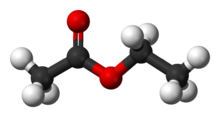
Ethyl acetate (systematically ethyl ethanoate, commonly abbreviated EtOAc, ETAC or EA) is the organic compound with the formula CH
3–COO–CH
2–CH
3, simplified to C
4H
8O
2. This colorless liquid has a characteristic sweet smell (similar to pear drops) and is used in glues, nail polish removers, decaffeinating tea and coffee. Ethyl acetate is the ester of ethanol and acetic acid; it is manufactured on a large scale for use as a solvent. The combined annual production in 1985 of Japan, North America, and Europe was about 400,000 tonnes.[4] In 2004, an estimated 1.3 million tonnes were produced worldwide.[5]
Contents
1 Production
1.1 By dehydrogenation of ethanol
2 Uses
2.1 Laboratory uses
2.2 Occurrence in wines
2.3 Entomological killing agent
3 Reactions
4 Safety
5 References
6 External links
Production
Ethyl acetate is synthesized in industry mainly via the classic Fischer esterification reaction of ethanol and acetic acid. This mixture converts to the ester in about 65% yield at room temperature:
- CH
3CH
2OH + CH
3COOH → CH
3COOCH
2CH
3 + H
2O
The reaction can be accelerated by acid catalysis and the equilibrium can be shifted to the right by removal of water. It is also prepared in industry using the Tishchenko reaction, by combining two equivalents of acetaldehyde in the presence of an alkoxide catalyst:
- 2 CH
3CHO → CH
3COOCH
2CH
3
Silicotungstic acid is used to manufacture ethyl acetate by the alkylation of acetic acid by ethylene:[6]
- C
2H
4 + CH
3CO
2H → CH
3CO
2C
2H
5
By dehydrogenation of ethanol
A specialized industrial route entails the catalytic dehydrogenation of ethanol. This method is more cost effective than the esterification but is applied with surplus ethanol in a chemical plant. Typically, dehydrogenation is conducted with copper at an elevated temperature but below 250 °C. The copper may have its surface area increased by depositing it on zinc, promoting the growth of snowflake-like fractal structures (dendrites). Surface area can be again increased by deposition onto a zeolite, typically ZSM-5. Traces of rare-earth and alkali metals are beneficial to the process. Byproducts of the dehydrogenation include diethyl ether, which is thought to arise primarily due to aluminum sites in the catalyst, acetaldehyde and its aldol products, higher esters, and ketones. Separations of the byproducts are complicated by the fact that ethanol forms an azeotrope with water, as does ethyl acetate with ethanol and water, and methyl ethyl ketone (MEK, which forms from 2-butanol) with both ethanol and ethyl acetate. These azeotropes are broken by pressure swing distillation or membrane distillation.
Uses
Ethyl acetate is used primarily as a solvent and diluent, being favored because of its low cost, low toxicity, and agreeable odor. For example, it is commonly used to clean circuit boards and in some nail varnish removers (acetone and acetonitrile are also used). Coffee beans and tea leaves are decaffeinated with this solvent.[7] It is also used in paints as an activator or hardener.[citation needed] Ethyl acetate is present in confectionery, perfumes, and fruits. In perfumes, it evaporates quickly, leaving only the scent of the perfume on the skin.
Laboratory uses
In the laboratory, mixtures containing ethyl acetate are commonly used in column chromatography and extractions. Ethyl acetate is rarely selected as a reaction solvent because it is prone to hydrolysis and transesterification.
Ethyl acetate is fairly volatile at room temperature and has a boiling point of 77 °C (171 °F). Due to these properties, it can be removed from a sample by heating in a hot water bath and providing ventilation with compressed air.
Occurrence in wines
Ethyl acetate is the most common ester in wine, being the product of the most common volatile organic acid – acetic acid, and the ethyl alcohol generated during the fermentation. The aroma of ethyl acetate is most vivid in younger wines and contributes towards the general perception of "fruitiness" in the wine. Sensitivity varies, with most people having a perception threshold around 120 mg/L. Excessive amounts of ethyl acetate are considered a wine fault.
Entomological killing agent
In the field of entomology, ethyl acetate is an effective asphyxiant for use in insect collecting and study. In a killing jar charged with ethyl acetate, the vapors will kill the collected insect quickly without destroying it. Because it is not hygroscopic, ethyl acetate also keeps the insect soft enough to allow proper mounting suitable for a collection.
Reactions
Ethyl acetate can be hydrolyzed in acidic or basic conditions to regain acetic acid and ethanol. The use of an acid catalyst accelerates the hydrolysis, which is subject to the Fischer equilibrium mentioned above. In the laboratory, and usually for illustrative purposes only, ethyl esters are typically hydrolyzed in a two-step process starting with a stoichiometric amount of a strong base, such as sodium hydroxide. This reaction gives ethanol and sodium acetate, which is unreactive toward ethanol:
- CH
3CO
2C
2H
5 + NaOH → C
2H
5OH + CH
3CO
2Na
The rate constant is 0.111 L/mol·s at 25 °C.[citation needed]
Safety
The LD50 for rats is 5620 mg/kg,[8] indicating low toxicity. Given that the chemical is naturally present in many organisms, there is little risk of toxicity.
Overexposure to ethyl acetate may cause irritation of the eyes, nose, and throat. Severe overexposure may cause weakness, drowsiness, and unconsciousness.[9] Humans exposed to a concentration of 400 ppm in 1.4 mg/L ethyl acetate for a short time were affected by nose and throat irritation.[10] Ethyl acetate is an irritant of the conjunctiva and mucous membrane of the respiratory tract. Animal experiments have shown that, at very high concentrations, the ester has central nervous system depressant and lethal effects; at concentrations of 20,000 to 43,000 ppm (2.0–4.3%), there may be pulmonary edema with hemorrhages, symptoms of central nervous system depression, secondary anemia and liver damage. In humans, concentrations of 400 ppm cause irritation of the nose and pharynx; cases have also been known of irritation of the conjunctiva with temporary opacity of the cornea. In rare cases exposure may cause sensitization of the mucous membrane and eruptions of the skin. The irritant effect of ethyl acetate is weaker than that of propyl acetate or butyl acetate.[11]
References
^ abcdef NIOSH Pocket Guide to Chemical Hazards. "#0260". National Institute for Occupational Safety and Health (NIOSH)..mw-parser-output cite.citation{font-style:inherit}.mw-parser-output .citation q{quotes:"""""""'""'"}.mw-parser-output .citation .cs1-lock-free a{background:url("//upload.wikimedia.org/wikipedia/commons/thumb/6/65/Lock-green.svg/9px-Lock-green.svg.png")no-repeat;background-position:right .1em center}.mw-parser-output .citation .cs1-lock-limited a,.mw-parser-output .citation .cs1-lock-registration a{background:url("//upload.wikimedia.org/wikipedia/commons/thumb/d/d6/Lock-gray-alt-2.svg/9px-Lock-gray-alt-2.svg.png")no-repeat;background-position:right .1em center}.mw-parser-output .citation .cs1-lock-subscription a{background:url("//upload.wikimedia.org/wikipedia/commons/thumb/a/aa/Lock-red-alt-2.svg/9px-Lock-red-alt-2.svg.png")no-repeat;background-position:right .1em center}.mw-parser-output .cs1-subscription,.mw-parser-output .cs1-registration{color:#555}.mw-parser-output .cs1-subscription span,.mw-parser-output .cs1-registration span{border-bottom:1px dotted;cursor:help}.mw-parser-output .cs1-ws-icon a{background:url("//upload.wikimedia.org/wikipedia/commons/thumb/4/4c/Wikisource-logo.svg/12px-Wikisource-logo.svg.png")no-repeat;background-position:right .1em center}.mw-parser-output code.cs1-code{color:inherit;background:inherit;border:inherit;padding:inherit}.mw-parser-output .cs1-hidden-error{display:none;font-size:100%}.mw-parser-output .cs1-visible-error{font-size:100%}.mw-parser-output .cs1-maint{display:none;color:#33aa33;margin-left:0.3em}.mw-parser-output .cs1-subscription,.mw-parser-output .cs1-registration,.mw-parser-output .cs1-format{font-size:95%}.mw-parser-output .cs1-kern-left,.mw-parser-output .cs1-kern-wl-left{padding-left:0.2em}.mw-parser-output .cs1-kern-right,.mw-parser-output .cs1-kern-wl-right{padding-right:0.2em}
^ "ethyl acetate MSDS".
^ ab "Ethyl acetate". Immediately Dangerous to Life and Health Concentrations (IDLH). National Institute for Occupational Safety and Health (NIOSH).
^ Riemenschneider, Wilhelm; Bolt, Hermann M., "Esters, Organic", Ullmann's Encyclopedia of Industrial Chemistry, Weinheim: Wiley-VCH, doi:10.1002/14356007.a09_565.pub2
^ Dutia, Pankaj (August 10, 2004). "Ethyl Acetate: A Techno-Commercial Profile" (PDF). Chemical Weekly: 184. Retrieved 2009-03-21.
^ Misono, Makoto (2009). "Recent progress in the practical applications of heteropolyacid and perovskite catalysts: Catalytic technology for the sustainable society". Catalysis Today. 144 (3–4): 285–291. doi:10.1016/j.cattod.2008.10.054.
^ ico.org Archived 2007-04-29 at the Wayback Machine
^ Hazard Ethyl Acetate MSDS "Ethyl Acetate MSDS Number: E2850".
^ Mackison, F. W.; Stricoff, R. S.; Partridge, L. J., Jr., eds. (Jan 1981). NIOSH/OSHA – Occupational Health Guidelines for Chemical Hazards. DHHS (NIOSH) Publication No. 81–123. Washington, DC: U.S. Government Printing Office.
^ Clayton, G.D.; Clayton, F.E., eds. (1993–94). Patty's Industrial Hygiene and Toxicology. Volumes 2A, 2B, 2C, 2D, 2E, 2F: Toxicology (4th ed.). New York, NY: John Wiley & Sons. p. 2981.
^ Encyclopedia of Occupational Health and Safety, Geneva, Switzerland: International Labour Office, 1983, p. 782
External links
- https://pubchem.ncbi.nlm.nih.gov/compound/ethyl_acetate#section=Toxicity
- NIOSH Pocket Guide to Chemical Hazards
- International Chemical Safety Cards
Material safety data (MSDS) for ethyl acetate- National Pollutant Inventory – Ethyl acetate fact sheet
- Ethyl Acetate: Molecule of the Month
- Purpose of Using Concentrated Sulfuric Acid in Esterification for Catalysis
- Basic facts and contact SEKAB [1] SEKAB ethyl acetate
- A Techno Commercial Profile of Ethyl Acetate in India
- Calculation of vapor pressure, liquid density, dynamic liquid viscosity, surface tension of ethyl acetate


Comments
Post a Comment