 Mixing
Carabineros de Chile
| Carabiniers of Chile Carabineros de Chile | |
|---|---|
 | |
| Motto | Orden y Patria Order and Fatherland |
| Agency overview | |
| Formed | April 27, 1927[1] |
| Preceding agency |
|
| Operational structure | |
| Overviewed by | Dirección General |
| Headquarters | Santiago de Chile |
| Agency executive |
|
| Website | |
| www.Carabineros.cl | |
Carabiniers of Chile (Spanish: Carabineros de Chile) are the Chilean national police force, who have jurisdiction over the entire national territory of Chile.
Created in 1927, their mission is to maintain order and create public respect for the laws of the country. They reported to the Ministerio de Defensa Nacional (Ministry of National Defense) through the Undersecretary of Carabiniers but since 2011, the Ministry of the Interior and Public Security has full control over them. They are in practice separated fully from the three other military branches by department but still considered part of the armed forces. Chile also has an investigative police force, the Investigations Police of Chile, also under the Interior and Public Security Ministry; a Maritime Police also exists for patrol of Chile's coastline.
Contents
1 History
1.1 Carabiniers of Chile (1927)
2 Today
3 Emergencies
4 Aircraft inventory
4.1 Aircraft in Service
5 Vehicles
5.1 Patrol cars
5.2 Motorcycles
5.3 Special operations (Grupo de Operaciones Policiales Especiales)
5.4 Chile Border Patrol
6 Ranks of the Chilean Carabiniers
6.1 Enlisted personnel and non-commissioned officers
6.2 Commissioned officers
7 General Directors
8 References
9 See also
10 External links
History
The origins of the Carabiniers can be traced back to night watchmen such as the Dragones de la Reina (Queen's Dragoons) (created in 1758 and later renamed the Dragoons of Chile in 1812) and other organizations that fulfilled functions such as the watch and local policing.
Later, cities such as Santiago and Valparaíso created their own city police forces. In 1881 the Rural Police (Policía Rural) was created for the rural areas of the country. However, the main problem with these police services was that they were dependent on local authorities for day-to-day decision making. This led to local officials abusing this power for their own political ends. In 1896 the Policía Fiscal (Prosecuting Police) was created to serve the cities.
The first policing organization with the name "Carabiniers" was the Corps of Carabiniers, in Spanish Cuerpo de Carabineros (with similar meaning as the Italian Carabinieri), formed in 1903 to bring law and order to the Araucanía Region of Southern Chile (then much larger than today), formerly the Gendarme Corps, which would later be merged with the Army's 5th Carabiniers Regiment and the Rural Police. The Carabinier Regiment was then a Chilean Army unit, thus the reason why the Carabiniers of today sport military ranks and insignia. In 1908 the Carabiniers' School (Escuela de Carabineros, currently located in Providencia) was created, which until 1935 trained all officers and non-commissioned sworn personnel.
Carabiniers of Chile (1927)
On April 27, 1927, President Carlos Ibáñez del Campo merged the Fiscal Police (Policía Fiscal), the Rural Police (Policia Rural), and the existing Corps of Carabiniers to form the Carabiniers of Chile, one unified, paramilitary and national security institution under the direction of the national government. The organization still carries the name given to it by Ibáñez, who became the Carabiniers' first Director General. In 1929 its official coat of arms – two white crossed carbines in a green shield – was formally adopted. The service in 1930 became one of the pioneer mobile police forces in Latin America. By 1933 the Investigations Police of Chile was created in the basis of the investigations service. The roots of today's NCO School began in 1934 when in Santiago's Macul Commune, the service's mounted command began training NCOs and enlisted personnel independently. In 1939 the service received its own staff college, the Police Sciences Academy, and the mounted training squadron begame the present day NCO School in 1951.
The Air Operations Prefecture, the air arm of the service, was raised in 1960.
1962 would see it become the first among the Chilean uniformed services to include women into its ranks. The next year, the Children and Fatherland Foundation was formed as its social responsibility arm for troubled kids and preteens.
In 1973, the Carabiniers, headed by General Cesar Mendoza Duran, later appointed Director General, joined the Chilean coup of 1973 under the lead of the Army, Navy and Air Forces leaders, that overthrew President Salvador Allende. As such, the Carabiniers' commander was a formal member of the Military Government Junta (1973–1990), as well as members of the institution taking on administrative roles, such as being in charge of the Ministry of Education.
In 1974, formal command of the service was handed over to the Chilean Ministry of National Defense, and it was integrated into the ranks and traditions of the Chilean Armed Forces as a result. Until 2011, this was the case for the service, from that year onward it is a part of the Ministry of the Interior and Public Security.
The Basic Training Center, which trains future personnel of the other ranks, was created in 1979.
Today
The Carabiniers' mission is to maintain or re-establish order and security in Chilean society through civic education, service to the community, police work, and in a war situation, to act as a military force (all their members have military training). Under the Chilean Constitution the Carabiniers are integrated directly into the Armed Forces in a state of emergency to better guarantee the public order.
They also have a special armed police unit called the Special Police Operations Group (GOPE or Grupo de Operaciones Policiales Especiales). There is also an Elite Corps in charge of security in La Moneda Palace and for the President – the Presidential Guard Group whose cavalry troop is one of two horse guards units of the Republic, the latter having been raised recently and also serves as the youngest, and also sports a foot guards infantry battalion. The Central National Band of the Carabineros, the premiere representative marching band of the service (created in 1929), occasionally performs on state occasions and during the Guard Mounting at the La Moneda Palace and Citizenry Square on selected days with the Guard Group.
They travel in heavily armored trucks from which they can spray pressured water to control mobs.
The Carabineros have recently replaced their Ruger P90 with the 9mm SIG P220. While most police forces issue the Chilean FAMAE revolver or the Brazilian Taurus Model 82, increasing numbers have adopted the Austrian Glock 17.
Emergencies
The emergency number of the police is 133 which is connected to the Central Communications (CENCO), closest to the nearest location of a police station.
This number will provide medical help, police or fire support. If one would need to communicate directly with any of these services this list of numbers will be useful:
132: This number connects directly to the Fire Station closest to the residence concerned, under the Chilean National Firefighters Council's constituent fire services
131: This number connects to the Emergency Medical Care Service or SAMU
134: This number connects to the Investigations Police of Chile or PDI
137: This number connects to the Maritime Rescue Unit (Navy)
Aircraft inventory
Carabineros de Chile operate 35 aircraft in support of their operations, including 10 helicopters. Recently, 5 Augusta A109E[2] have been acquired.
Aircraft in Service
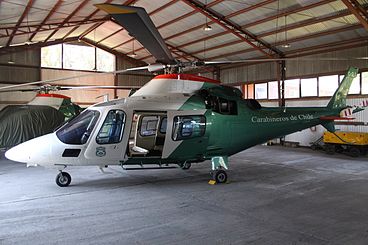
C-21 Agusta A109 Chilean Police
| Aircraft | Origin | Type | Versions | In service[3] |
|---|---|---|---|---|
Agusta A109 |  Italy Italy | Utility transport | Agusta A109E | 5 |
AgustaWestland AW139 | Italy | Utility transport | Agusta AW139 | 1 |
Bell 206 |  United States United States | Utility helicopter | 206B | 1 |
Cessna 182 | United States | Utility | 182Q | 5 |
Cessna 206 | United States | Utility | 3 | |
Cessna 208 | United States | Utility | 1 | |
Cessna 210 | United States | Utility transport | 5 | |
Cessna Citation | United States | VIP transport | 550 Citation II | 2 |
Eurocopter Bo 105 |  Germany Germany | Utility helicopter | Bo 105C Bo 105LSA-3 | 5 2 |
Eurocopter EC 135 | Germany | Utility helicopter | EC 135 T1 | 1 |
MBB/Kawasaki BK 117 | Germany Japan Japan | Utility helicopter | BK117B-1 | 2 |
Piper PA-31 Navajo | United States | Utility transport | PA-31 PA-31T Cheyenne |
Vehicles
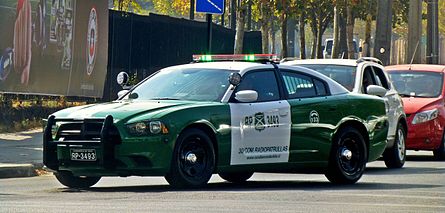
Dodge charger 2014 of Chilean Police
Patrol cars
| Vehicle | Origin | Function |
|---|---|---|
Dodge Charger Police 2017 | United States | Highway patrol |
Dodge Durango 2017 | United States | Patrol and Traffic enforcement |
Chevrolet Cruze LS | United States | Patrol and Traffic enforcement |
Mercedes Benz Sprinter | Germany | City Patrol |
Nissan Terrano | Japan | Patrol and Traffic enforcement |
Motorcycles
| Vehicle | Origin | Function |
|---|---|---|
BMW R-1200 RT | Germany | Highway Patrol and Traffic enforcement |
BMW F-700 GS |
Special operations (Grupo de Operaciones Policiales Especiales)
| Vehicle | Origin | Function |
|---|---|---|
| Renault Sherpa 2 |  France France | Armored vehicle |
| Mahindra Marksman |  India India | Light Armored vehicle |
| Chevrolet Tahoe | United States | Transport Unit / First response |
| Chevrolet Suburban | ||
| Hyundai H1 |  South Korea South Korea |
Chile Border Patrol
| Vehicle | Origin | Function |
|---|---|---|
Toyota Tundra | United States | Border Patrol |
Ram Pickup 3500 | United States | North Chilean Desert Border Patrol |
Ram Pickup 1500 | United States | Border Patrol |
Dodge Durango 4x4 | United States | Border Patrol |
| Can-Am Commander |  Canada Canada | North Chilean Desert Border Patrol |
Mercedes-Benz Zetros | Germany | North Chilean Desert Border Patrol |
Ranks of the Chilean Carabiniers
Enlisted personnel and non-commissioned officers
Chilean and foreign NCOs enter the service through enrollment at the Carabiniers Formation School and receive further training as corporals at the Carabiniers NCO Academy, both located in the Santiago Metropolitan Region, and some of them have later training at the various service schools of the Carabiniers specializing in frontier defense, horsemanship and K-9 training and handling skills.
Carabinero alumno (Student Carabinier)
Carabinero (Carabinier)
Cabo Segundo (Second Corporal)
Cabo Primero (First Corporal)
Sargento Segundo (Sergeant)
Sargento Primero (First Sergeant)
Suboficial (Sub-officer)
Suboficial Mayor (Subofficer Major)
| Ranks | Warrant Officers | NCOs | Enlisted | |||||
|---|---|---|---|---|---|---|---|---|
| Shirt Cape Carabinero shirt |  |  |  |  |  |  |  | |
| Raincoat Parka |  |  |  |  |  |  |  | |
| Smock |  |  | ||||||
| Operational shirt |  |  |  |  |  |  |  | |
| Ranks | Suboficial Mayor | Suboficial | Sargento 1º | Sargento 2° | Cabo 1º | Cabo 2° | Carabinero | |
| Abbreviation | (SOM) | (SuboF) | (SG1) | (SG2) | (CBO1) | (CBO2) | (Carab) | |
Commissioned officers
Officers of the Carabiners, native born or foreign officers having scholarships, start out as officer aspirants at the Carabinier Officers School "Pres. Gen. Carlos Ibanez del Campo" in Santiago, and after graduating become sublieutenants either in Chile or in their home countries. Later training is provided by the Police Sciences Academy also in Santiago, and in the aforementioned specialty schools of the force.
Aspirante a oficial (Officer Aspirant)
Subteniente (Sublieutenant)
Teniente (Lieutenant)
Capitan (Captain)
Mayor (Major)
Teniente Coronel (Lieutenant Colonel)
Coronel (Colonel)
General (General)
General Inspector (Inspector General)
General Director (Director General)
| Ranks | General officers | Senior officers | Head officers | Junior officers | |||||
|---|---|---|---|---|---|---|---|---|---|
| Uniform coat General officers' cape |  |  |  |  |  | 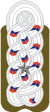 | 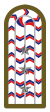 |  |  |
| Shirt Raincoat Parka |  |  |  |  |  |  |  |  |  |
| Cape |  |  |  |  |  |  | |||
| Smock |  |  |  |  |  |  | |||
| Operational shirt |  |  |  |  |  |  |  |  |  |
| Ranks | General Director | General Inspector | General | Coronel | Teniente Coronel | Mayor | Capitán | Teniente | Subteniente |
| Abbreviation | GNRL DIR | GNRL INS | GNRL | CRNL | TTE CRNL | MAY | CAP | TTE | SUB TTE |
General Directors
References
^ "Día del Carabinero". Icarito. Retrieved 30 January 2013..mw-parser-output cite.citation{font-style:inherit}.mw-parser-output .citation q{quotes:"""""""'""'"}.mw-parser-output .citation .cs1-lock-free a{background:url("//upload.wikimedia.org/wikipedia/commons/thumb/6/65/Lock-green.svg/9px-Lock-green.svg.png")no-repeat;background-position:right .1em center}.mw-parser-output .citation .cs1-lock-limited a,.mw-parser-output .citation .cs1-lock-registration a{background:url("//upload.wikimedia.org/wikipedia/commons/thumb/d/d6/Lock-gray-alt-2.svg/9px-Lock-gray-alt-2.svg.png")no-repeat;background-position:right .1em center}.mw-parser-output .citation .cs1-lock-subscription a{background:url("//upload.wikimedia.org/wikipedia/commons/thumb/a/aa/Lock-red-alt-2.svg/9px-Lock-red-alt-2.svg.png")no-repeat;background-position:right .1em center}.mw-parser-output .cs1-subscription,.mw-parser-output .cs1-registration{color:#555}.mw-parser-output .cs1-subscription span,.mw-parser-output .cs1-registration span{border-bottom:1px dotted;cursor:help}.mw-parser-output .cs1-ws-icon a{background:url("//upload.wikimedia.org/wikipedia/commons/thumb/4/4c/Wikisource-logo.svg/12px-Wikisource-logo.svg.png")no-repeat;background-position:right .1em center}.mw-parser-output code.cs1-code{color:inherit;background:inherit;border:inherit;padding:inherit}.mw-parser-output .cs1-hidden-error{display:none;font-size:100%}.mw-parser-output .cs1-visible-error{font-size:100%}.mw-parser-output .cs1-maint{display:none;color:#33aa33;margin-left:0.3em}.mw-parser-output .cs1-subscription,.mw-parser-output .cs1-registration,.mw-parser-output .cs1-format{font-size:95%}.mw-parser-output .cs1-kern-left,.mw-parser-output .cs1-kern-wl-left{padding-left:0.2em}.mw-parser-output .cs1-kern-right,.mw-parser-output .cs1-kern-wl-right{padding-right:0.2em}
^ Entrega de 2 helicopteros en presencia de la Presidenta
^ "World Military Aircraft Inventory", Aerospace Source Book 2007, Aviation Week & Space Technology, January 15, 2007.
See also
- Chilean Navy
- Chilean Army
- La Moneda Palace Guard
External links
 | Wikimedia Commons has media related to Carabineros de Chile. |
- Official website
- Official Chilean Government Portal
Law enforcement in Chile | ||
|---|---|---|
|  | |
Chile articles | |||||||||
|---|---|---|---|---|---|---|---|---|---|
| History |
|  | |||||||
| Geography |
| ||||||||
| Politics |
| ||||||||
| Economy |
| ||||||||
| Society |
| ||||||||
| |||||||||


Comments
Post a Comment