 Mixing
Euler product
In number theory, an Euler product is an expansion of a Dirichlet series into an infinite product indexed by prime numbers. The original such product was given for the sum of all positive integers raised to a certain power as proven by Leonhard Euler. This series and its continuation to the entire complex plane would later become known as the Riemann zeta function.
Contents
1 Definition
2 Convergence
3 Examples
4 Notable constants
5 Notes
6 References
7 External links
Definition
In general, if a{displaystyle a}
- ∑na(n)n−s{displaystyle sum _{n}a(n)n^{-s},}

is equal to
- ∏pP(p,s){displaystyle prod _{p}P(p,s),}

where the product is taken over prime numbers p{displaystyle p}

- 1+a(p)p−s+a(p2)p−2s+⋯.{displaystyle 1+a(p)p^{-s}+a(p^{2})p^{-2s}+cdots .}

In fact, if we consider these as formal generating functions, the existence of such a formal Euler product expansion is a necessary and sufficient condition that a(n){displaystyle a(n)}


An important special case is that in which a(n){displaystyle a(n)}
- P(p,s)=11−a(p)p−s,{displaystyle P(p,s)={frac {1}{1-a(p)p^{-s}}},}
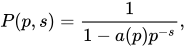
as is the case for the Riemann zeta-function, where a(n)=1{displaystyle a(n)=1}
Convergence
In practice all the important cases are such that the infinite series and infinite product expansions are absolutely convergent in some region
- Re(s)>C,{displaystyle operatorname {Re} (s)>C,}

that is, in some right half-plane in the complex numbers. This already gives some information, since the infinite product, to converge, must give a non-zero value; hence the function given by the infinite series is not zero in such a half-plane.
In the theory of modular forms it is typical to have Euler products with quadratic polynomials in the denominator here. The general Langlands philosophy includes a comparable explanation of the connection of polynomials of degree m, and the representation theory for GLm.
Examples
The Euler product attached to the Riemann zeta function ζ(s),{displaystyle zeta (s),}
- ∏p(1−p−s)−1=∏p(∑n=0∞p−ns)=∑n=1∞1ns=ζ(s).{displaystyle prod _{p}(1-p^{-s})^{-1}=prod _{p}{Big (}sum _{n=0}^{infty }p^{-ns}{Big )}=sum _{n=1}^{infty }{frac {1}{n^{s}}}=zeta (s).}

while for the Liouville function λ(n)=(−1)Ω(n),{displaystyle lambda (n)=(-1)^{Omega (n)},}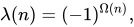
- ∏p(1+p−s)−1=∑n=1∞λ(n)ns=ζ(2s)ζ(s).{displaystyle prod _{p}(1+p^{-s})^{-1}=sum _{n=1}^{infty }{frac {lambda (n)}{n^{s}}}={frac {zeta (2s)}{zeta (s)}}.}

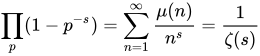
Using their reciprocals, two Euler products for the Möbius function μ(n){displaystyle mu (n)}
- ∏p(1−p−s)=∑n=1∞μ(n)ns=1ζ(s){displaystyle prod _{p}(1-p^{-s})=sum _{n=1}^{infty }{frac {mu (n)}{n^{s}}}={frac {1}{zeta (s)}}}
and
- ∏p(1+p−s)=∑n=1∞|μ(n)|ns=ζ(s)ζ(2s).{displaystyle prod _{p}(1+p^{-s})=sum _{n=1}^{infty }{frac {|mu (n)|}{n^{s}}}={frac {zeta (s)}{zeta (2s)}}.}

Taking the ratio of these two gives
- ∏p(1+p−s1−p−s)=∏p(ps+1ps−1)=ζ(s)2ζ(2s).{displaystyle prod _{p}{Big (}{frac {1+p^{-s}}{1-p^{-s}}}{Big )}=prod _{p}{Big (}{frac {p^{s}+1}{p^{s}-1}}{Big )}={frac {zeta (s)^{2}}{zeta (2s)}}.}

Since for even s the Riemann zeta function ζ(s){displaystyle zeta (s)}

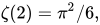
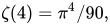

- ∏p(p2+1p2−1)=52,{displaystyle prod _{p}{Big (}{frac {p^{2}+1}{p^{2}-1}}{Big )}={frac {5}{2}},}
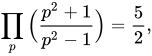
- ∏p(p4+1p4−1)=76,{displaystyle prod _{p}{Big (}{frac {p^{4}+1}{p^{4}-1}}{Big )}={frac {7}{6}},}
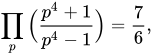
and so on, with the first result known by Ramanujan. This family of infinite products is also equivalent to
- ∏p(1+2p−s+2p−2s+⋯)=∑n=1∞2ω(n)n−s=ζ(s)2ζ(2s),{displaystyle prod _{p}(1+2p^{-s}+2p^{-2s}+cdots )=sum _{n=1}^{infty }2^{omega (n)}n^{-s}={frac {zeta (s)^{2}}{zeta (2s)}},}

where ω(n){displaystyle omega (n)}

If χ(n){displaystyle chi (n)}


- ∏p(1−χ(p)p−s)−1=∑n=1∞χ(n)n−s.{displaystyle prod _{p}(1-chi (p)p^{-s})^{-1}=sum _{n=1}^{infty }chi (n)n^{-s}.}
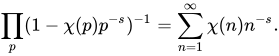
Here it is convenient to omit the primes p dividing the conductor N from the product. In his notebooks, Ramanujan generalized the Euler product for the zeta function as
- ∏p(x−p−s)≈1Lis(x){displaystyle prod _{p}(x-p^{-s})approx {frac {1}{operatorname {Li} _{s}(x)}}}
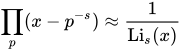
for s>1{displaystyle s>1}


Notable constants
Many well known constants have Euler product expansions.
The Leibniz formula for π,
- π4=∑n=0∞(−1)n2n+1=1−13+15−17+⋯,{displaystyle {frac {pi }{4}}=sum _{n=0}^{infty }{frac {(-1)^{n}}{2n+1}}=1-{frac {1}{3}}+{frac {1}{5}}-{frac {1}{7}}+cdots ,}

can be interpreted as a Dirichlet series using the (unique) Dirichlet character modulo 4, and converted to an Euler product of superparticular ratios
- π4=(∏p≡1(mod4)pp−1)⋅(∏p≡3(mod4)pp+1)=34⋅54⋅78⋅1112⋅1312⋯,{displaystyle {frac {pi }{4}}=left(prod _{pequiv 1{pmod {4}}}{frac {p}{p-1}}right)cdot left(prod _{pequiv 3{pmod {4}}}{frac {p}{p+1}}right)={frac {3}{4}}cdot {frac {5}{4}}cdot {frac {7}{8}}cdot {frac {11}{12}}cdot {frac {13}{12}}cdots ,}

where each numerator is a prime number and each denominator is the nearest multiple of four.[1]
Other Euler products for known constants include:
Hardy–Littlewood's twin prime constant:
- ∏p>2(1−1(p−1)2)=0.660161...{displaystyle prod _{p>2}left(1-{frac {1}{(p-1)^{2}}}right)=0.660161...}
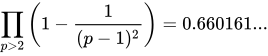
Landau-Ramanujan constant:
- π4∏p≡1(mod4)(1−1p2)1/2=0.764223...{displaystyle {frac {pi }{4}}prod _{pequiv 1{pmod {4}}}left(1-{frac {1}{p^{2}}}right)^{1/2}=0.764223...}

- 12∏p≡3(mod4)(1−1p2)−1/2=0.764223...{displaystyle {frac {1}{sqrt {2}}}prod _{pequiv 3{pmod {4}}}left(1-{frac {1}{p^{2}}}right)^{-1/2}=0.764223...}

Murata's constant (sequence A065485 in the OEIS):
- ∏p(1+1(p−1)2)=2.826419...{displaystyle prod _{p}left(1+{frac {1}{(p-1)^{2}}}right)=2.826419...}
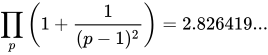
Strongly carefree constant ×ζ(2)2{displaystyle times zeta (2)^{2}}
- ∏p(1−1(p+1)2)=0.775883...{displaystyle prod _{p}left(1-{frac {1}{(p+1)^{2}}}right)=0.775883...}
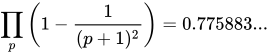
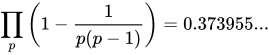
Artin's constant OEIS: A005596:
- ∏p(1−1p(p−1))=0.373955...{displaystyle prod _{p}left(1-{frac {1}{p(p-1)}}right)=0.373955...}
Landau's totient constant OEIS: A082695:
- ∏p(1+1p(p−1))=3152π4ζ(3)=1.943596...{displaystyle prod _{p}left(1+{frac {1}{p(p-1)}}right)={frac {315}{2pi ^{4}}}zeta (3)=1.943596...}

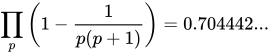
Carefree constant ×ζ(2){displaystyle times zeta (2)}
- ∏p(1−1p(p+1))=0.704442...{displaystyle prod _{p}left(1-{frac {1}{p(p+1)}}right)=0.704442...}
(with reciprocal) OEIS: A065489:
- ∏p(1+1p2+p−1)=1.419562...{displaystyle prod _{p}left(1+{frac {1}{p^{2}+p-1}}right)=1.419562...}

Feller-Tornier constant OEIS: A065493:
- 12+12∏p(1−2p2)=0.661317...{displaystyle {frac {1}{2}}+{frac {1}{2}}prod _{p}left(1-{frac {2}{p^{2}}}right)=0.661317...}

Quadratic class number constant OEIS: A065465:
- ∏p(1−1p2(p+1))=0.881513...{displaystyle prod _{p}left(1-{frac {1}{p^{2}(p+1)}}right)=0.881513...}

Totient summatory constant OEIS: A065483:
- ∏p(1+1p2(p−1))=1.339784...{displaystyle prod _{p}left(1+{frac {1}{p^{2}(p-1)}}right)=1.339784...}

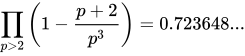
Sarnak's constant OEIS: A065476:
- ∏p>2(1−p+2p3)=0.723648...{displaystyle prod _{p>2}left(1-{frac {p+2}{p^{3}}}right)=0.723648...}
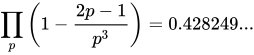
Carefree constant OEIS: A065464:
- ∏p(1−2p−1p3)=0.428249...{displaystyle prod _{p}left(1-{frac {2p-1}{p^{3}}}right)=0.428249...}
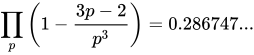
Strongly carefree constant OEIS: A065473:
- ∏p(1−3p−2p3)=0.286747...{displaystyle prod _{p}left(1-{frac {3p-2}{p^{3}}}right)=0.286747...}
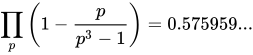
Stephens' constant OEIS: A065478:
- ∏p(1−pp3−1)=0.575959...{displaystyle prod _{p}left(1-{frac {p}{p^{3}-1}}right)=0.575959...}
Barban's constant OEIS: A175640:
- ∏p(1+3p2−1p(p+1)(p2−1))=2.596536...{displaystyle prod _{p}left(1+{frac {3p^{2}-1}{p(p+1)(p^{2}-1)}}right)=2.596536...}

Taniguchi's constant OEIS: A175639:
- ∏p(1−3p3+2p4+1p5−1p6)=0.678234...{displaystyle prod _{p}left(1-{frac {3}{p^{3}}}+{frac {2}{p^{4}}}+{frac {1}{p^{5}}}-{frac {1}{p^{6}}}right)=0.678234...}

Heath-Brown and Moroz constant OEIS: A118228:
- ∏p(1−1p)7(1+7p+1p2)=0.0013176...{displaystyle prod _{p}left(1-{frac {1}{p}}right)^{7}left(1+{frac {7p+1}{p^{2}}}right)=0.0013176...}

Notes
^ Debnath, Lokenath (2010), The Legacy of Leonhard Euler: A Tricentennial Tribute, World Scientific, p. 214, ISBN 9781848165267.mw-parser-output cite.citation{font-style:inherit}.mw-parser-output q{quotes:"""""""'""'"}.mw-parser-output code.cs1-code{color:inherit;background:inherit;border:inherit;padding:inherit}.mw-parser-output .cs1-lock-free a{background:url("//upload.wikimedia.org/wikipedia/commons/thumb/6/65/Lock-green.svg/9px-Lock-green.svg.png")no-repeat;background-position:right .1em center}.mw-parser-output .cs1-lock-limited a,.mw-parser-output .cs1-lock-registration a{background:url("//upload.wikimedia.org/wikipedia/commons/thumb/d/d6/Lock-gray-alt-2.svg/9px-Lock-gray-alt-2.svg.png")no-repeat;background-position:right .1em center}.mw-parser-output .cs1-lock-subscription a{background:url("//upload.wikimedia.org/wikipedia/commons/thumb/a/aa/Lock-red-alt-2.svg/9px-Lock-red-alt-2.svg.png")no-repeat;background-position:right .1em center}.mw-parser-output .cs1-subscription,.mw-parser-output .cs1-registration{color:#555}.mw-parser-output .cs1-subscription span,.mw-parser-output .cs1-registration span{border-bottom:1px dotted;cursor:help}.mw-parser-output .cs1-hidden-error{display:none;font-size:100%}.mw-parser-output .cs1-visible-error{font-size:100%}.mw-parser-output .cs1-subscription,.mw-parser-output .cs1-registration,.mw-parser-output .cs1-format{font-size:95%}.mw-parser-output .cs1-kern-left,.mw-parser-output .cs1-kern-wl-left{padding-left:0.2em}.mw-parser-output .cs1-kern-right,.mw-parser-output .cs1-kern-wl-right{padding-right:0.2em}.
References
G. Polya, Induction and Analogy in Mathematics Volume 1 Princeton University Press (1954) L.C. Card 53-6388 (A very accessible English translation of Euler's memoir regarding this "Most Extraordinary Law of the Numbers" appears starting on page 91)
Apostol, Tom M. (1976), Introduction to analytic number theory, Undergraduate Texts in Mathematics, New York-Heidelberg: Springer-Verlag, ISBN 978-0-387-90163-3, MR 0434929, Zbl 0335.10001
(Provides an introductory discussion of the Euler product in the context of classical number theory.)
G.H. Hardy and E.M. Wright, An introduction to the theory of numbers, 5th ed., Oxford (1979)
ISBN 0-19-853171-0 (Chapter 17 gives further examples.)
- George E. Andrews, Bruce C. Berndt, Ramanujan's Lost Notebook: Part I, Springer (2005),
ISBN 0-387-25529-X
- G. Niklasch, Some number theoretical constants: 1000-digit values"
External links
"Euler product". PlanetMath.
Hazewinkel, Michiel, ed. (2001) [1994], "Euler product", Encyclopedia of Mathematics, Springer Science+Business Media B.V. / Kluwer Academic Publishers, ISBN 978-1-55608-010-4
- Weisstein, Eric W. "Euler Product". MathWorld.
Niklasch, G. (23 Aug 2002). "Some number-theoretical constants". Archived from the original on 12 Jun 2006.


Comments
Post a Comment