 Mixing
Indian locomotive class WAP-4
| WAP-4 | |||||||||||||||||||||||||||||||||||||
|---|---|---|---|---|---|---|---|---|---|---|---|---|---|---|---|---|---|---|---|---|---|---|---|---|---|---|---|---|---|---|---|---|---|---|---|---|---|
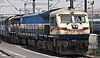
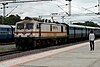
 Vijayawada based WAP 4 parked in Lingampally Railway Station | |||||||||||||||||||||||||||||||||||||
| |||||||||||||||||||||||||||||||||||||
| |||||||||||||||||||||||||||||||||||||
| |||||||||||||||||||||||||||||||||||||
| |||||||||||||||||||||||||||||||||||||

WAP-4 loco of Erode shed; Erode owns highest no. of WAP 4 locomotives
WAP - 4 is a common electric locomotive used in India.
The locomotive was developed after a previous class WAP 1 was found inadequate to haul the longer, heavier express trains (24-26 coaches) that were becoming the mainstay of the Indian Railways network. It was introduced in 1994, with a similar bodyshell to the WAP-1 class, but with Hitachi traction motors. Electricals are traditional DC loco type tap changers, driving 6 traction motors arranged in Co-Co fashion. This locomotive has proved to be highly successful, with over 750 units in service. Newer examples have been fitted with Microprocessor Controlled diagnostics, Static Converter units (instead of arnos) and roof mounted Dynamic (Rheostatic) Brakes.The locomotive can be seen in service across the electrified network of Indian Railways and is homed at 14 sheds (depots).
The last locomotive produced by the Chittaranjan Locomotive Works (CLW) was numbered 25051 in December 2015 and production of this locomotive has been stopped
Contents
1 Design
2 Performance
3 Technical specifications
4 Image Gallery
5 Sheds Holding WAP-4
6 See also
7 References
7.1 Notes
7.2 Bibliography
Design
The loco has a streamlined twin cab carbody design, with top-mounted headlamps. The first 150 or so units had the headlamp mounted at waist level, with the lights being mounted in a protruding nacelle. Some earlier locos, especially from the Erode loco shed have the headlamps placed on the top. Later on the headlamps were placed in a recessed nacelle, and from road #22579 onward, the headlamps were moved to the top. Also they have digital notch repeaters.
Newer locos also feature larger windshields, more spacious driver cabin with bucket type seats and ergonomic controls. The control panel also features a mix of digital and analog displays in newer units (all analog display in older versions).
Original units were weighed 120 tonnes, which was brought down to 112 tonnes through the usage of lighter material.
Some of the WAP-1 and WAP-3 and all the WAP-6 units were rebuilt to WAP-4 specifications after replacing the bogies & electricals.
It has different underframe for handling larger buffing loads. Some units are fitted with speed recorders and some changes to control electronics. Some units also have data recorders for energy consumption. Some are even fitted with windshield washers and rearview mirrors. Few were provided with signalling lamps which were subsequently removed.
Technical variants include WAP-4E which are probably fitted with electronic sensor for sensing loss in pressure in pipes.
The Hitachi traction motors are the ones used on freight engines. It was a challenge to put these in a passenger engine due to weight constraints. So the transformer is aluminum foil-wound and aluminum chequered plates are used for reducing the weight.
415 volts, 3 phase, 50 Hz power supply is used to drive various auxiliary motors like (1) Traction motor blowers (2) Transformer radiater blower (3) Transformer oil pump (4) Smoothing Reactor Blowers (5) Silicon Rectifier Blowers (6) Battery charger. The 3 phase, 415 volt supply is obtained from the single phase supply by Arno converter or static converter.
Indian railways has installed microprocessor based fault diagnostic system and Vigilance Control Device for the enhancement of safety and reliability of electric Locomotives. Some of the Newly manufactured WAP-4 locomotives also have air conditioning system for the comfort of the loco pilot.
Performance
If the average weight of ICF coach is 55 tonnes then it can haul the following capacity in tonnes:
| GradeKPH | Start | 20 | 40 | 60 | 70 | 80 | 90 | 100 | 110 | 120 | 130 | 140 | 150 | 160 |
|---|---|---|---|---|---|---|---|---|---|---|---|---|---|---|
| Level | 1500+ | 1500+ | 1500+ | 1500+ | 1500+ | 1500+ | 1500+ | 1500+ | 1500+ | 1500+ | 1500+ | 1155 | 805 | 570 |
| 1 in 500 | 1500+ | 1500+ | 1500+ | 1500+ | 1500+ | 1500+ | 1500+ | 1500+ | 1500+ | 1500+ | 1105 | 805 | 565 | 400 |
| 1 in 200 | 1500+ | 1500+ | 1500+ | 1500+ | 1500+ | 1500+ | 1500+ | 1320 | 1230 | 1035 | 730 | 535 | 375 | 260 |
| 1 in 150 | 1500+ | 1500+ | 1500+ | 1500+ | 1500+ | 1500+ | 1405 | 1090 | 1020 | 860 | 610 | 445 | 310 | 215 |
| 1 in 100 | 1500+ | 1570 | 1490 | 1405 | 1365 | 1195 | 1020 | 795 | 750 | 635 | 445 | 320 | 220 | 145 |
| 1 in 50 | 1160 | 770 | 750 | 720 | 710 | 625 | 530 | 410 | 390 | 325 | 220 | 150 | 90 | 45 |
Technical specifications

A WAP-4 Locomotive at Secunderabad
| Gear Ratio | 58:23 (One loco, #22559, was said to have a 59:23) |
| Transformer | 5400 kVA, 32 taps |
| Transformer cooling | Forced oil with Forced Air |
| Transformer Insulation | A |
| Pantographs | Two Stone India (Calcutta) AM-12. |
| Rectifiers | Two silicon rectifiers |
| Rectifier Cooling | Forced air |
| Current Ratings | 1300 A for 2 min, 1100 A for 10 min, 900 A continuous |
| Drive arrangement | Gear pinion |
| Number of sandboxes | 4 |
| 2 headlights | 90 W, 24 V |
| Lead acid battery | 10 Batteries each of 11 V, 75 Ah Capacity. |
| Arno Converter | 1420 rpm |
| 2 Elgi Compressors | 1000 l/minute at 7.5 kg/cm2. |
| 2 compressor motors | 3 phase 12.5 hp and 380 V |
| 2 SF India Ltd. Traction motor blowers | MLBR-42.5-144 type |
| 2 Siemens Traction motor blower motors | 22 kW, 415 V, 50 A and 2820 rpm |
| 2 SF India Ltd. Smoothing Reactor Blower | PFTA-50, ARR6 type |
| Traction Motor Suspension | Axle-hung, nose suspended |
| Traction motor weight | 3650 kg |
| Armature temperature rise | 90 °C |
| Field temperature rise | 70 °C |
| Commutator temperature rise | 85 °C |
| Armature coil resistance at 110 °C | 0.0126 ohms |
| Field coil resistance at 110 °C | 0.0117 ohms |
| Commutator coil resistance at 110 °C | 0.089 ohms |
| Traction motor continuous rating | 675kW (905 hp), 750 V, 900 A and 895 rpm |
| Traction motor 1 hour rating | 1030 hp, 750 V and 877 rpm |
| Traction Motor air gap main place | 6.35 mm |
| Traction motor air gap inter-pole | 10 mm |
| Traction motor | 6 P |
| 2 SF India Ltd. silicon rectifier blower | 3100–3200 m/hr |
| 2 Rectifier blower motor | 22 kW, 415 V, 8 A, 2860 rpm and 60 kg(approx) |
| Oil cooler blower motor | 30 hp, 380 V, 43 A and 1450 rpm |
| BEST and Co. Pvt. Ltd. Transformer Oil Pump | 750 l/minute |
| Oil pump motor | 3.3 kW, 415 V, 6.6 A and 2865 rpm |
| SL-30 type smoothing reactor | 1250 V and 1350 A. |
| Smoothing reactor resistance at 110 °C | 0.00718 ohms |
| Notches | 32 |
Image Gallery

indian locomotive WAP-4 Erode

22530, off POH+RC+RP @ KPA, 16-02-2019

ELS Arakkonam Jn.

Ghaziabad based WAP 4 with large model number similar to Ghaziabad based WAP 5 & WAP 7


Sheds Holding WAP-4
Sheds holding WAP4s as of April 2019[2] :
| Shed | Number of locos | Railways | Service Status |
|---|---|---|---|
Erode (ED) | 94 | Southern Railway (SR) | All locomotives in service |
Arakkonam (AJJ) | 58 | Southern Railway (SR) | All locomotives in service |
Howrah (HWH) | 92 | Eastern Railway (ER) | All locomotives in service |
Santragachi (SRC) | 81 | South Eastern Railway (SER) | WAP 4 22330 condemned |
Itarsi (ET) | 64 | West Central Railway (WCR) | All locomotives in service |
Vadodara (BRC) | 66 | Western Railway (WR) | All locomotives in service |
Mughalsarai (MGS) | 93 | East Central Railway (ECR) | All locomotive in service |
Kanpur (CNB) | 48 | North Central Railway (NCR) | All locomotives in service |
Bhusawal (BSL) | 42 | Central Railway (CR) | All locomotives in service |
Lallaguda (LGD) | 25 | South Central Railway (SCR) | All locomotives in service |
Vijayawada (BZA) | 35 | South Coast Railway (SCoR) | All locomotives in service |
Visakhapatnam (VSKP) | 21 | South Coast Railway (SCoR) | All locomotives in service |
Ludhiana (LDH) | 28 | Northern Railway (NR) | All locomotives in service |
Gonda (GD) | 3 | North Eastern Railway (NER) | All locomotives in service |
See also

- History of rail transport in India
- Indian Railways
- Locomotives of India
- Rail transport in India
References
Notes
^ "Indian AC electric loco information". Irfca.org. Retrieved 2013-04-03..mw-parser-output cite.citation{font-style:inherit}.mw-parser-output .citation q{quotes:"""""""'""'"}.mw-parser-output .citation .cs1-lock-free a{background:url("//upload.wikimedia.org/wikipedia/commons/thumb/6/65/Lock-green.svg/9px-Lock-green.svg.png")no-repeat;background-position:right .1em center}.mw-parser-output .citation .cs1-lock-limited a,.mw-parser-output .citation .cs1-lock-registration a{background:url("//upload.wikimedia.org/wikipedia/commons/thumb/d/d6/Lock-gray-alt-2.svg/9px-Lock-gray-alt-2.svg.png")no-repeat;background-position:right .1em center}.mw-parser-output .citation .cs1-lock-subscription a{background:url("//upload.wikimedia.org/wikipedia/commons/thumb/a/aa/Lock-red-alt-2.svg/9px-Lock-red-alt-2.svg.png")no-repeat;background-position:right .1em center}.mw-parser-output .cs1-subscription,.mw-parser-output .cs1-registration{color:#555}.mw-parser-output .cs1-subscription span,.mw-parser-output .cs1-registration span{border-bottom:1px dotted;cursor:help}.mw-parser-output .cs1-ws-icon a{background:url("//upload.wikimedia.org/wikipedia/commons/thumb/4/4c/Wikisource-logo.svg/12px-Wikisource-logo.svg.png")no-repeat;background-position:right .1em center}.mw-parser-output code.cs1-code{color:inherit;background:inherit;border:inherit;padding:inherit}.mw-parser-output .cs1-hidden-error{display:none;font-size:100%}.mw-parser-output .cs1-visible-error{font-size:100%}.mw-parser-output .cs1-maint{display:none;color:#33aa33;margin-left:0.3em}.mw-parser-output .cs1-subscription,.mw-parser-output .cs1-registration,.mw-parser-output .cs1-format{font-size:95%}.mw-parser-output .cs1-kern-left,.mw-parser-output .cs1-kern-wl-left{padding-left:0.2em}.mw-parser-output .cs1-kern-right,.mw-parser-output .cs1-kern-wl-right{padding-right:0.2em}
^ http://www.indianrailways.gov.in/railwayboard/view_section.jsp?lang=0&id=0,1,304,366,549,687,709
Bibliography
.mw-parser-output .refbegin{font-size:90%;margin-bottom:0.5em}.mw-parser-output .refbegin-hanging-indents>ul{list-style-type:none;margin-left:0}.mw-parser-output .refbegin-hanging-indents>ul>li,.mw-parser-output .refbegin-hanging-indents>dl>dd{margin-left:0;padding-left:3.2em;text-indent:-3.2em;list-style:none}.mw-parser-output .refbegin-100{font-size:100%}
Hughes, Hugh (1996). Indian Locomotives: Part 4 – 1941–1990. Harrow, Middlesex: The Continental Railway Circle. ISBN 0-9521655-1-1.
 | Wikimedia Commons has media related to Indian locomotive class WAP4. |
Broad gauge locomotives of India | ||||||||||
|---|---|---|---|---|---|---|---|---|---|---|
| Steam |
|     | ||||||||
| Diesel |
| |||||||||
DC electric |
| |||||||||
AC electric |
| |||||||||
| Dual (AC and DC) electric |
| |||||||||


Comments
Post a Comment