 Mixing
埃迪卡拉纪
埃迪卡拉纪 635–542百万年前 PreЄ Є O S D C P T J K Pg N | |
全時期平均大氣O2含量 | 约8 Vol %[1] (为現代的40% ) |
全時期平均大氣CO2含量 | 约4500 ppm[2] (为前工業時期16倍) |
埃迪卡拉纪(英语:Ediacaran),又称艾迪卡拉纪[3]、震旦纪、文德纪,是元古宙最後的一段时期。一般指6.35-5.41億年前。学者曾用这个名字指稱不同阶段,直到2004年5月13日,国际地质科学联合会(英语:International Union of Geological Sciences,IUGS)明確定義其年代,这是这个组织120年來首次對其加时期定义。最古老的動物遺跡可追溯至十億年前,但最早的動物化石出現於約六億年前的埃迪卡拉纪。
目录
1 名字来源
2 埃迪卡拉生物群
2.1 特徵
2.2 例子
3 末期灭绝事件
4 參見
5 參考資料
5.1 脚注
5.2 书目
名字来源
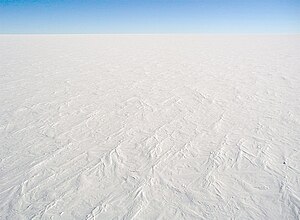
於南極拍攝的照片,可能就是埃迪卡拉纪時南極陸地上的樣子
埃迪卡拉動物群因為發現於南澳大利亞的埃迪卡拉山而得名。1946年,一位澳洲地質學家(Reg Sprigg)在古代的沙岩板中留意到一曾在这里发现顯生宙以前的化石。研究这些化石的科學家(Martin Glaessner)認为这是珊瑚、水母和蠕虫的先驱。以后几十年,南澳大利亚还找到很多的隐生宙化石,其他各大洲也找到一些。这些化石都叫作埃迪卡拉动物。一開始,人們認為埃迪卡拉動物是寒武紀的動物,但經過仔細的觀察,埃迪卡拉化石比寒武紀還久遠,應屬於埃迪卡拉纪。
本纪曾被一些人称为震旦紀(Sinian)[4]。震旦纪的名称来源于中国,“震旦”是中国的古称。由于古印度人称中国为Cinisthana,在佛经中被译为震旦,故名震旦纪。时至今日,中国学者仍经常这么称呼,中国教科书上一直称此纪为震旦纪。俄国人又把埃迪卡拉纪称为文德纪,他们在这一时期的地层中又发现了一些古线虫动物的化石。
埃迪卡拉生物群

狄更遜水母為埃迪卡拉動物群中較著名的種類
埃迪卡拉生物群(英语:Ediacaran biota)是1946年发现于澳大利亚南部埃迪卡拉(英语:Ediacara)山地的末远古系庞德石英岩中的化石群,这类化石群已在世界30多个地点被发现。
特徵
埃迪卡拉动物和今天的大多數動物不同,牠們既沒頭、尾、四肢,又沒嘴巴和消化器官,因此牠們大概只能從水中攝取養份。大多的埃迪卡拉动物固著在海底,和植物十分相近,其他的則平躺在淺海處,等待營養順水流而送上門來。埃迪卡拉动物化石出土越多,反而越没有规律。有几种化石比较像后来动物的先驱。
例子
加尼亞蟲(学名:Charnia)、斯瓦特蟲(Swartpuntia)、狄更遜水母(Dickinsonia)、古线虫(Paleolina)、皱节虫(Sabellidites)等
雖然在埃迪卡拉紀出現了很多的生物,但在埃迪卡拉紀末期,埃迪卡拉动物分成兩支,牠們有的成功演化成更有活力,更具進攻性的動物,有的則走向滅亡。而牠們的特徵也永遠消失於歷史舞台上。
末期灭绝事件
此為一次可能發生在約5.42億年前埃迪卡拉纪末期的大滅絕。該次事件包括疑源類生物的大型集體滅絕、埃迪卡拉生物群突然消失以及寒武紀大爆發之前的一段地球生命空白期。
有部分生物存活過了這次大滅絕,因此地球上的生命才得以存續至今。然而,只有極少部分的生物種類在埃迪卡拉纪-寒武紀交界帶兩側被同時發現。其中一種是凝集的有孔蟲門生物
Platysolenites[5]。
其他明顯的倖存者,例如奇翼虫,被重新解釋為與埃迪卡拉生物群無關。
參見
- 埃迪卡拉生物群
- 埃迪卡拉纪末期灭绝事件
參考資料
脚注
^ Image:Sauerstoffgehalt-1000mj.svg
^ Image:Phanerozoic Carbon Dioxide.png
^ Bottjer, David J.; 翻譯/姚若潔. 小春蟲背後的演化秘密. 科學人雜誌. 2005年9月, 第43期 [2014-11-24]. 引文使用过时参数coauthors (帮助)
^ 见大英百科全書條目
^ Kontorovich, A; Varlamov, A; Grazhdankin, D; Karlova, G; Klets, A; Kontorovich, V; Saraev, S; Terleev, A; Belyaev, S; 等. A section of Vendian in the east of West Siberian Plate (based on data from the Borehole Vostok 3). Russian Geology and Geophysics. 2008, 49 (12): 932. Bibcode:2008RuGG...49..932K. doi:10.1016/j.rgg.2008.06.012.
书目
- A. Knoll, M. Walter, G. Narbonne, and N. Christie-Blick (2004) "The Ediacaran Period: A New Addition to the Geologic Time Scale." Submitted on Behalf of the Terminal Proterozoic Subcommission of the International Commission on Stratigraphy.
- Knoll, A. H.; Walter, MR; Narbonne, G. M; Christie-Blick, N (2004). "A new period for the geologic time scale". Science 305 (5684): 621–622.
- Knoll, A. H., Walter, M. R., Narbonne, G. M., and Christie-Blick, N. (2006). "The Ediacaran Period: A new addition to the geologic time scale". Lethaia 39: 13–30.
- "Geological time gets a new period: Geologists have added a new period to their official calendar of Earth's history—the first in 120 years". London: BBC. 2004-05-17. Accessed 27 December 2010.
- "South Australian Museum Newsletter April 2005" Accessed 9 August 2010.
- B. M. Sokolov (1952). "On the age of the old sedimentary cover of the Russian Platform". Izvestiya Akademii Nauk SSSR, Seriya eologicheskaya 5: 21–31.
- Sokolov, B.S. (1997). "Essays on the Advent of the Vendian System." 153 pp. KMK Scientific Press, Moscow. (in Russian)
- Sokolov B. S. (1965) "Abstracts of All-Union Symposium on Paleontology of the Precambrian and Early Cambrian." Nauka, Novosibirsk.
- Rozanov, A.Y., Missarzhevskij, V.V., Volkova, N.A., Voronova, L.G., Krylov, I.N., Keller, B.M., Korolyuk, I.K., Lendzion, K., Michniak, R., Pykhova, N.G., and Sidorov, A.D. (1969). "The Tommotian Stage and the problem of the lower boundary of the Cambrian". Trudy Geologičeskogo Instituta AN SSSR 206: 1–380.
- M. A. Fedonkin, B. S. Sokolov, M. A. Semikhatov, N. M. Chumakov (2007). "Vendian versus Ediacaran: priorities, contents, prospectives". In: "The Rise and Fall of the Vendian (Ediacaran) Biota". Origin of the Modern Biosphere. Transactions of the International Conference on the IGCP Project 493n Moscow: GEOS. August 20–31, 2007.
- Khomentovsky, V. V. (2008). "The Yudomian of Siberia, Vendian and Ediacaran systems of the International stratigraphic scale". Stratigraphy and Geological Correlation 16 (6): 581–598.
- Comments By B. S. Sokolov, M. A. Semikhatov, And M. A. Fedonkin. (2004) Appendix 2 in: "The Ediacaran Period: A New Addition to the Geologic Time Scale." Submitted on Behalf of the Terminal Proterozoic Subcommission of the International Commission on Stratigraphy. pp. 32–34
- Bristow, T. F. and Kennedy, M. J. (2008). "Carbon isotope excursions and the oxidant budget of the Ediacaran atmosphere and ocean". Geology 36 (11): 863–866. Retrieved 2007-05-05.
- Le Guerroué, E., Allen, P. A., Cozzi, A. (2006). "Chemostratigraphic and sedimentological framework of the largest negative carbon isotopic excursion in Earth history: The Neoproterozoic Shuram Formation (Nafun Group, Oman)". Precambrian Research 146 (1–2): 68–92.
- Le Guerroué, E.; Allen, P. A., Cozzi, A., Etienne, J. L. and Fanning, C. M. (2006). "50 Myr recovery from the largest negative δ13C excursion in the Ediacaran ocean". Terra Nova 18 (2): 147–153.
- Le Guerroué, E.; Allen, P. A., Cozzi, A. (2006). "Parasequence development in the Ediacaran Shuram Formation (Nafun Group, Oman): primary origin stratigraphic test of negative carbon isotopic ratios". Basin Research 18 (2): 205–220.
- A. Ragozina, D. Dorjnamjaa, A. Krayushkin, E. Serezhnikova (2008). "Treptichnus pedum and the Vendian-Cambrian boundary". 33 Intern. Geol. Congr. August 6–14, 2008, Oslo, Norway. Abstracts. Section HPF 07 Rise and fall of the Ediacaran (Vendian) biota. P. 183.
- Hoffmann, K.H.; Condon, D.J.; Bowring, S.A.; Crowley, J.L. (2004-09-01). "U-Pb zircon date from the Neoproterozoic Ghaub Formation, Namibia: Constraints on Marinoan glaciation". Geology 32 (9): 817–820.
- Condon, D., Zhu, M., Bowring, S., Wang, W., Yang, A., and Jin, Y. (1 April 2005). "U-Pb Ages from the Neoproterozoic Doushantuo Formation, China" (abstract). Science 308 (5718): 95–98.
- Calver, C.R.; Black, Lance P.; Everard, John L.; Seymour, David B. (2004-10-01). "U-Pb zircon age constraints on late Neoproterozoic glaciation in Tasmania". Geology 32 (10): 893–896.
- Ogg, J. G. (2004). "Status of Divisions of the International Geologic Time Scale". Lethaia 37 (2): 183–199.
- Amthor, J. E.; Grotzinger, John P.; Schröder, Stefan; Bowring, Samuel A.; Ramezani, Jahandar; Martin, Mark W.; Matter, Albert (2003). "Extinction of Cloudina and Namacalathus at the Precambrian-Cambrian boundary in Oman". Geology 31: pp 431–434.
- "Earliest Animal Footprints Ever Found -- Discovered in Nevada" Newswise, Retrieved on October 5, 2008. Reporting on a poster session at the Geological Society of America
地质年代 | |||||||||||||||||||||||||||||||||||
|---|---|---|---|---|---|---|---|---|---|---|---|---|---|---|---|---|---|---|---|---|---|---|---|---|---|---|---|---|---|---|---|---|---|---|---|
冥古宙 | 太古宙 | 元古宙 | 显生宙 | ||||||||||||||||||||||||||||||||
隱 生 代 | 原 生 代 | 酒 神 代 | 雨 海 代 | 始 太 古 代 | 古 太 古 代 | 中 太 古 代 | 新 太 古 代 | 古元古代 | 中元古代 | 新元古代 | 古生代 | 中生代 | 新生代 | ||||||||||||||||||||||
成 鐵 紀 | 層 侵 紀 | 造 山 紀 | 固 結 紀 | 蓋 層 紀 | 延 展 紀 | 狹 帶 紀 | 拉 伸 紀 | 成 冰 紀 | 埃 迪 卡 拉 紀 | 寒 武 紀 | 奧 陶 紀 | 志 留 紀 | 泥 盆 紀 | 石 炭 纪 | 二 疊 紀 | 三 疊 紀 | 侏 羅 紀 | 白 堊 紀 | 古近纪 | 新近纪 | 第四紀 | ||||||||||||||
古 新 世 | 始 新 世 | 漸 新 世 | 中 新 世 | 上 新 世 | 更 新 世 | 全 新 世 | |||||||||||||||||||||||||||||


Comments
Post a Comment