 Mixing
U2 (Vienna U-Bahn)
 | This article may be expanded with text translated from the corresponding article in German. (April 2017) Click [show] for important translation instructions.
|
 Line U2 Line U2 | |
|---|---|
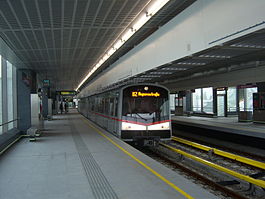 Line U2 train at Donaumarina | |
| Overview | |
| Type | Rapid transit |
| System | Vienna U-Bahn |
| Status | Operational |
| Termini | Karlsplatz Seestadt |
| Stations | 20 |
| Operation | |
| Opened | 1980 |
| Operator(s) | Wiener Linien |
| Technical | |
| Line length | 16.7 km |
| Track gauge | 1,435 mm (4 ft 8 1⁄2 in) |
Line U2 is a line on the Vienna U-Bahn metro system.[1]
It currently has 20 stations and it runs 16.7 km from Karlsplatz to Seestadt.
It is connected to Line U1 and Line U4 at Karlsplatz, Line U3 at Volkstheater, Line U4 at Schottenring and Line U1 at Praterstern.
It opened in 1980.
Contents
1 Stations
2 History
3 References
4 External links
Stations
| Station | Transfers |
|---|---|
| Karlsplatz |   |
| Museumsquartier | |
| Volkstheater |  |
| Rathaus | |
| Schottentor | |
| Schottenring | |
| Taborstraße | |
| Praterstern |      |
| Messe-Prater | |
| Krieau | |
| Stadion | |
| Donaumarina | |
| Donaustadtbrücke | |
| Stadlau |  |
| Hardeggasse | |
| Donauspital | |
| Aspernstraße | |
| Hausfeldstraße | |
| Aspern Nord | |
| Seestadt |
History
The Construction of U2 (1963-1982)
The construction of the tunnel, which was later the centrepiece of the U2, was started in 1963. After the tunnel was completed in 1966 with a length of 1.8 kilometres, it ran from Vienna Secession to Friedrich-Schmidt-Platz. Soon after, the modern construction of Vienna's railway was built on the 3 November 1969.[2] This consisted of the newly built U1 line, and two merged lines from a tram and old metro, of the line U2 and U4 respectively. As the result of a more streamlined network, there were new routes between U1, U2 and U4.[3]
Line U2 Routes: Karlsplatz - Lastenstrasse - Schottenring (3.5 kilometres in length)[4]
In the 1960s and 1970s, U2 received a total of three new stations: Karlsplatz, Schottentor and Schottenring. On August 30, 1980, the U2 between Karlsplatz and Schottenring was opened. Between 1980 and 2008, the U2 remained by far the weakest busy line in the Vienna network. As a result, U2 was extended to the Ernst Happel Stadium, Stadion-Aspernstraße in 2010, and finally Aspern Seestadt on October 5 2013.[5]
The development of the cars of the U2 Trains was by Simmering-Graz-Pauker (SGP) in 1972.[6] This unit had a two-axle motorcar, it was 36.8 metres long and 2.8 metres wide and a permanently coupled twin railcar. A train was made up of three double cars. From 1987, SGP upgraded their cars' technical equipment, which included water-cooled three-phase motors, brakes with energy recovery and modernised emergency braking and safety equipment.[7] In 2006, the U2 LED displays replaced the original in-and-out illuminated telltale displays. In addition, the trains were retrofitted with plastic seats, video surveillance and warning lights that had signalled the door closing. An individual car consists of 49 seats and 91 standing spots.
References
^ http://homepage.univie.ac.at/horst.prillinger/metro/english/u2.html
^ Rout, Stephen. "Vienna Underground Train System - Information from Vienna Direct". ViennaDirect. Retrieved 2018-09-14..mw-parser-output cite.citation{font-style:inherit}.mw-parser-output .citation q{quotes:"""""""'""'"}.mw-parser-output .citation .cs1-lock-free a{background:url("//upload.wikimedia.org/wikipedia/commons/thumb/6/65/Lock-green.svg/9px-Lock-green.svg.png")no-repeat;background-position:right .1em center}.mw-parser-output .citation .cs1-lock-limited a,.mw-parser-output .citation .cs1-lock-registration a{background:url("//upload.wikimedia.org/wikipedia/commons/thumb/d/d6/Lock-gray-alt-2.svg/9px-Lock-gray-alt-2.svg.png")no-repeat;background-position:right .1em center}.mw-parser-output .citation .cs1-lock-subscription a{background:url("//upload.wikimedia.org/wikipedia/commons/thumb/a/aa/Lock-red-alt-2.svg/9px-Lock-red-alt-2.svg.png")no-repeat;background-position:right .1em center}.mw-parser-output .cs1-subscription,.mw-parser-output .cs1-registration{color:#555}.mw-parser-output .cs1-subscription span,.mw-parser-output .cs1-registration span{border-bottom:1px dotted;cursor:help}.mw-parser-output .cs1-ws-icon a{background:url("//upload.wikimedia.org/wikipedia/commons/thumb/4/4c/Wikisource-logo.svg/12px-Wikisource-logo.svg.png")no-repeat;background-position:right .1em center}.mw-parser-output code.cs1-code{color:inherit;background:inherit;border:inherit;padding:inherit}.mw-parser-output .cs1-hidden-error{display:none;font-size:100%}.mw-parser-output .cs1-visible-error{font-size:100%}.mw-parser-output .cs1-maint{display:none;color:#33aa33;margin-left:0.3em}.mw-parser-output .cs1-subscription,.mw-parser-output .cs1-registration,.mw-parser-output .cs1-format{font-size:95%}.mw-parser-output .cs1-kern-left,.mw-parser-output .cs1-kern-wl-left{padding-left:0.2em}.mw-parser-output .cs1-kern-right,.mw-parser-output .cs1-kern-wl-right{padding-right:0.2em}
^ Horst, Prillinger. "The Modern Metro (U-Bahn), Phase 1 - The Vienna Metro". The Vienna Metro. Retrieved 2018-09-14.
^ "U2 Route: TIme Schedules, Stops & Maps". Moovit. Retrieved 2018-09-14.
^ "U2 auf verlängerter Strecke unterwegs". Wiener Linien. Archived from the original on 2014-02-03. Retrieved 2018-09-14.
^ Horst, Prillinger. "U, U11 and U2 Stock". The Vienna Metro. Retrieved 2018-09-14.
^ "Vienna U-Bahn". Rehau. Retrieved 2018-09-14.
External links
 Media related to Metro line U2 (Vienna) at Wikimedia Commons
 Media related to Metro line U2 (Vienna) at Wikimedia Commons
Lines of Vienna U-Bahn | |||
|---|---|---|---|
 | | ||


Comments
Post a Comment