 Mixing
Korean People's Army Ground Force
| 조선인민군 륙군 朝鮮人民軍 陸軍 Korean People's Army Ground Force | |
|---|---|
 The flag of the Korean People's Army Ground Force | |
| Founded | August 20, 1947 (1947-08-20) |
| Country |  North Korea North Korea |
| Allegiance |  Kim Jong-un[1] Kim Jong-un[1] |
| Type | Army |
| Size | 950,000 active; 7,620,000 reserve[2] |
| Part of | Korean People's Army |
| Equipment | 4,300 tanks 2,500 infantry fighting vehicles 8,600 artillery pieces 5,500 multiple rocket launcher systems[3][4] |
| Engagements | Korean War |
| Commanders | |
| Commander-in-chief | General Ri Myong-su |
| Notable commanders | Choi Yong-kun, Kim Chaek |
| Former flag |  |
The Korean People's Army Ground Force (KPAGF; Chosŏn'gŭl: 조선인민군 륙군; Hancha: 朝鮮人民軍 陸軍; lit. Korean People's Military Land Group) is the main branch of the Korean People's Army, responsible for land-based military operations.
Contents
1 History
2 Current status
3 Equipment
3.1 Armor
3.2 Vehicles
3.3 Artillery
4 Weapons
4.1 Anti-tank weapons
4.2 Anti-aircraft weapons
4.3 Small arms
4.3.1 Reserve small arms
5 Ranks and uniforms
5.1 Ranks
5.1.1 Enlisted
5.1.2 Officers
5.1.3 Marshals
5.2 Uniform
6 See also
7 References
8 External links
History
The Korean People's Army Ground Force was formed on August 20, 1947. It outnumbered and outgunned the South Korean army on the outbreak of the Korean War in June 1950. North Korean ground forces formations which fought in the Korean War included the I Corps, the II and III Corps. The IV Corps and V Corps, VI and VII Corps were formed after the outbreak of war. Divisions included the 105th Armored Division, the 1st, 2nd, 3rd, 4th, 5th, 6th, 7th, 8th, 9th, 10th, 12th, 19th, and 43rd Infantry Divisions. During the Korean War, it also contained a number of independent units such as the 766th Infantry Regiment.

Military parade in Pyongyang in 2015
In 1960, the KPAGF may have totaled fewer than 400,000 personnel and probably did not rise much above that figure before 1972. The force then massively expanded over the next two decades. In 1992, there were 950,000 personnel.[5] Before this expansion of the North Korean ground forces, the South Korean army outnumbered the KPAGF. From the 1970s on, South Korea started exceeding North Korea in terms of economics. Thus, South Korea could modernize its forces, which in turn alerted North Korea and resulted in the expansion of the North Korean armed forces. The weaker of the two Koreas has maintained the larger armed force. The size, organization, disposition, and combat capabilities of the Ground Force give Pyongyang military, albeit technologically inferior, possible options both for limited offensive operations to assault the lower half of the peninsula or for limited defensive operations against any perceived threat from South Korea.
Scalapino and Lee's Communism in Korea: The Society gave an organisation chart in 1972 that showed the 1st, 2nd, 3rd, 5th, and 7th Army Groups (p.940). The 1st, 2nd (five divs), and 5th had four divisions plus a brigade or regiment; the 3rd had four divisions, and the 7th three divisions and three brigades. Scalapino and Lee drew upon the South Korean-published The North Korean Yearbook. A declassified 1971 CIA document referring to a 1970 DIA assessment appear to indicate that the 1st Army Group included the 13th and 47th Infantry Divisions.
Yossef Bodansky's Crisis in Korea gives an account of the North Korean order of battle in 1984–88.[6] The 1st, 2nd (five divs, one brigade), and 5th Army Groups, each with four divisions and one independent brigade, covered the eastern, Western, and central sectors of the DMZ. The III, VI, and VII Corps were deployed around Wonsan and the coastal regions, with the IV Corps, recently converted from the 4th Army Group, around Pyongyang. All the corps had the virtually-standard four divisions and an independent brigade under command, apart from the VII Corps with three divisions and three brigades. The army groups were described as striking forces while the corps also had ground-holding responsibilities. The III, VI, and VII Corps began forming armoured and mechanised units in 1985.
Over time, this organization has adjusted to the unique circumstances of the military problem the KPA faces and to the evolution of North Korean military doctrine and thought.
In 1996, a significant portion of the staff, along with local government officials of the VI Corps was arrested and convicted of bribery and corruption.[7] The VI Corps HQ, which was in Chongjin, was in charge of military activities in the whole of North Hamgyong Province. It consisted of three infantry divisions, four rocket brigades and one artillery division. Joseph F. Bermudez reports in Shield of the Great Leader that the incident was not a coup, but it is often reported as such.[8] In any event, the corps was disbanded, and its units reallocated elsewhere, some to the IX Corps in North Hamgyong Province. The IX Corps now includes the 24th Division and the 42nd Division.
Current status
The overwhelming majority of active ground forces are deployed in three echelons — a forward operational echelon of four infantry corps; supported by a second operational echelon of two mechanized corps, the armor corps, and an artillery corps; and a strategic reserve of the two remaining mechanized corps and the other artillery corps.[9] These forces include the 806th and 815th Mechanized Corps and the 820th Armored Corps. These forces are garrisoned along major north-south lines of communication that provide rapid, easy access to avenues of approach into South Korea. The KPAGF has positioned massive numbers of artillery pieces, including some fakes,[citation needed] especially its longer-range systems, close to the Demilitarized Zone (DMZ) that separates the two Koreas.

KPA soldiers at the DMZ
As of 2013[update], the US Department of Defense has reported the ground forces in number totals 950,000 in strength.[10]
Equipment
 | This section includes a list of references, but its sources remain unclear because it has insufficient inline citations. (January 2017) (Learn how and when to remove this template message) |
The Ground Forces have a mix of domestic and imported equipment in their inventory. Prior to the breakup of the Soviet Union, most of these items were Soviet made and later, from China.[11][12][13]
The annual report of North Korea's military capabilities by the U.S. Department of Defense, released in early 2014, identified the North Korean Army's strength at 950,000 personnel, 4,200 tanks, 2,200 armored vehicles, 8,600 artillery guns, and over 4,800 multiple rocket launchers.[14]
The bi-annual report of North Korea's military capabilities by the ROK's Ministry of National Defense, released in 2018, identified the North Korean Army's strength at 7,620,000 reserves troops, 4,300 tanks, 2,500 armored vehicles, 8,600 artillery guns, 5,500 multiple rocket launchers.[15]
Armor
Today's KPA arsenal includes a mix of Soviet and Chinese products and locally produced armored vehicles.
| Name | Type | Quantity | Origin | Photo | Notes | |
|---|---|---|---|---|---|---|
| Tanks | ||||||
| T-34 | Main Battle Tank | 650 |  Soviet Union Soviet Union |  | ||
| T-55 | 1,600[16] |  | Some 2000 T-55 and Type 59 Tanks are thought to currently be in service. Can be equipped with spaced armor to defeat HEAT warheads.[17] | |||
| T-62 | 800[16] | 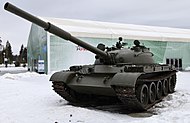 | Various variants including T-62D.[18] Capable of receiving later model Ch'onma-Ho upgrades. | |||
T-72S | Unknown |  | The Soviet Union reportedly sold T-72S tanks to North Korea in the early 1980s. The number sold and the number currently in service is unknown. | |||
| T-80 | Unknown | Soviet Union | ? | Reportedly acquired from Afghanistan in early 1990's.[19] | ||
| Type 59 | 175[16][20] |  China China |  | Some 2,000 T-55 and Type 59 tanks are thought to currently be in service. | ||
| Ch'ŏnma-ho | ~1,000[16] | North Korea |  | 1,000 manufactured (as of the early 1990s). | ||
| Chonma 215-216 | ~1,000+ in service as of 2017[update] | Locally designed main battle tank. Korean analogue of a Soviet supplied T-72. | ||||
| PT-76 | Amphibious light tank | 550 | Soviet Union |  | Some PT-76 are in reserve status. | |
| Type 63 | N/A | China |  | [21] | ||
PT-85 (Type-82) | more than 50 tanks | North Korea | Based on the VTT-323 APC chassis. | |||
| Armored Personnel Carriers & Infantry Fighting Vehicles | ||||||
| BMP-1 | Infantry fighting vehicle | 100 | Soviet Union Ukraine Ukraine | 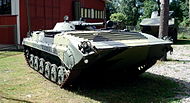 | Designated as Korshun. | |
BTR-50P | Armored personnel carrier | N/A |  | |||
BTR-60PB | 1,000[16] |  | First ordered in 1966. | |||
BTR-80A | 35[16] |  | Imported from Ukraine | |||
| BTR-152 | N/A |  | ||||
| M-2010 (Chunma-D) | N/A | North Korea |  | A modified clone of the BTR-80.[22] | ||
| M-2010 (6 x 6 version) | N/A | A shortened version of the M-2010.[23] | ||||
| Type 55 | N/A | China |  | |||
| Type 63 APC | 500[16] | North Korea |  | Variant VTT-323 based on Chinese A531. | ||
| M1992 | N/A |  | Locally designed APC based on the BRDM-2.[24] Armed with an AGS-17 grenade launcher and a 9K113 Konkurs ATGM. | |||
VTT-323 (M-1973) | 3,200 |  | Based on the YW-531. | |||
| Model 2009 (Chunma-D, or Junma-Le)[25] | 3,200 | | Based on the PT-85 light tank hull but fitted with a turret from a M-2010 personal carrier.[25] | |||
Vehicles
| Name | Type | In Service | Notes | |||
|---|---|---|---|---|---|---|
| Transportation and logistics | ||||||
Mercedes G-Class | Utility vehicle | Seen during the funeral of Kim Jong-il[26] | ||||
UAZ-3151 | Utility vehicle | |||||
Iveco 90.17 WM | General-purpose truck | |||||
Ural-4320 | General-purpose truck | |||||
FAW MV3 | General-purpose truck | |||||
| MAN TGA | Tractor truck | Supplemented by Sinotruk HOWO A7 | ||||
| Iveco Stralis | Tractor truck | Supplemented by Sinotruk HOWO A7 | ||||
| Renault Premium | Tractor truck | Supplemented by Sinotruk HOWO A7 | ||||
| Ambulance | Ambulance | |||||
MAZ-7310 | Missile system carrier | |||||
WS-51200 TEL | Transporter erector launcher platform | 10 | ||||
Artillery
The KPA-GF artillery pool include both imports and locally produced guns.
| Name | Type | In Service | Notes | |||
|---|---|---|---|---|---|---|
| Howitzers | ||||||
M-1985 | 152 mm gun-howitzer | D-20/M1955; Type 83 | ||||
M-1981 | 122 mm self-propelled gun | Type 54 SPH | ||||
M-1978 | 170 mm SP gun-howitzer | Largest caliber self-propelled howitzer in KPA service | ||||
180 mm gun S-23[27] | 180mm howitzer | Largest caliber howitzer in KPA | ||||
M-1975 | 130 mm self-propelled gun | |||||
M-1974 | 152 mm SP gun-howitzer | |||||
M-1992 | 122 mm self-propelled gun | |||||
M-1991 | 152 mm self-propelled howitzer | |||||
M-1992 | 120 mm self-propelled combination gun | |||||
M-2018 | 152mm self-propelled gun | Jane's compared its ordnancee with 2S19 Msta [measure the photo by straightedge][28][29] | ||||
SU-100 | 100 mm SP assault gun | |||||
| Mortars | ||||||
Mortars | Various | North Korea is known to have some 10,000 mortars of different types and origin in its inventory | ||||
| Rocket Artillery | ||||||
Type 63 | 107 mm multiple rocket launcher | 4,000 delivered between 1964–1990 | ||||
M-1985 | 122 mm multiple rocket launcher | |||||
M-1993 | 122 mm multiple rocket launcher | |||||
BM-11 | 122 mm multiple rocket launcher | |||||
RM-70 | 122 mm multiple rocket launcher | [30] | ||||
BMD-20 | 200 mm multiple rocket launcher | 200 delivered in mid-1950s[31] | ||||
BM-24 | 240 mm multiple rocket launcher | 500 delivered in 1955 | ||||
| M1985/M1991 | 240 mm rocket launcher | Estimated 200+ in service between both models[32][33] | Range estimates of 30–43–60–70 km (19–27–37–43 mi)[34][35] | |||
KN-09 | 300 mm guided rocket launcher | 10 estimated in 2016.[36] | [37][38] | |||
Crucially, the North Korean Army has large numbers of heavy artillery in positions close to the DMZ and near Seoul, the capital of South Korea, a city having a population of approximately 25 million people, around 50% of the total population of South Korea. These artillery pieces can reach the northern parts of Seoul, and are often considered to be a more significant threat than North Korea's nuclear weapons.[39] North Korea's threat of a 'sea of fire' upon Seoul is usually taken to refer to the use of this artillery.[40]
Studies have differed over the number of casualties these artillery can inflict; one 2011 study suggests that the North Korean artillery, firing so as to cause maximum civilian casualties instead of for military effect, could inflict "only" about 3,000 – 30,000 casualties in the first day of a conflict, after which the population would evacuate or find shelter and the North Korean artillery pieces were themselves substantially destroyed.[41]
Weapons
Anti-tank weapons
| Name | ||||||
|---|---|---|---|---|---|---|
| Man-portable anti-tank | ||||||
RPG-2 | ||||||
RPG-7 (local production with tandem warhead) | ||||||
Type 69 RPG (Chinese rocket-propelled grenade) | ||||||
RPO-A (assumed to be locally produced) | ||||||
| ATGMs | ||||||
AT-1 Snapper (retired) | ||||||
AT-2 Swatter (in reserve) | ||||||
AT-3 Sagger (local production as Bulsae-1) | ||||||
AT-4 Spigot (local production as Bulsae-2) | ||||||
AT-5 Spandrel (assumed to be locally produced and used on Type 85 Susang) | ||||||
AT-7 Metis | ||||||
AT-9 Spiral-2 [42] | ||||||
AT-14 Spriggan (local production as Bulsae-3)[43] | ||||||
| Recoilless rifles | ||||||
B-10 recoilless rifle | ||||||
B-11 recoilless rifle | ||||||
SPG-9 (local production) | ||||||
| Self-propelled ATGMs | ||||||
Type 85 Susang | ||||||
M-2018 ATGM[44] | ||||||
| Towed anti-tank cannon | ||||||
| 152mm extended D-20 derivative[45] | ||||||
Anti-aircraft weapons
| Name | ||||||
|---|---|---|---|---|---|---|
| MANPADS[46] | ||||||
SA-7 MANPADS (locally produced) | ||||||
SA-14 MANPADS (locally produced) | ||||||
SA-16 MANPADS (locally produced) | ||||||
SA-18 MANPADS (locally produced) | ||||||
FIM-92A (locally produced) | ||||||
HN-5A (locally produced) | ||||||
| Anti-aircraft artillery | ||||||
ZPU-4 (locally produced) | ||||||
ZU-23-2 | ||||||
M1939 | ||||||
| SPAAG | ||||||
ZSU-57-2 | ||||||
ZSU-23-4 | ||||||
| M1984 14.5mm (locally produced) | ||||||
| M1985 57 mm (locally produced) | ||||||
| M1992 30 mm (locally produced) | ||||||
| M1992 37 mm (locally produced) | ||||||
Small arms
In South Korea, many of North Korean small arms are showcased in many war museums, such as War Memorial of Korea, tourist sites of North Korean infiltration tunnels, or for the purpose of inspiring patriotism to citizens. The Korean Defense Intelligence Command (KDIC) displays North Korean equipment (most of them used by Special Forces) on an exhibition van in various military-related events place such as military units or public establishments.[47]
| Name | Country of origin | Notes | ||||
|---|---|---|---|---|---|---|
| Semi-automatic pistols | ||||||
| Type 64 |  Belgium / North Korea Belgium / North Korea | Unlicensed copy of FN Browning M1900 | ||||
| Type 66 | Soviet Union / North Korea | Indigenous copy of Makarov pistol | ||||
| Type 68 | Soviet Union / North Korea | Indigenous copy of TT-30 pistol. | ||||
| Type 70 | North Korea | Self-designed and produced; Modeled after the FN M1900; chambered in .32 ACP[48] | ||||
| BaekDuSan |  Czechoslovakia / North Korea Czechoslovakia / North Korea | Issued to high-ranking officers, pilots, and special force members. In recent years the pistol is becoming the standard issued sidearm for most officers. | ||||
| Norinco NZ-75 | China / North Korea | |||||
| FN Baby Browning | Belgium | Issued to spies | ||||
| CZ 82 | Czech Republic | Issued to senior officers | ||||
| Inglis Hi-Power |  Canada Canada | Issued to spies and special force members | ||||
| Sub-machine guns | ||||||
| PPS-43 | Soviet Union / China | Both Soviet PPS submachine guns and Chinese Type 54s | ||||
| M3 |  United States United States | M3 was captured and used during the Korean War. Still used Limited supply used for Spies. | ||||
| M56 |  Yugoslavia Yugoslavia | |||||
| Sterling submachine gun |  United Kingdom United Kingdom | Very limited use. Issued to elite special operations force units and spies for infiltration combat missions in South Korea. | ||||
| PP-19 Bizon |  Russia Russia | Extremely rare. Issued to elite special operations force units. | ||||
| vz.61 | Czechoslovakia | Used by special force units, and spies. | ||||
| Shotguns | ||||||
| KS-23 | Soviet Union | |||||
| Assault rifles | ||||||
| vz. 58 | Czechoslovakia | |||||
| Type 56 | China | Produced locally as the Type 58 | ||||
| Type 63 | China | |||||
| Norinco CQ | China North Korea | Limited use, issued to special force members | ||||
| M16A1 |  United States United States | Limited use, unlicensed locally made copies, issued to special force members. Seen in use by North Korean Commandos in the Gangneung incident in 1996.[49][50] | ||||
| K2 |  South Korea South Korea | Limited use, unlicensed locally made copies, issued to special force members at least since 1990s.[51] | ||||
| Type 58 | North Korea | Standard issue of KPA reserve forces | ||||
| Type 68 | Soviet Union / North Korea | Standard issue among North Korean infantry and being slowly supplanted by the Type 88 or 98 | ||||
| Type 88 | North Korea | Slowly supplanting the Type 68 as the future standard issue rifle of the KPA. Type 88-1 uses a side folding stock. Type 88-2 uses an overfolding stock and is modified and has a shorter AK-74U style muzzle brake and barrel. It is designed to use a new NK-designed helical magazine that can hold between 100-150 5.45 x 39 mm cartridges.[52][better source needed] | ||||
| ? | North Korea | OICW-Type, assault rifle chambered to fire the 5.45 mm round, as well as (23-30 mm?) airburst shells from its bullpup bolt-action over-barrel launcher with magazine containing 3 to 5 rounds[53] | ||||
| Sniper rifles | ||||||
| Dragunov SVD | Soviet Union | |||||
| PSL |  Romania Romania | |||||
| Chogyok-Pochong | Yugoslavia / North Korea | |||||
| Light machine guns | ||||||
| Type 64 | Soviet Union | |||||
| Type 82 GPMG | Soviet Union | |||||
| RPD | North Korea | |||||
| Type 73 | North Korea | Indigenous design based on the Vz. 52 machine gun and the Kalashnikov PK machine gun design | ||||
| Nikonov machine gun | Soviet Union | |||||
| RP-46 | Soviet Union | |||||
| Gun-2? | North Korea | Indigenous gatling-type, chambered to fire 7.62x54mmR | ||||
| Heavy machine guns | ||||||
| DShKM | Soviet Union / North Korea | Standard issue | ||||
| KPV | Soviet Union / North Korea | |||||
| Indigenous 14.5x114mm gatling gun | North Korea | |||||
| Grenade launchers | ||||||
| GP-25 | Soviet Union North Korea | |||||
| AGS-17 | Soviet Union North Korea | [54] | ||||
| AGS-30 | Russia North Korea | Seen on Chonma-Ho 216 model 2017[55] | ||||
| Non-lethal | ||||||
| ZM-87 | China | Reported to have been used to illuminate two US Army Apache helicopters in 2003.[56] | ||||
Reserve small arms
(Mostly used by Worker-Peasant Red Guards).
TT pistol – Soviet-made Tokarev batches, replaced by the locally-made Type 68 pistol.
Type 54 pistol Chinese-made Tokarev batches, replaced by the locally-made Type 68 pistol.
PPSh-41 – Under the designation Type 49.[57]
Type 100 – Japanese sub-machine gun, captured during World War II and used in the Korean War.
Mosin–Nagant – Now used for ceremonial purposes only.
M1903 Springfield - U.S. bolt action rifle captured during the Korean War. Used by Worker-Peasant Red Guard units. Sometimes used with a suppressor attached.
Murata Rifle – Captured from the Japanese in 1905. Still used today by Worker-Peasant Red Guard units.
Nambu Pistol – Captured from the Japanese during the Jeungmi Righteous War in 1907. Now in use with Worker-Peasant Red Guard officers.- PPD-40
- SVT-40
- SG-43 Goryunov
- DP
- Type 63 Rifle – Locally produced variant of the Soviet SKS carbine. Now used by ceremonial and reserve forces of the KPA.
Shin guntō – Japanese sword, captured during World War II and used in the Korean War.
Luger P08 – Unlicensed copy given to officers.
Ranks and uniforms
Ranks
Korean People's Army Ground Forces has six categories of ranks; marshals (-Su), general officers (-Jang), senior officers (-Jwa, "Commanders"), junior officers (-Wī, "Leaders"), Non-commissioned Officers (-Sa), and Soldiers (-Pyŏngsa, "Soldier" and -Chŏnsa, "Warrior).
Enlisted
| Equivalent NATO code | OR-9 | OR-8 | OR-7 | OR-6 | OR-5 | OR-4 | OR-3 | OR-2 | OR-1 | |||||||||||||||||||||||||||
|---|---|---|---|---|---|---|---|---|---|---|---|---|---|---|---|---|---|---|---|---|---|---|---|---|---|---|---|---|---|---|---|---|---|---|---|---|
| North Korea (Edit) |  |  |  |  |  |  |  |  | No equivalent | |||||||||||||||||||||||||||
T'ŭkmu-sangsa 특무상사 | Sangsa 상사 | Chungsa 중사 | Hasa 하사 | Sanggŭp-pyŏngsa 상급병사 | Chungŭp-pyŏngsa 중급병사 | Hagŭp-pyŏngsa 하급병사 | Chŏnsa 전사 | |||||||||||||||||||||||||||||
Sergeant major | Master sergeant | Sergeant first class | Staff sergeant | Sergeant | Corporal | Lance corporal | Private | |||||||||||||||||||||||||||||
Officers
| Equivalent NATO code | OF-10 | OF-9 | OF-8 | OF-7 | OF-6 | OF-5 | OF-4 | OF-3 | OF-2 | OF-1 | OF(D) and student officer | |||||||||||||||||||||||||
|---|---|---|---|---|---|---|---|---|---|---|---|---|---|---|---|---|---|---|---|---|---|---|---|---|---|---|---|---|---|---|---|---|---|---|---|---|
| North Korea (Edit) |  | 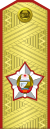 |  | 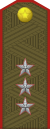 |  |  |  | 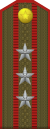 | 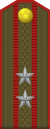 |  |  | 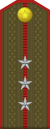 |  |  | Unknown | |||||||||||||||||||||
Marshal of the KPA (인민군원수) | Vice marshal (차수) | General of the Army (대장) | Colonel general (상장) | Lieutenant general (중장) | Major general (소장) | Senior colonel (Brigadier) (대좌) | Colonel (상좌) | Lieutenant colonel (중좌) | Major (소좌) | Captain (대위) | Senior lieutenant (상위) | Lieutenant (중위) | Junior lieutenant (소위) | |||||||||||||||||||||||
Marshals
| Supreme commanders | Marshals | |||
|---|---|---|---|---|
 |  |  |  | |
| Ranks in Korean | Tae wonsu 대원수 | Konghwaguk Wonsu 공화국원수 | Wonsu 원수 | Ch'asu 차수 |
| Ranks | Generalissimo | Marshal of the DPRK | Marshal of the KPA | Vice marshal |
Uniform
KPA officers and soldiers are most often seen wearing a mix of olive green or tan uniforms. The basic dress uniform consists of a tunic and pants (white tunics for general officers in special occasions); female soldiers wear knee length skirts but can sometimes wear pants.
Caps or peaked caps, especially for officers (and sometimes berets for women) are worn in spring and summer months and a Russian style fur hat (the Ushanka hats) in winter. A variant of the Disruptive Pattern Material, the Disruptive Pattern Combat Uniform (green), the ERDL pattern, the M81 Woodland and the Tigerstripe is also being worn by a few and rare images of North Korean army officers and service personnel. In Non-Dress uniforms, a steel helmet (Soviet SSh-68 combat helmet) seems to be the most common headgear, and is sometimes worn with a camouflage covering.
Standard military boots are worn for combat, women wear low heel shoes or heel boots for formal parades.
Camouflage uniforms are slowly becoming more common in the KPA. During the April 15, 2012 parade, Kevlar helmets were displayed in certain KPA units and similar helmets are currently used by KPA special operations forces.
See also

- Republic of Korea Army
- Korean People's Army
- Korean People's Navy
- Korean People's Army Air and Anti-Air Force
- Korean People's Army Special Operation Force
- Korean People's Army Strategic Force
- Worker-Peasant Red Guards
References
^ "North Korean military takes oath of loyalty". www.enca.com..mw-parser-output cite.citation{font-style:inherit}.mw-parser-output .citation q{quotes:"""""""'""'"}.mw-parser-output .citation .cs1-lock-free a{background:url("//upload.wikimedia.org/wikipedia/commons/thumb/6/65/Lock-green.svg/9px-Lock-green.svg.png")no-repeat;background-position:right .1em center}.mw-parser-output .citation .cs1-lock-limited a,.mw-parser-output .citation .cs1-lock-registration a{background:url("//upload.wikimedia.org/wikipedia/commons/thumb/d/d6/Lock-gray-alt-2.svg/9px-Lock-gray-alt-2.svg.png")no-repeat;background-position:right .1em center}.mw-parser-output .citation .cs1-lock-subscription a{background:url("//upload.wikimedia.org/wikipedia/commons/thumb/a/aa/Lock-red-alt-2.svg/9px-Lock-red-alt-2.svg.png")no-repeat;background-position:right .1em center}.mw-parser-output .cs1-subscription,.mw-parser-output .cs1-registration{color:#555}.mw-parser-output .cs1-subscription span,.mw-parser-output .cs1-registration span{border-bottom:1px dotted;cursor:help}.mw-parser-output .cs1-ws-icon a{background:url("//upload.wikimedia.org/wikipedia/commons/thumb/4/4c/Wikisource-logo.svg/12px-Wikisource-logo.svg.png")no-repeat;background-position:right .1em center}.mw-parser-output code.cs1-code{color:inherit;background:inherit;border:inherit;padding:inherit}.mw-parser-output .cs1-hidden-error{display:none;font-size:100%}.mw-parser-output .cs1-visible-error{font-size:100%}.mw-parser-output .cs1-maint{display:none;color:#33aa33;margin-left:0.3em}.mw-parser-output .cs1-subscription,.mw-parser-output .cs1-registration,.mw-parser-output .cs1-format{font-size:95%}.mw-parser-output .cs1-kern-left,.mw-parser-output .cs1-kern-wl-left{padding-left:0.2em}.mw-parser-output .cs1-kern-right,.mw-parser-output .cs1-kern-wl-right{padding-right:0.2em}
^ http://www.mnd.go.kr/user/mnd/upload/pblictn/PBLICTNEBOOK_201901160236460390.pdf
^ http://www.mnd.go.kr/user/mndEN/upload/pblictn/PBLICTNEBOOK_201705180357180050.pdf
^ http://www.mnd.go.kr/user/mnd/upload/pblictn/PBLICTNEBOOK_201901160236460390.pdf
^ "Korean People's Army". Archived from the original on 2008-04-15. Retrieved 2008-02-14.
^ Yossef., Bodansky, (1994). Crisis in, Korea. New York, N.Y.: S.P.I. Books. pp. 87–88. ISBN 9781561713325. OCLC 30641772.
^ Joseph F. Bermudez, Shield of the Great Leader, 2001, 59.
^ "Remembering the Coup d'etat in 1996". Daily NK. Retrieved 2017-01-12.
^ Hodge, Homer T., "North Korea's Military Strategy", Hodge: 2003.
^ "Military and Security Developments Involving the Democratic People's Republic of Korea" (PDF). Archived from the original (PDF) on 2014-03-07. Retrieved 2014-03-07.
^ John Pike. "Equipment Holdings – Korean People's Army". Globalsecurity.org. Retrieved 2017-01-12.
^ "About this Collection – Country Studies | Digital Collections | Library of Congress" (PDF). Lcweb2.loc.gov. Retrieved 2017-01-12.
^ "NORTH KOREA COUNTRY HANDBOOK" (PDF). Archived from the original (PDF) on 2016-03-04. Retrieved 2015-09-03.
^ "Military and Security Developments Involving the Democratic People's Republic of Korea" (PDF). Defense.gov. Retrieved 2017-01-12.
^ http://www.mnd.go.kr/user/mnd/upload/pblictn/PBLICTNEBOOK_201901160236460390.pdf
^ abcdefg "SIPRI arms transfer database". Stockholm International Peace Research Institute. 6 November 2013. Retrieved 1 May 2016.
^ "Vol. 2, No. 12 – December 2013". Kpajournal.com. Retrieved 2017-01-12.
^ James Warford: "The Ch'ŏnma-ho Main Battle Tank: A Look at the Present and Future of North Korea's
^ http://cms.atimes.com/atimes/Korea/DG06Dg01.html
^ Christopher F Foss. Jane's Armour and Artillery 2005–2006.
^ North Korean Army Tanks, Vehicles and Artillery Since 1950. Military Factory. 9 May 2014. Retrieved 28 April 2015.
^ "North Korean M-2012 8x8 APC derived from BTR-80". www.massimotessitori.altervista.org. Retrieved 2017-01-14.
^ "North Korean M-2012 6x6 APC derived from BTR-80". www.massimotessitori.altervista.org. Retrieved 2017-01-14.
^ ARG. "M1992 Armored Personnel Carrier – Military-Today.com".
^ ab "M-2009 Chunma-D North Korean IFV". www.massimotessitori.altervista.org. Retrieved 2017-01-14.
^ IBtimes.com "Kim Jong-il's Funeral Held in N. Korea"
^ "S-23 (Nywka C-23) 180mm Towed Artillery System - Soviet Union".
^ "North Korea parades latest self-propelled howitzers, missile carriers - Jane's 360". www.janes.com.
^ "'Missing' missiles at North Korea parade are no surprise". IISS.
^ Analysis: New combat vehicles and tanks at military parade in North Korea by Army Recognition Archived 2017-04-18 at the Wayback Machine – Armyrecognition.com, 17 April 2017
^ "BMD-20 Multiple Launch Rocket Systems". Military-Today.com. Retrieved 2017-01-12.
^ The North Korean M1985 MLRS & M1991 MLRS – Tanknutdave.com
^ "M1985 Multiple Launch Rocket System". Military-Today.com. Retrieved 2017-01-12.
^ M-1991 240 mm Juche 100 MRLS Multiple Rocket launcher System Armyrecognition.com
^ North Korea deploys new 240 mm artillery rocket launcher systems along border with South Korea Armyrecognition.com, 30 June 2013
^ http://www.mnd.go.kr/user/mndEN/upload/pblictn/PBLICTNEBOOK_201705180357180050.pdf
^ The threat of North Korea’s new rocket artillery – NKnews.org, 13 March 2014
^ "Document says North now has guided 300mm launchers". Korea JoongAng Daily.
^ Mizokami, Kyle. "North Korea's Ultimate Weapon Isn't Nuclear Weapons (Think 'Big Guns')". The National Interest. Retrieved 29 September 2017.
^ CNN Wire Staff. "North Korea threatens 'a sea of fire' upon South Korea". CNN. Retrieved 29 September 2017.
^ Cavazos, Roger. "Mind the Gap Between Rhetoric and Reality". The Nautilus Institute for Security and Sustainability. Retrieved 29 September 2017.
^ ARG. "Ataka Anti-Tank Guided Missile - Military-Today.com". www.military-today.com.
^ 1977, Роман. "Корейская народная армия. Противотанковое вооружение".
^ "North Korea parades latest self-propelled howitzers, missile carriers - Jane's 360". www.janes.com.
^ "4rXw1AK.jpg". Imgur. Retrieved 21 November 2018.
^ https://www.files.ethz.ch/isn/160759/BICC_brief_47.pdf
^ "N. Korean special operation forces infiltration van showcased for 19th ESC senior leader development". DVIDS – Defense Video & Imagery Distribution System. 4 Aug 2014.
^ Forgotten Weapons (8 April 2015). "North Korean Type 70 Pistol at RIA" – via YouTube.
^ "A Weapon Displayed From North Korea Special Forces and their Submarine". MBC News. 25 September 1996.
^ "Equipment of North Korean Special Forces and Espionage". Yu Yong-won's Military World, Chosun Ilbo. 16 April 2013.
^ "시사저널 - 북한 5만 특공대, 저공 침투 대기중". sisapress.com. 19 September 1996. Archived from the original on 3 June 2018.
^ "North Korean Helical AK Magazines". www.armamentresearch.com. February 4, 2014.
^ F, Nathaniel (21 April 2017). "North Korean "OICW" Combined Assault Rifle and Automatic Grenade Launcher Revealed During Day of the Sun Parade – The Firearm Blog". The Firearm Blog. Archived from the original on 19 June 2017.
^ "North Korean Small Arms". Small Arms Defense Journal.
^ "North-korean-battle-tanks.jpg". The Inquisitr. Retrieved 21 November 2018.
^ Lister, Tim. "North Korea's military aging but sizeable". CNN. Archived from the original on 26 November 2010. Retrieved 24 December 2010.
^ US Department of Defense. "North Korea Country Handbook 1997, Appendix A: Equipment Recognition, PPSH 1943 SUBMACHINEGUN (TYPE-50 CHINA/MODEL-49 DPRK) p. A-79" (PDF).
- Robert A. Scalapino, Chong-Sik Lee, Communism in Korea: The society, University of California Press, 1972 – Political Science
External links
 | Wikimedia Commons has media related to Korean People's Army Ground Force. |
- Military and Security Developments Involving the Democratic People's Republic of Korea 2012
- Military and Security Developments Involving the Democratic People's Republic of Korea 2013
| Missiles of North Korea | |
|---|---|
| Short-range |
|
| Medium-range |
|
| Intermediate-range |
|
| ICBM |
|
| SLBM |
|
| Cruise missiles |
|
| Anti-ship missiles |
|
| Surface-to-air missiles |
|
| Air to air missiles |
|
| Anti-tank guided missiles |
|
| Air to ground missiles |
|
| Anti-ship ballistic missiles |
|
Artillery rockets and MRLs |
|
| Missile tests |
|


Comments
Post a Comment