 Mixing
Pigou–Dalton principle
The Pigou–Dalton principle (PDP) is a principle in welfare economics, particularly in cardinal welfarism.
Named after Arthur Cecil Pigou and Hugh Dalton, it is a condition on social welfare functions.
It says that, all other things being equal, a social welfare function should prefer allocations that are more equitable. In other words, a transfer of utility from the rich to the poor is desired, as long as it does not bring the rich to a poorer situation than the poor.
Formally,[1]:67–68 let u=(u1,u2,…,un){displaystyle u=(u_{1},u_{2},dots ,u_{n})}

- u1<u2{displaystyle u_{1}<u_{2}}

and at the second profile:
u1′+u2′=u1+u2{displaystyle u_{1}'+u_{2}'=u_{1}+u_{2}}and
u3′=u3,u4′=u4,…,un′=un{displaystyle u'_{3}=u_{3},u'_{4}=u_{4},dots ,u'_{n}=u_{n}}and
u1<u1′<u2{displaystyle u_{1}<u_{1}'<u_{2}}and u1<u2′<u2{displaystyle u_{1}<u_{2}'<u_{2}}
- (so u1<u1′<u2′<u2{displaystyle u_{1}<u_{1}'<u_{2}'<u_{2}}
or u1<u1′=u2′<u2{displaystyle u_{1}<u_{1}'=u_{2}'<u_{2}}
or u1<u2′<u1′<u2{displaystyle u_{1}<u_{2}'<u_{1}'<u_{2}}
)
- (so u1<u1′<u2′<u2{displaystyle u_{1}<u_{1}'<u_{2}'<u_{2}}
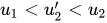
Then, the social-welfare ordering should weakly prefer the second profile u′{displaystyle u'}
PDP was suggested by Arthur Cecil Pigou[2]:24 and developed by Hugh Dalton[3]:351 (see, e.g., Amartya Sen, 1973 or Herve Moulin, 2004).
Examples
- The egalitarian function: W(u)=min(u1,u2){displaystyle W(u)=min(u_{1},u_{2})}
satisfies PDP in a strong sense: when utility is transferred from the rich to the poor, the value of W{displaystyle W}
strictly increases.
- The utilitarian function: W(u)=u1+u2{displaystyle W(u)=u_{1}+u_{2}}
satisfies PDP in a weak sense: when utility is transferred from the rich to the poor, the value of W{displaystyle W}
- The function W(u)=u12+u22{displaystyle W(u)=u_{1}^{2}+u_{2}^{2}}
violates PDP: when utility is transferred from the rich to the poor, the value of W{displaystyle W}
References
^ Herve Moulin (2004). Fair Division and Collective Welfare. Cambridge, Massachusetts: MIT Press. ISBN 9780262134231..mw-parser-output cite.citation{font-style:inherit}.mw-parser-output q{quotes:"""""""'""'"}.mw-parser-output code.cs1-code{color:inherit;background:inherit;border:inherit;padding:inherit}.mw-parser-output .cs1-lock-free a{background:url("//upload.wikimedia.org/wikipedia/commons/thumb/6/65/Lock-green.svg/9px-Lock-green.svg.png")no-repeat;background-position:right .1em center}.mw-parser-output .cs1-lock-limited a,.mw-parser-output .cs1-lock-registration a{background:url("//upload.wikimedia.org/wikipedia/commons/thumb/d/d6/Lock-gray-alt-2.svg/9px-Lock-gray-alt-2.svg.png")no-repeat;background-position:right .1em center}.mw-parser-output .cs1-lock-subscription a{background:url("//upload.wikimedia.org/wikipedia/commons/thumb/a/aa/Lock-red-alt-2.svg/9px-Lock-red-alt-2.svg.png")no-repeat;background-position:right .1em center}.mw-parser-output .cs1-subscription,.mw-parser-output .cs1-registration{color:#555}.mw-parser-output .cs1-subscription span,.mw-parser-output .cs1-registration span{border-bottom:1px dotted;cursor:help}.mw-parser-output .cs1-hidden-error{display:none;font-size:100%}.mw-parser-output .cs1-visible-error{font-size:100%}.mw-parser-output .cs1-subscription,.mw-parser-output .cs1-registration,.mw-parser-output .cs1-format{font-size:95%}.mw-parser-output .cs1-kern-left,.mw-parser-output .cs1-kern-wl-left{padding-left:0.2em}.mw-parser-output .cs1-kern-right,.mw-parser-output .cs1-kern-wl-right{padding-right:0.2em}
^ Pigou, 1912
^ Dalton, H. The measurement of the inequality of incomes, Economic Journal, 30 (1920), pp. 348–461.


Comments
Post a Comment