 Mixing
Mohács
Mohács | ||
|---|---|---|
Town | ||
 Aerial view | ||
| ||
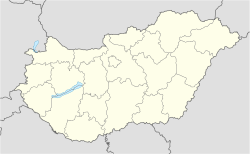  Mohács Location of Mohács | ||
| Coordinates: 45°59′45″N 18°40′47″E / 45.99593°N 18.67985°E / 45.99593; 18.67985Coordinates: 45°59′45″N 18°40′47″E / 45.99593°N 18.67985°E / 45.99593; 18.67985 | ||
| Country |  Hungary Hungary | |
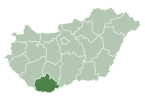
| County | Baranya | |
| District | Mohács | |
| Area | ||
| • Total | 112.23 km2 (43.33 sq mi) | |
| Population (2011) | ||
| • Total | 17,808 | |
| • Density | 158.67/km2 (411.0/sq mi) | |
| Time zone | UTC+1 (CET) | |
| • Summer (DST) | UTC+2 (CEST) | |
| Postal code | 7700 | |
| Area code | (+36) 69 | |
| Website | www.mohacs.hu | |
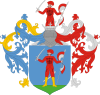
Mohács (Hungarian pronunciation: [ˈmohaːt͡ʃ]; Croatian and Bunjevac: Mohač; German: Mohatsch; Serbian: Мохач; Turkish: Mohaç) is a town in Baranya county, Hungary on the right bank of the Danube.
Contents
1 Etymology
2 History
3 Events
4 Demographics
5 Twin towns — sister cities
6 Notable citizens
7 Photos
8 References
9 External links
Etymology
The name probably comes from the Slavic *Mъchačь,*Mocháč: mъchъ (moss, Hungarian moha is a loanword from Slavic/) + the Slavic suffix -ačь, like Slovak Mochnáč or Czech Macháč.[1][2] See 1093/1190/1388 Mohach.[2]
History
Two famous battles took place there:
Battle of Mohács, 1526
Battle of Mohács, 1687
These battles represented the beginning and end, respectively, of the Ottoman domination of Hungary.
In Roman times there was a camp on the banks of the Danube near Mohács.
In the medieval Kingdom of Hungary, Mohács was part of the historical Baranya county, and during Ottoman rule it was the administrative seat of the Sanjak of Mohács, an Ottoman administrative unit. After the Habsburgs took the area from the Ottomans, Mohács was included in the restored Baranya county.
In 1910, the population of the Mohács district numbered 56,909 people, of whom 21,951 spoke German, 20,699 Hungarian, 4,312 Serbian, and 421 Croatian. Another 9,600 inhabitants were listed as speaking "other languages" (presumably Bunjevac and Šokac).[3]
Events
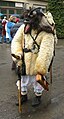
Every spring, the town hosts the annual Busójárás carnival.
Demographics
According to the 2011 census the total population of Mohács was 17,808, of whom there were 15,842 (84.2%) Hungarians, 1,723 (9.7%) Germans, 700 (3.9%) Croats and 537 (3%) Romani. 14% of the total population did not declare their ethnicity. In Hungary people can declare more than one ethnicity (dual identity), so the sum exceeds the total population.[4][5]
Twin towns — sister cities
Mohács is twinned with:
 Beli Manastir, Croatia (1967)
 Bensheim, Germany (1987)
 Câmpia Turzii, Romania (1990)
 Wattrelos, France (1993)
 Siemianowice Śląskie, Poland (1999)
 Beykoz, Turkey (2008)
Sveti Filip i Jakov, Croatia (2014)


Notable citizens
Ferenc Pfaff (1851-1913), Hungarian architect
Endre Rozsda (1913-1919), Hungarian-French Painter
Norbert Michelisz (1984), Hungarian racing driver
Dunai Tamás (1949), hungarian actor - https://hu.wikipedia.org/wiki/Dunai_Tam%C3%A1s
Photos
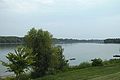
The Danube at Mohács

Town Hall

Church in the center of city

Memorial park

Memorial park

Annual carnival Busójárás

Buso masks
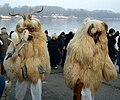
Carnival
Carnival

Multilingual (Hungarian, German and Croatian) city limit sign


References
 This article incorporates text from a publication now in the public domain: Chisholm, Hugh, ed. (1911). . Encyclopædia Britannica. 18 (11th ed.). Cambridge University Press. pp. 646–647..mw-parser-output cite.citation{font-style:inherit}.mw-parser-output .citation q{quotes:"""""""'""'"}.mw-parser-output .citation .cs1-lock-free a{background:url("//upload.wikimedia.org/wikipedia/commons/thumb/6/65/Lock-green.svg/9px-Lock-green.svg.png")no-repeat;background-position:right .1em center}.mw-parser-output .citation .cs1-lock-limited a,.mw-parser-output .citation .cs1-lock-registration a{background:url("//upload.wikimedia.org/wikipedia/commons/thumb/d/d6/Lock-gray-alt-2.svg/9px-Lock-gray-alt-2.svg.png")no-repeat;background-position:right .1em center}.mw-parser-output .citation .cs1-lock-subscription a{background:url("//upload.wikimedia.org/wikipedia/commons/thumb/a/aa/Lock-red-alt-2.svg/9px-Lock-red-alt-2.svg.png")no-repeat;background-position:right .1em center}.mw-parser-output .cs1-subscription,.mw-parser-output .cs1-registration{color:#555}.mw-parser-output .cs1-subscription span,.mw-parser-output .cs1-registration span{border-bottom:1px dotted;cursor:help}.mw-parser-output .cs1-ws-icon a{background:url("//upload.wikimedia.org/wikipedia/commons/thumb/4/4c/Wikisource-logo.svg/12px-Wikisource-logo.svg.png")no-repeat;background-position:right .1em center}.mw-parser-output code.cs1-code{color:inherit;background:inherit;border:inherit;padding:inherit}.mw-parser-output .cs1-hidden-error{display:none;font-size:100%}.mw-parser-output .cs1-visible-error{font-size:100%}.mw-parser-output .cs1-maint{display:none;color:#33aa33;margin-left:0.3em}.mw-parser-output .cs1-subscription,.mw-parser-output .cs1-registration,.mw-parser-output .cs1-format{font-size:95%}.mw-parser-output .cs1-kern-left,.mw-parser-output .cs1-kern-wl-left{padding-left:0.2em}.mw-parser-output .cs1-kern-right,.mw-parser-output .cs1-kern-wl-right{padding-right:0.2em}
 This article incorporates text from a publication now in the public domain: Chisholm, Hugh, ed. (1911).
^ Stanislav, Ján (2004). Slovenský juh v stredoveku II (in Slovak). Slovenské literárne centrum. p. 298. ISBN 80-88878-89-6.
^ ab Kiss, Lajos (1978). Földrajzi nevek etimológiai szótára (in Hungarian). Budapest: Akadémiai. p. 429.
^ http://www.talmamedia.com/php/district/district.php?county=Baranya
^ Hungarian census 2011, Baranya County
^ Hungarian census 2011 - final data and methodology
External links
 | Wikimedia Commons has media related to Mohács. |
Official website in Hungarian, English and German
Towns and villages of Mohács District | ||
|---|---|---|
| Town (1) |
|  |
| Villages (25) |
| |
Baranya County | ||
|---|---|---|
| City with county rights |
|   |
| Towns |
| |
| Large villages |
| |
| Villages |
| |
| Other topics |
| |


Comments
Post a Comment