 Mixing
Ladies' Gaelic football
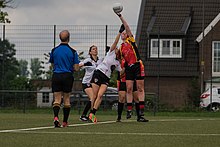 Ladies' football game beginning with a "throw-in" by the referee | |
| Highest governing body | Ladies' Gaelic Football Association (LGFA) |
|---|---|
| Nicknames | Ladies' Football Ladies' Gaelic |
| First played | 1926 |
| Clubs | More than 1,000 |
| Characteristics | |
| Contact | No |
| Team members | 15 on each team |
| Mixed gender | Single |
| Type | Outdoor |
| Equipment | Gaelic football |
| Presence | |
| Olympic | No |
| Paralympic | No |
Ladies' Gaelic football (Irish: Peil Ghaelach na mBan) is a team sport for women, very similar to Gaelic football, and co-ordinated by the Ladies' Gaelic Football Association. The sport originated in Ireland and is most popular there, although it is played in other countries, often by members of the Irish diaspora.
Contents
1 Play
1.1 Differences from men's football
2 Ladies' Gaelic football outside Ireland
2.1 North America
2.1.1 Canada
2.1.2 United States
2.2 Australasia
2.3 Asia
2.4 Africa
3 References
4 External links
Play
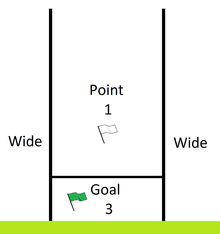
Goalposts and scoring system used in ladies' football
There are two teams of 15 players kick or hand-pass a round ball towards goals at either end of a grass pitch. There are two main competitions in this sport; the National League which is staged during the winter-spring months and is used as a warm-up to the All-Ireland Championship which is played during the summer. The All-Ireland Final is played on the last Sunday in September or the first Sunday in October in Croke Park, Dublin, where the winners receive the Brendan Martin Cup. The National League and Championship are organised by the Ladies' Gaelic Football Association.
Differences from men's football
Most of the rules of ladies' gaelic football are the same as those for men's game. The main differences are -
- A player may pick the ball up directly from the ground, so long as she is standing
- Most matches last 60 minutes; in men's senior inter-county football, games last 70 minutes
- Kickouts may be taken from the hand
- Changing hands: Throwing the ball from your right hand to left or vice versa.
- A countdown clock with siren is used if available; in the men's game, the referee decides the end of the game
- All deliberate bodily contact is forbidden except when "shadowing" an opponent, competing to catch the ball, or blocking the delivery of the ball
- A smaller size 4 gaelic ball is used compared to the size 5 ball used in the men's game.
Ladies' Gaelic football outside Ireland
North America
Canada
- Toronto Division
- Brampton Roger Casements
The Casements are a young women's team working on the development of the game in the Toronto region
- Western Canada Division
- Calgary Chieftains
The Chieftainettes have competed in the west and are currently supporting the development of Celtic games.
- Vancouver Harps
In 2007 they became the first team other than the Edmonton ladies to win the Championship.
United States
Midwest Division
Pittsburgh Banshees [1]
- Southwest Division
- Austin Celtic Cowboys
- Dallas Fionn MacCumhaills
- Denver Gaels
- Houston Gaels
- San Diego Na Fianna
- Northwest Division
- Seattle Gaels
Winners of the 2007 Junior B North American Gaelic Football Championship
- New York
- Manhattan Gaels
New York's newest GAA club
Australasia
- Australia
- New Zealand
Asia
- China
- Hong Kong
- Japan
- Thailand
- South Korea
- Singapore
- UAE (Dubai and Abu Dhabi)
Africa
- South Africa
References
External links
- Cumann Peil na mBan homepage
- TG4 Reality TV Show looking for contestants who play Ladies GAA
- Ladies Gaelic Football News Fixtures and Results from Sports.ie
- WFN International Rules Ladies Ireland to play Australia in 2006
- Ladies Football GAA Allstars


Comments
Post a Comment