 Mixing
Northern Mindanao
Northern Mindanao Region X | |
|---|---|
Region | |
     From top, left to right: White Island in Camiguin, Skyline of Cagayan de Oro, Maria Cristina Falls in Iligan, Port of Ozamiz in Misamis Occidental, and Kitanglad Mountain Range in Bukidnon. | |
 Location in the Philippines | |
| Coordinates: 8°45′N 124°55′E / 8.75°N 124.92°E / 8.75; 124.92Coordinates: 8°45′N 124°55′E / 8.75°N 124.92°E / 8.75; 124.92 | |
| Country | Philippines |
| Island group | Mindanao |
| Regional center | Cagayan de Oro |
| Area | |
| • Total | 20,496.02 km2 (7,913.56 sq mi) |
| Population (2015 census)[1] | |
| • Total | 4,689,302 |
| • Density | 230/km2 (590/sq mi) |
| Time zone | UTC+8 (PST) |
| ISO 3166 code | PH-10 |
| Provinces | 5
|
| Cities | 9
|
| Municipalities | 84 |
| Barangays | 2,022 |
| Cong. districts | 14 |
| Languages |
|
| Website | www.northernmindanao.com |
Northern Mindanao (Cebuano: Amihanang Mindanao; Filipino: Hilagang Mindanao) is an administrative region in the Philippines, designated as Region X. It comprises five provinces: Camiguin, Misamis Oriental, Lanao del Norte, Bukidnon and Misamis Occidental and two cities classified as highly urbanized, all occupying the north-central part of Mindanao island, and the island-province of Camiguin. The regional center is Cagayan de Oro. Lanao del Norte was transferred to Northern Mindanao from Region XII (then called Central Mindanao) by virtue of Executive Order No. 36 in September 2001.[2]
Contents
1 Etymology
2 Geography
2.1 Climate
3 Demographics
4 Economy
5 Administrative divisions
5.1 Component cities
5.1.1 Bukidnon
5.1.2 Misamis Occidental
5.1.3 Misamis Oriental
5.1.4 Lanao Del Norte
6 See also
7 References
8 External links
Etymology
The current name of the region was derived from its position on Mindanao island. The term was officially coined by the Americans after the establishment of American colonial rule in the Philippines due to the defeat of Filipino revolutionaries. There have been proposals to rename the current Northern Mindanao region, which is dominated by the Cebuano ethnic group, into the Amihanan region. Amihanan literally translates to 'northern area' from the Cebuano language, which is the lingua franca of the region. Another proposed name is Calaminon, which is a combination of the names of the region's provinces.[3][4]
Geography
Northern Mindanao has a total land area of 2,049,602 hectares (5,064,680 acres).[5] More than 60% of Northern Mindanao's total land area are classified as forest land. Its seas abound with fish and other marine products.
Climate
Rainfall in Northern Mindanao is evenly distributed throughout the year. Its abundant vegetation, natural springs and high elevation contribute to the region's cool, mild and invigorating climate.
Demographics
| Population census of Northern Mindanao | ||
|---|---|---|
| Year | Pop. | ±% p.a. |
| 1990 | 2,811,646 | — |
| 2000 | 3,505,708 | +2.23% |
| 2010 | 4,297,323 | +2.06% |
| 2015 | 4,689,302 | +1.68% |
| Source: Philippine Statistics Authority[1][6] | ||
Northern Mindanao is the 8th most populous region in the Philippines and 2nd in Mindanao (after Davao Region) according to the 2015 Philippine Statistics Authority Census. The major urban area of Region X is Metro Cagayan de Oro which includes Cagayan de Oro and some municipalities and cities of Misamis Oriental and Bukidnon.
The vast majority of the region's inhabitants descended from migrants from Cebu and Bohol. Some other inhabitants are of Waray, Hiligaynon, Zamboangueño, Maranao and Tausug descent, while the autochthonous Bukidnons and Manobos populate the inner highlands.
The predominate Religion is Roman Catholicism that forms 72% of the population while Protestants form a significant minority forming 14% of the population. The largest Non Christian religion is Islam forming 8% of the Population[7]
Economy
The economy of Northern Mindanao is the largest regional economy in the island of Mindanao.[8] The economy in Northern Mindanao is mainly agricultural. But there is also a booming growth of industries particularly in Cagayan de Oro and in Iligan. The famous Del Monte Philippines located in the Province of Bukidnon and its processing plant is located in Cagayan de Oro, which shipped to the entire Philippines and Asia-Pacific region. The Agus-IV to VII Hydroelectric Plants in Iligan and Balo-i, Lanao del Norte supplies most of its electrical power in Mindanao.
Administrative divisions

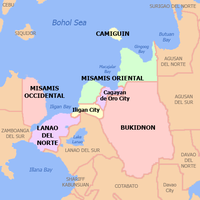
Map of Region X
The region is composed of five provinces: Bukidnon, the island province of Camiguin, Lanao del Norte, Misamis Occidental and Misamis Oriental. It has two highly urbanized cities, Cagayan de Oro and Iligan, that are administered independently from any province. The provinces are further subdivided into seven component cities and 84 municipalities, with a total of 2,022 barangays. The regional center is Cagayan de Oro.
| Province or HUC | Provincial Capital | Population (2015)[1] | Area[5][9] | Density | Cities | Muni. | Bgy. | |||||
|---|---|---|---|---|---|---|---|---|---|---|---|---|
| km2 | sq mi | /km2 | /sq mi | |||||||||
Bukidnon | Malaybalay | 30.2% | 1,415,226 | 10,498.59 | 4,053.53 | 130 | 340 | 2 | 20 | 464 | ||
Camiguin | Mambajao | 1.9% | 88,478 | 237.95 | 91.87 | 370 | 960 | 0 | 5 | 58 | ||
Lanao del Norte | Tubod | 14.4% | 676,395 | 3,346.57 | 1,292.12 | 200 | 520 | 0 | 22 | 462 | ||
Misamis Occidental | Oroquieta | 12.8% | 602,126 | 2,055.22 | 793.52 | 290 | 750 | 3 | 14 | 490 | ||
Misamis Oriental | Cagayan de Oro | 18.9% | 888,509 | 3,131.52 | 1,209.09 | 280 | 730 | 2 | 23 | 424 | ||
Cagayan de Oro | † | — | 14.4% | 675,950 | 412.80 | 159.38 | 1,600 | 4,100 | — | — | 80 | |
Iligan | † | — | 7.3% | 342,618 | 813.37 | 314.04 | 420 | 1,100 | — | — | 44 | |
| Total | 4,689,302 | 20,496.02 | 7,913.56 | 230 | 600 | 9 | 84 | 2,022 | ||||
† Cagayan de Oro and Iligan are highly-urbanized cities; figures are excluded from Misamis Oriental and Lanao del Norte respectively. | ||||||||||||
Component cities
Bukidnon
- Malaybalay
- Valencia
Misamis Occidental
- Oroquieta
- Ozamiz
- Tangub
Misamis Oriental
- El Salvador
- Gingoog
Lanao Del Norte
- Tubod
- Lala
- Kapatagan
See also
- Laguindingan Airport
References
^ abc
Census of Population (2015). Highlights of the Philippine Population 2015 Census of Population. PSA. Retrieved 20 June 2016..mw-parser-output cite.citation{font-style:inherit}.mw-parser-output .citation q{quotes:"""""""'""'"}.mw-parser-output .citation .cs1-lock-free a{background:url("//upload.wikimedia.org/wikipedia/commons/thumb/6/65/Lock-green.svg/9px-Lock-green.svg.png")no-repeat;background-position:right .1em center}.mw-parser-output .citation .cs1-lock-limited a,.mw-parser-output .citation .cs1-lock-registration a{background:url("//upload.wikimedia.org/wikipedia/commons/thumb/d/d6/Lock-gray-alt-2.svg/9px-Lock-gray-alt-2.svg.png")no-repeat;background-position:right .1em center}.mw-parser-output .citation .cs1-lock-subscription a{background:url("//upload.wikimedia.org/wikipedia/commons/thumb/a/aa/Lock-red-alt-2.svg/9px-Lock-red-alt-2.svg.png")no-repeat;background-position:right .1em center}.mw-parser-output .cs1-subscription,.mw-parser-output .cs1-registration{color:#555}.mw-parser-output .cs1-subscription span,.mw-parser-output .cs1-registration span{border-bottom:1px dotted;cursor:help}.mw-parser-output .cs1-ws-icon a{background:url("//upload.wikimedia.org/wikipedia/commons/thumb/4/4c/Wikisource-logo.svg/12px-Wikisource-logo.svg.png")no-repeat;background-position:right .1em center}.mw-parser-output code.cs1-code{color:inherit;background:inherit;border:inherit;padding:inherit}.mw-parser-output .cs1-hidden-error{display:none;font-size:100%}.mw-parser-output .cs1-visible-error{font-size:100%}.mw-parser-output .cs1-maint{display:none;color:#33aa33;margin-left:0.3em}.mw-parser-output .cs1-subscription,.mw-parser-output .cs1-registration,.mw-parser-output .cs1-format{font-size:95%}.mw-parser-output .cs1-kern-left,.mw-parser-output .cs1-kern-wl-left{padding-left:0.2em}.mw-parser-output .cs1-kern-right,.mw-parser-output .cs1-kern-wl-right{padding-right:0.2em}
^ "Executive Order No. 36; Providing for the Reorganization of the Administrative Regions in Mindanao and for Other Purposes". Official Gazette of the Republic of the Philippines. Malacañang, Manila, Philippines. 19 September 2001. Retrieved 29 March 2016.SECTION 2. Region X, known as Northern Mindanao, is hereby reorganized and shall be composed of the following provinces and cities: a. Provinces i. Bukidnon ii. Camiguin iii. Lanao del Norte iv. Misamis Occidental v. Misamis Oriental b. Cities i. Cagayan de Oro City ii. Gingoog City iii. Iligan City iv. Malaybalay City v. Oroquieta City vi. Ozamis City vii. Tangub City viii. Valencia City,Bukidnon
^ http://opinion.inquirer.net/95645/change-name-will-good-philippines
^ http://news.abs-cbn.com/news/06/13/17/should-the-philippines-be-renamed-historian-weighs-in
^ ab "List of Provinces". PSGC Interactive. Makati City, Philippines: National Statistical Coordination Board. Retrieved 9 June 2014.
^ "Population and Annual Growth Rates for The Philippines and Its Regions, Provinces, and Highly Urbanized Cities" (PDF). 2010 Census and Housing Population. Philippine Statistics Authority. Archived from the original (PDF) on 28 September 2013. Retrieved 12 August 2013.
^ http://psa.gov.ph/sites/default/files/attachments/hsd/specialrelease/_REGION%20X_Statistical%20Tables.xls
^ Pelone, Ruel V. (7 February 2010). "Region 10: Mindanao's dominant regional economy". Cagayan de Oro: Business Week Mindanao. Retrieved 4 February 2010.
^ "List of Cities". PSGC Interactive. Makati City, Philippines: National Statistical Coordination Board. Retrieved 9 June 2014.
External links
 | Wikimedia Commons has media related to Northern Mindanao. |
Philippine Standard Geographic Code listing for Northern Mindanao—National Statistical Coordination Board
 Northern Mindanao (Region X) Northern Mindanao (Region X) | ||
|---|---|---|
| Regional Center |
|  |
| Provinces |
| |
| Highly Urbanized Cities |
| |
| Component Cities |
| |
| Provincial Capitals |
| |
| Municipalities |
| |
Mindanao, Republic of the Philippines | ||
 Administrative divisions of the Philippines Administrative divisions of the Philippines | |||||
|---|---|---|---|---|---|
| Capital |
|   | |||
| Island groups |
| ||||
| Regions |
| ||||
| Provinces |
| ||||
| Cities |
| ||||
| Municipalities |
| ||||
| Barangays |
| ||||
| Other subdivisions |
| ||||
| Proposed |
| ||||
| Historical |
| ||||


Comments
Post a Comment