 Mixing
Brunei Malay
| Brunei Malay | |
|---|---|
| Kedayan | |
| Bahasa Melayu Brunei | |
| Native to | Brunei, Malaysia |
| Ethnicity | Bruneian Malay, Kedayan |
Native speakers | (270,000 cited 1984–2013)[1] |
Language family | Austronesian
|
| Language codes | |
| ISO 639-3 | kxd |
| Glottolog | brun1242[2] |
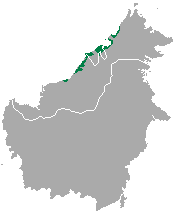 Area where Brunei Malay is spoken | |
Brunei Malay (Bahasa Melayu Brunei) is the most widely spoken language in Brunei and a lingua franca in some parts of East Malaysia, such as Labuan, Limbang, Lawas, Sipitang and Papar.[3][4] Though Standard Malay is promoted as the official language of Brunei, Brunei Malay is socially dominant and it is currently replacing the minority languages of Brunei,[5] including the Dusun and Tutong languages.[6] It is quite divergent from Standard Malay to the point where it is almost mutually unintelligible with it. Although the idea that Brunei Malay might be classified as a creole language has been discredited, it does bear considerable similarities to East Indonesian Malay-based creole languages.
Contents
1 Phonology
2 Dialects
3 Common Bruneian Malay words
4 Example sentences
5 Studies
6 References
7 Further reading
8 External links
Phonology
The consonants of Brunei Malay are shown in the following table.[4]
| Bilabial | Alveolar | Palatal | Velar | Glottal | ||||||
|---|---|---|---|---|---|---|---|---|---|---|
| Plosive | p | b | t | d | k | ɡ | | |||
| Affricate | tʃ | dʒ | | |||||||
| Fricative | s | h | | |||||||
| Nasal | m | n | ɲ | ŋ | | |||||
| Trill/Tap | r | | ||||||||
| Approximant | w | j | | |||||||
| Lateral Approximant | l | | ||||||||
Some analysts exclude /w/ and /j/ from this table on the basis that they are 'margin high vowels',[7] while others include /w/ but exclude /j/.[3]
All these consonants can occur in initial position except /h/. While /h/ can occur in final position, its absence from initial position means that Standard Malay hutan ('forest') is utan in Brunei Malay, and Standard Malay hitam ('black') is itam.[4]
All the consonants can occur in word-final position apart from the palatal sounds /tʃ dʒ ɲ/ and the voiced plosives /b d ɡ/ (except in a few borrowed words such as mac ('March') and kabab ('kebab')).[3]

Acoustic analysis of the three vowels of Brunei Malay
Brunei Malay has a three-vowel system: /i/, /a/, /u/.[3][8] Acoustic variation in the realisation of these vowels is shown in the plot on the right, based on the reading of a short text by a single female speaker.[4]
While /i/ is distinct from the other two vowels, there is substantial overlap between /a/ and /u/. This is partly because of the vowel in the first syllable of words such as maniup ('to blow') which can be realised as [ə]. Indeed, the Brunei Malay dictionary uses an 'e' for the prefix in this word, listing it as meniup,[9] though other analyses prefer to show prefixes such as this with 'a', on the basis that Brunei Malay just has three vowels.[10][7][3]
Dialects
Brunei Malay, Kedayan and Kampong Ayer can be regarded as different dialects of Malay. Brunei Malay is used by the numerically and politically dominant Brunei people, who traditionally lived on water, while Kedayan is used by the land-dwelling farmers, and the Kampong Ayer dialect is used by the inhabitants of the river north of the capital.[11][12] It has been estimated that 94% of the words of Brunei Malay and Kedayan are lexically related.[13]
Common Bruneian Malay words
| Bruneian Malay | Meaning/Note |
|---|---|
| Aku | First person singular |
| Saya | |
| Peramba | First person singular when in conversation with a Royal Family Member |
| Awak | Second person singular |
| Kau | |
| Ko | |
| Awda | From '(si) awang' and '(si) dayang'. It is used like the Malaysian word 'anda'. |
| Kamu | Second person plural |
| Ia | Third person singular |
| Kitani | First person plural (inclusive) |
| Kita | To be used either like 'kitani' or 'biskita' |
| Si awang | Male third person singular |
| Si dayang | Female third person singular |
| Biskita | To address a listener of older age. Also first person plural |
| Cinta | To address a loved one |
| Ani | This |
| Atu | That |
| (Di) mana? | Where (at)? |
| Ke mana? | Where to? |
| Lelaki | Male (human) |
| Laki-laki | |
| Perempuan | Female (human) |
| Bini-bini1 | |
| Budiman | A gentleman |
| Kebawah Duli | His Majesty |
| Awu | Yes |
| Ya | |
| Inda | No |
| To close (a door etc.) | |
| Makan | To eat |
| Suka | To like |
| Cali | Funny (adj.), derived from Charlie Chaplin |
| Siuk | cf. Malaysian ‘Syok’, Singaporean ‘Shiok’ |
| Lakas | To be quick, (in a) hurry(ing) (also an interjection) |
| Karang | At a later time, soon |
| Tarus | Straight ahead; immediately |
| Manada | Used as a term when in a state denial (as in 'No way!' or 'It can't be') |
| Baiktah | 'Might as well ... ' |
| Orang putih | Generally refers to a white Westerner. |
| Kaling | Refers to a Bruneian of Indian descent. (This is generally regarded as pejorative.)[14] |
1 "Bini-bini" is exclusively used in Brunei to refer to a lady. In Indonesia, Malaysia and Singapore, it is an informal way to refer to one's wives or a group of married women.
Example sentences
- "Ia atu bini-bini." = She is a lady.
- "Sudah kau makan?" = Have you eaten?
- "Awda mendapat cabutan bertuah." = You have received a lucky draw.
- "Rumah saya di sana." = My house is there
Studies
The vocabulary of Brunei Malay has been collected and published by several western explorers in Borneo including Pigafetta in 1521, De Crespigny in 1872, Charles Hose in 1893, A. S. Haynes in 1900, Sidney H. Ray in 1913, H. B. Marshall in 1921, and G. T. MacBryan in 1922, and some Brunei Malay words are included in "A Malay-English Dictionary" by R. J. Wilkinson.[15][16][17]
References
^ Brunei Malay at Ethnologue (18th ed., 2015)
^ Hammarström, Harald; Forkel, Robert; Haspelmath, Martin, eds. (2017). "Brunei". Glottolog 3.0. Jena, Germany: Max Planck Institute for the Science of Human History..mw-parser-output cite.citation{font-style:inherit}.mw-parser-output q{quotes:"""""""'""'"}.mw-parser-output code.cs1-code{color:inherit;background:inherit;border:inherit;padding:inherit}.mw-parser-output .cs1-lock-free a{background:url("//upload.wikimedia.org/wikipedia/commons/thumb/6/65/Lock-green.svg/9px-Lock-green.svg.png")no-repeat;background-position:right .1em center}.mw-parser-output .cs1-lock-limited a,.mw-parser-output .cs1-lock-registration a{background:url("//upload.wikimedia.org/wikipedia/commons/thumb/d/d6/Lock-gray-alt-2.svg/9px-Lock-gray-alt-2.svg.png")no-repeat;background-position:right .1em center}.mw-parser-output .cs1-lock-subscription a{background:url("//upload.wikimedia.org/wikipedia/commons/thumb/a/aa/Lock-red-alt-2.svg/9px-Lock-red-alt-2.svg.png")no-repeat;background-position:right .1em center}.mw-parser-output .cs1-subscription,.mw-parser-output .cs1-registration{color:#555}.mw-parser-output .cs1-subscription span,.mw-parser-output .cs1-registration span{border-bottom:1px dotted;cursor:help}.mw-parser-output .cs1-hidden-error{display:none;font-size:100%}.mw-parser-output .cs1-visible-error{font-size:100%}.mw-parser-output .cs1-subscription,.mw-parser-output .cs1-registration,.mw-parser-output .cs1-format{font-size:95%}.mw-parser-output .cs1-kern-left,.mw-parser-output .cs1-kern-wl-left{padding-left:0.2em}.mw-parser-output .cs1-kern-right,.mw-parser-output .cs1-kern-wl-right{padding-right:0.2em}
^ abcde Clynes, A. (2014). Brunei Malay: An Overview. In P. Sercombe, M. Boutin, & A. Clynes (Eds.), Advances in Research on Linguistic and Cultural Practices in Borneo (pp. 153–200). Phillips, ME: Borneo Research Council.
^ abcd Deterding, D., & Ishamina, A. (2017). Brunei Malay. Journal of the International Phonetic Association, 47(1), 99-108. On-line Version
^ McLellan, J., Noor Azam Haji-Othman, & Deterding, D. (2016). The language situation in Brunei Darussalam. In Noor Azam Haji-Othman, J. McLellan, & D. Deterding (Eds.), The use and status of language in Brunei Darussalam: A kingdom of unexpected linguistic diversity (pp. 9–16). Singapore: Springer.
^ Noor Azam Haji-Othman & Siti Ajeerah Najib (2016). The state of indigenous languages in Brunei. In Noor Azam Haji-Othman, J. McLellan, & D. Deterding (Eds.), The use and status of language in Brunei Darussalam: A kingdom of unexpected linguistic diversity (pp. 17–28). Singapore: Springer.
^ ab Mataim Bakar. (2007). The phonotactics of Brunei Malay: An Optimality Theoretic account. Bandar Seri Begawan: Dewan Bahasa dan Pustaka Brunei.
^ Poedjosoedarmo, G. (1996). Variation and change in the sound systems of Brunei dialects of Malay. In P. Martin, C. Ozog, & Gloria Poedjosoedarmo (Eds.), Language use and language change in Brunei Darussalam (pp. 37–42). Athens, OH: Ohio University Center for International Studies.
^ Dewan Bahasa dan Pustaka Brunei. (2007). Kamus Bahasa Melayu Brunei (Edisi Kedua) [Brunei Malay dictionary, 2nd edition]. Bandar Seri Begawan: Dewan Bahasa dan Pustaka Brunei.
^ Jaludin Chuchu. (2000). Morphology of Brunei Malay. Bangi: Universiti Kebangsaan Malaysia.
^ Gallop, 2006. "Brunei Darussalam: Language Situation". In Keith Brown, ed. (2005). Encyclopedia of Language and Linguistics (2 ed.). Elsevier. ISBN 0-08-044299-4.
^ Wurm, Mühlhäusler, & Tryon, Atlas of languages of intercultural communication in the Pacific, Asia and the Americas, 1996:677
^ Nothofer, B. (1991). The languages of Brunei Darussalam. In H. Steinhauer (Ed.), Papers in Austronesian Linguistics (pp. 151–172). Canberra: Australian National University.
^ Najib Noorashid (2016). The ‘K’ word referring to Indians in Brunei. Paper presented at the Brunei-Malaysia 2016 Forum, Universiti Brunei Darussalam, 16–17 November 2016.
^ Martin, P. W. (1994). Lexicography in Brunei Darussalam: An overview. In B. Sibayan & L. E. Newell (Eds.), Papers from the First Asia International Lexicography Conference, Manila, Philippines, 1992. LSP Special Monograph Issue, 35 (pp. 59–68). Manila: Linguistic Society of the Philippines. [1]
^ Uhlenbeck 1958, p. 8.
^ Sidhu 2009, p. 283.
Further reading
De Crespigny, C. 1872. On Northern Borneo. Proceedings of the Royal Geographical Society XVI. 171-187. [2] [3] [4] [5] [6] [7] [8]
"Brunei Low Dialect" [9] [10]
Haynes, A. S. “A List of Brunei-Malay words.” JSBRAS 34 ( July 1900): 39—48. [11]
- Hose, Charles. No. 3. "A Journey up the Baram River to Mount Dulit and the Highlands of Borneo". The Geographical Journal. No. 3. VOL. I. (March, 1893)
MacBryan, G.T. 1922. Additions to a vocabulary of Brunei-Malay. JSBRAS. 86:376-377. [12]
- Marshall, H.B. and Moulton, J.C. 1921, "A vocabulary of Brunei Malay", in Journal of the Straits Branch, Royal Asiatic Society. [13] [14] [15]
- Marshall, H.B. 1921. A vocabulary of Brunei Malay. JSBRAS. 83:45-74.
- Ray, Sidney H. 1913. The Languages of Borneo. The Sarawak Museum Journal. 1,4:1-196.
- Roth, Henry Ling. 1896. The Natives of Sarawak and British North Borneo. 2 vols. London: Truslove and Hanson. Rep. 1980. Malaysia: University of Malaya Press. [16] VOL I. [17] VOL II. VOL II. [18] [19][permanent dead link]
http://www.jstor.org/stable/41561363?
A Vocabulary of Brunei Malay
H. B. Marshall
Journal of the Straits Branch of the Royal Asiatic Society
No. 83 (APRIL, 1921), pp. 45–74
Published by: Malaysian Branch of the Royal Asiatic Society
Stable URL: https://www.jstor.org/stable/41561363
Page Count: 30
External links
- Brunei Malay
- The Pronunciation of Brunei Malay
- Lexicography in Brunei Darussalam: An Overview
- Majority and minority language planning in Brunei Darussalam
- Dominant Language Transfer in Minority Language Documentation Projects: Some Examples from Brunei
 Languages of Brunei Languages of Brunei | |
|---|---|
| Official language |
|
| Minority languages |
|
 Languages of Malaysia Languages of Malaysia | |||||||
|---|---|---|---|---|---|---|---|
| Main |
| ||||||
| Significant minority |
| ||||||
| Families |
| ||||||
| Creoles |
| ||||||
Natives & Indigenous |
| ||||||
| Mixed & Others |
| ||||||
| Immigrants |
| ||||||
| Signs |
| ||||||
1 Extinct languages. 2 Nearly extinct languages. | |||||||


Comments
Post a Comment