 Mixing
Fataluku language
| Fataluku | |
|---|---|
| Region | Eastern East Timor |
Native speakers | 37,000 (2010 census)[1] regional usage |
Language family | Trans–New Guinea ?
|
| Language codes | |
| ISO 639-3 | ddg |
| Glottolog | fata1247[2] |
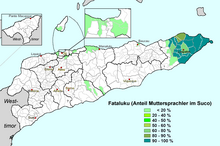 Distribution of Fataluku in East Timor | |
Fataluku (also known as Dagaga, Dagoda', Dagada) is a Papuan language spoken by approximately 37,000 people of Fataluku ethnicity in the eastern areas of East Timor, especially around Lospalos. It is a member of the Timor-Alor-Pantar language family, which includes languages spoken both in East Timor and nearby regions of Indonesia.[3] Fataluku's closest relative is Oirata, spoken on Kisar island, in the Moluccas of Indonesia.[3] Fataluku is given the status of a national language under the constitution.
Contents
1 Phonology
1.1 Vowels
1.2 Consonants
2 Words and phrases
3 See also
4 References
5 External links
Phonology
Vowels
| Front | Central | Back | |
|---|---|---|---|
| Close | i /i/ | u /u/ | |
| Mid | e /e/ | o /o/ | |
| Open | a /a/ |
Consonants
Bilabial | Labiodental | Coronal | Palatal | Velar | Glottal | ||
|---|---|---|---|---|---|---|---|
Nasals | m /m/ | n /n/ | |||||
Plosive | p /p/ | t /t/ | k /k/ | ' /ʔ/ | |||
Affricates | voiceless | c /t͡ʃ/¹ | |||||
voiced | j /d͡ʒ/ | ||||||
Fricatives | voiceless | f /f/ | s /s/ | h /h/ | |||
voiced | v /β/² | v /v/² | z /z/ | ||||
Flap | v /ⱱ/² | r /ɾ/ | |||||
Lateral | l /l/ | ||||||
Semivowel | v /w/² | ||||||
- ¹ Spelled <tj> in Nácher orthography.
- ² Pronunciation of <v> varies in dialects.
Words and phrases
The letter 'c' and the letter combination 'tx' are pronounced as 'ch'.
Rau ana kapare? / e nicha rau rau / maice ana umpe? "how are you?"

Rau "good"

Kapare "not good"

Hó "yes"

Xaparau "thank you"

Tali even xaparau "thank you very much"

nitawane "you're welcome"

Favoruni "please"

itu nae tini "excuse me"

Ó lai'i "hello"

mua toto, ia toto,purupale " take care"

Kois ta niat ali fanuhene "see you later"


Pronoun						                Possessive pronoun

I   :		Aniri/Ana					My: Ahani

You :		Eri (singular), Iri (plural)			Your:  Eheni(sing), Eheniere (plur)

We  :		Iniri (excl), Afiri (inclusive) 		Our: Inihini (exc), Afihini: (incl)

They : 		Tawari, Márafuri				Their: Their Tavarhini, Marafurhini

He/She :	Tavai, marí, mármocoi				His/Her: Tavahini, Marmokoihini

It :		Iví						Its: Ivihini, Tavahini
See also
- Rusenu language
- Languages of East Timor
References
^ Fataluku at Ethnologue (18th ed., 2015)
^ Hammarström, Harald; Forkel, Robert; Haspelmath, Martin, eds. (2017). "Fataluku". Glottolog 3.0. Jena, Germany: Max Planck Institute for the Science of Human History..mw-parser-output cite.citation{font-style:inherit}.mw-parser-output .citation q{quotes:"""""""'""'"}.mw-parser-output .citation .cs1-lock-free a{background:url("//upload.wikimedia.org/wikipedia/commons/thumb/6/65/Lock-green.svg/9px-Lock-green.svg.png")no-repeat;background-position:right .1em center}.mw-parser-output .citation .cs1-lock-limited a,.mw-parser-output .citation .cs1-lock-registration a{background:url("//upload.wikimedia.org/wikipedia/commons/thumb/d/d6/Lock-gray-alt-2.svg/9px-Lock-gray-alt-2.svg.png")no-repeat;background-position:right .1em center}.mw-parser-output .citation .cs1-lock-subscription a{background:url("//upload.wikimedia.org/wikipedia/commons/thumb/a/aa/Lock-red-alt-2.svg/9px-Lock-red-alt-2.svg.png")no-repeat;background-position:right .1em center}.mw-parser-output .cs1-subscription,.mw-parser-output .cs1-registration{color:#555}.mw-parser-output .cs1-subscription span,.mw-parser-output .cs1-registration span{border-bottom:1px dotted;cursor:help}.mw-parser-output .cs1-ws-icon a{background:url("//upload.wikimedia.org/wikipedia/commons/thumb/4/4c/Wikisource-logo.svg/12px-Wikisource-logo.svg.png")no-repeat;background-position:right .1em center}.mw-parser-output code.cs1-code{color:inherit;background:inherit;border:inherit;padding:inherit}.mw-parser-output .cs1-hidden-error{display:none;font-size:100%}.mw-parser-output .cs1-visible-error{font-size:100%}.mw-parser-output .cs1-maint{display:none;color:#33aa33;margin-left:0.3em}.mw-parser-output .cs1-subscription,.mw-parser-output .cs1-registration,.mw-parser-output .cs1-format{font-size:95%}.mw-parser-output .cs1-kern-left,.mw-parser-output .cs1-kern-wl-left{padding-left:0.2em}.mw-parser-output .cs1-kern-right,.mw-parser-output .cs1-kern-wl-right{padding-right:0.2em}
^ ab Heston, Tyler M. (2015). The segmental and suprasegmental phonology of Fataluku. University of Hawai'i at Mānoa PhD Dissertation.
External links
 | Fataluku language test of Wikipedia at Wikimedia Incubator |
- Fataluku Language Project
- Fataluku language website
- Fataluku community and language with Fataluku/English and English/Fataluku wordlists
- Fataluku wordlist at the Austronesian Basic Vocabulary Database
- Materials on Fataluku are included in the open access Arthur Capell collection. (AC2) held by Paradisec.
Songs in Fataluku are included in the Ros Dunlop collection held by Paradisec.
 Languages of East Timor Languages of East Timor | |
|---|---|
| Official languages |
|
| National languages |
|
| Working languages |
|
 | This Indonesia-related article is a stub. You can help Wikipedia by expanding it. |
 | This East Timor-related article is a stub. You can help Wikipedia by expanding it. |
This Papuan languages-related article is a stub. You can help Wikipedia by expanding it. |


Comments
Post a Comment