• DNA synthesis involved in DNA repair • lagging strand elongation • regulation of transcription involved in G1/S transition of mitotic cell cycle • DNA replication • leading strand elongation • cell proliferation • viral process • double-strand break repair via nonhomologous end joining • DNA strand elongation involved in DNA replication • DNA replication, synthesis of RNA primer • telomere maintenance via semi-conservative replication • G1/S transition of mitotic cell cycle • DNA replication initiation • DNA repair • nucleotide-excision repair • DNA synthesis involved in UV-damage excision repair • mitotic DNA replication initiation • synthesis of RNA primer involved in mitotic DNA replication
Sources:Amigo / QuickGO
Orthologs
Species
Human
Mouse
Entrez
5422
18968
Ensembl
ENSG00000101868
ENSMUSG00000006678
UniProt
P09884
P33609
RefSeq (mRNA)
NM_016937 NM_001330360
NM_008892
RefSeq (protein)
NP_001317289 NP_058633
NP_032918
Location (UCSC)
Chr X: 24.69 – 25 Mb
Chr X: 93.3 – 93.63 Mb
PubMed search
[3]
[4]
Wikidata
View/Edit Human
View/Edit Mouse
DNA polymerase alpha catalytic subunit is an enzyme that in humans is encoded by the POLA1 gene.[5]
Contents
1Function
2Interactions
3See also
4References
5Further reading
Function
Pol α has limited processivity and lacks 3′ exonuclease activity for proofreading errors. Thus it is not well suited to efficiently and accurately copy long templates (unlike Pol Delta and Epsilon). Instead it plays a more limited role in replication. Pol α is responsible for the initiation of DNA replication at origins of replication (on both the leading and lagging strands) and during synthesis of Okazaki fragments on the lagging strand. The Pol α complex (pol α-DNA primase complex) consists of four subunits: the catalytic subunit POLA1, the regulatory subunit POLA2, and the small and the large primase subunits PRIM1 and PRIM2 respectively. Once primase has created the RNA primer, Pol α starts replication elongating the primer with ~20 nucleotides.
In addition to its role during DNA replication, POLA1 plays a role in type I interferon activation. The POLA1 gene was found to be the site of a mutation resulting in X-linked reticulate pigmentary disorder. This leads to altered mRNA splicing and decreased expression of POLA1 protein to a level that does not impair DNA replication. The reduction in POLA1 expression is accompanied by marked reduction in cytosolic RNA:DNA hybrid molecules and a concomitant hyperactivation of the IRF pathway, with consequent overproduction of type I interferons.[6]
Interactions
DNA dependent polymerase alpha (Pol α) has been shown to interact with Retinoblastoma protein,[7]PARP1[8] and RBMS1.[9]
See also
DNA Polymerase
DNA polymerase alpha subunit 2
References
^ abcGRCh38: Ensembl release 89: ENSG00000101868 - Ensembl, May 2017
^ abcGRCm38: Ensembl release 89: ENSMUSG00000006678 - Ensembl, May 2017
^Starokadomskyy P, Gemelli T, Rios JJ, Xing C, Wang RC, Li H, Pokatayev V, Dozmorov I, Khan S, Miyata N, Fraile G, Raj P, Xu Z, Xu Z, Ma L, Lin Z, Wang H, Yang Y, Ben-Amitai D, Orenstein N, Mussaffi H, Baselga E, Tadini G, Grunebaum E, Sarajlija A, Krzewski K, Wakeland EK, Yan N, de la Morena MT, Zinn AR, Burstein E (2016). "DNA polymerase-α regulates the activation of type I interferons through cytosolic RNA:DNA synthesis". Nature Immunology. 17 (5): 495–504. doi:10.1038/ni.3409. PMC 4836962. PMID 27019227.
^Takemura M, Kitagawa T, Izuta S, Wasa J, Takai A, Akiyama T, Yoshida S (November 1997). "Phosphorylated retinoblastoma protein stimulates DNA polymerase alpha". Oncogene. 15 (20): 2483–92. doi:10.1038/sj.onc.1201431. PMID 9395244.
^Dantzer F, Nasheuer HP, Vonesch JL, de Murcia G, Ménissier-de Murcia J (April 1998). "Functional association of poly(ADP-ribose) polymerase with DNA polymerase alpha-primase complex: a link between DNA strand break detection and DNA replication". Nucleic Acids Res. 26 (8): 1891–8. doi:10.1093/nar/26.8.1891. PMC 147507. PMID 9518481.
^Niki T, Galli I, Ariga H, Iguchi-Ariga SM (June 2000). "MSSP, a protein binding to an origin of replication in the c-myc gene, interacts with a catalytic subunit of DNA polymerase alpha and stimulates its polymerase activity". FEBS Lett. 475 (3): 209–12. doi:10.1016/S0014-5793(00)01679-3. PMID 10869558.
Simbulan CM, Suzuki M, Izuta S, Sakurai T, Savoysky E, Kojima K, Miyahara K, Shizuta Y, Yoshida S (Jan 1993). "Poly(ADP-ribose polymerase stimulates DNA polymerase alpha by physical association". J. Biol. Chem. 268 (1): 93–99. PMID 8416979.
Pollok S, Stoepel J, Bauerschmidt C, Kremmer E, Nasheuer HP (2003). "Regulation of eukaryotic DNA replication at the initiation step". Biochem. Soc. Trans. 31 (Pt 1): 266–9. doi:10.1042/BST0310266. PMID 12546699.
Fisher PA, Korn D (1977). "DNA polymerase-alpha. Purification and structural characterization of the near homogeneous enzyme from human KB cells". J. Biol. Chem. 252 (18): 6528–35. PMID 893425.
Dornreiter I, Erdile LF, Gilbert IU, von Winkler D, Kelly TJ, Fanning E (1992). "Interaction of DNA polymerase alpha-primase with cellular replication protein A and SV40 T antigen". EMBO J. 11 (2): 769–76. PMC 556510. PMID 1311258.
Coverley D, Kenny MK, Lane DP, Wood RD (1992). "A role for the human single-stranded DNA binding protein HSSB/RPA in an early stage of nucleotide excision repair". Nucleic Acids Res. 20 (15): 3873–80. doi:10.1093/nar/20.15.3873. PMC 334061. PMID 1508673.
Popanda O, Thielmann HW (1992). "The function of DNA polymerases in DNA repair synthesis of ultraviolet-irradiated human fibroblasts". Biochim. Biophys. Acta. 1129 (2): 155–60. doi:10.1016/0167-4781(92)90480-N. PMID 1730053.
Collins KL, Kelly TJ (1991). "Effects of T antigen and replication protein A on the initiation of DNA synthesis by DNA polymerase alpha-primase". Mol. Cell. Biol. 11 (4): 2108–15. PMC 359898. PMID 1848671.
Martelli AM, Cocco L, Manzoli FA (1991). "On the association of DNA polymerase alpha activity with the nuclear matrix in HeLa cells". Cell Biol. Int. Rep. 15 (2): 131–40. doi:10.1016/0309-1651(91)90104-Q. PMID 1903085.
Pearson BE, Nasheuer HP, Wang TS (1991). "Human DNA polymerase alpha gene: sequences controlling expression in cycling and serum-stimulated cells". Mol. Cell. Biol. 11 (4): 2081–95. PMC 359896. PMID 2005899.
Matsumoto T, Eki T, Hurwitz J (1991). "Studies on the initiation and elongation reactions in the simian virus 40 DNA replication system". Proc. Natl. Acad. Sci. U.S.A. 87 (24): 9712–6. doi:10.1073/pnas.87.24.9712. PMC 55243. PMID 2175912.
Hsi KL, Copeland WC, Wang TS (1991). "Human DNA polymerase alpha catalytic polypeptide binds ConA and RCA and contains a specific labile site in the N-terminus". Nucleic Acids Res. 18 (21): 6231–7. doi:10.1093/nar/18.21.6231. PMC 332486. PMID 2243771.
Wang TS, Pearson BE, Suomalainen HA, Mohandas T, Shapiro LJ, Schröder J, Korn D (1985). "Assignment of the gene for human DNA polymerase alpha to the X chromosome". Proc. Natl. Acad. Sci. U.S.A. 82 (16): 5270–4. doi:10.1073/pnas.82.16.5270. PMC 390549. PMID 2410918.
Knorre DG, Lavrik OI, Nevinsky GA (1988). "Protein-nucleic acid interaction in reactions catalyzed with DNA polymerases". Biochimie. 70 (5): 655–61. doi:10.1016/0300-9084(88)90250-7. PMID 3139084.
Nishida C, Reinhard P, Linn S (1988). "DNA repair synthesis in human fibroblasts requires DNA polymerase delta". J. Biol. Chem. 263 (1): 501–10. PMID 3335506.
Wong SW, Wahl AF, Yuan PM, Arai N, Pearson BE, Arai K, Korn D, Hunkapiller MW, Wang TS (1988). "Human DNA polymerase alpha gene expression is cell proliferation dependent and its primary structure is similar to both prokaryotic and eukaryotic replicative DNA polymerases". EMBO J. 7 (1): 37–47. PMC 454213. PMID 3359994.
Tsuda M, Masuyama M, Katsunuma T (1986). "Inhibition of human DNA polymerase alpha by alpha 1-antichymotrypsin". Cancer Res. 46 (12 Pt 1): 6139–42. PMID 3490907.
Jackson DA, Cook PR (1987). "Different populations of DNA polymerase alpha in HeLa cells". J. Mol. Biol. 192 (1): 77–86. doi:10.1016/0022-2836(86)90465-1. PMID 3820307.
Miller MR, Seighman C, Ulrich RG (1986). "Inhibition of DNA replication and DNA polymerase alpha activity by monoclonal anti-(DNA polymerase alpha) immunoglobulin G and F(ab) fragments". Biochemistry. 24 (25): 7440–5. doi:10.1021/bi00346a061. PMID 4084590.
Bensch KG, Tanaka S, Hu SZ, Wang TS, Korn D (1982). "Intracellular localization of human DNA polymerase alpha with monoclonal antibodies". J. Biol. Chem. 257 (14): 8391–6. PMID 7045121.
Tanaka S, Hu SZ, Wang TS, Korn D (1982). "Preparation and preliminary characterization of monoclonal antibodies against human DNA polymerase alpha". J. Biol. Chem. 257 (14): 8386–90. PMID 7085672.
Eckert KA, Kunkel TA (1993). "Fidelity of DNA synthesis catalyzed by human DNA polymerase alpha and HIV-1 reverse transcriptase: effect of reaction pH". Nucleic Acids Res. 21 (22): 5212–20. doi:10.1093/nar/21.22.5212. PMC 310639. PMID 7504813.
v
t
e
PDB gallery
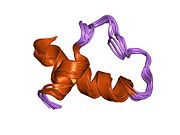
1k0p: NMR Structures of the Zinc Finger Domain of Human DNA Polymerase-alpha
1k18: Minimized Average NMR Structure of the Zinc Finger Domain of Human DNA Polymerase-alpha
1n5g: NMR Structures of the Zinc Finger Domain of Human DNA Polymerase-alpha
v
t
e
DNA replication (comparing Prokaryotic to Eukaryotic)
Initiation
Prokaryotic (initiation)
Pre-replication complex
dnaC
Cdc6
Helicase
dnaA
dnaB
T7
Primase
dnaG
Eukaryotic (preparation in G1 phase)
Pre-replication complex
Origin recognition complex
ORC1
ORC2
ORC3
ORC4
ORC5
ORC6
Cdc6
Cdt1
Minichromosome maintenance
MCM2
MCM3
MCM4
MCM5
MCM6
MCM7
Licensing factor
Autonomously replicating sequence
Single-strand binding protein
SSBP2
SSBP3
SSBP4
RNase H
RNASEH1
RNASEH2A
Helicase: HFM1
Primase: PRIM1
PRIM2
Both
Origin of replication/Ori/Replicon
Replication fork
Lagging and leading strands
Okazaki fragments
Primer
Replication
Prokaryotic (elongation)
DNA polymerase III holoenzyme
dnaC
dnaE
dnaH
dnaN
dnaQ
dnaT
dnaX
holA
holB
holC
holD
holE
Replisome
DNA ligase
DNA clamp
Topoisomerase
DNA gyrase
Prokaryotic DNA polymerase: DNA polymerase I
Klenow fragment
Eukaryotic (synthesis in S phase)
Replication factor C
RFC1
Flap endonuclease
FEN1
Topoisomerase
Replication protein A
RPA1
Eukaryotic DNA polymerase:
alpha
POLA1
POLA2
PRIM1
PRIM2
delta
POLD1
POLD2
POLD3
POLD4
epsilon
POLE
POLE2
POLE3
POLE4
DNA clamp
PCNA
Control of chromosome duplication
Both
Movement: Processivity
DNA ligase
Termination
Telomere: Telomerase
TERT
TERC
DKC1
This article on a gene on the human X chromosome and/or its associated protein is a stub. You can help Wikipedia by expanding it.
For other uses, see Monte Carlo (disambiguation). Quarter and ward of Monaco in Monaco Monte Carlo Quarter and ward of Monaco Monte Carlo in Monaco (Ward shown) Monte Carlo Location in relation to France Coordinates: 43°44′23″N 7°25′38″E / 43.73972°N 7.42722°E / 43.73972; 7.42722 Coordinates: 43°44′23″N 7°25′38″E / 43.73972°N 7.42722°E / 43.73972; 7.42722 Country Monaco Government • Type Principality Area • Urban 0.61 km 2 (.234 sq mi) Population • Quarter and ward of Monaco 15,200 (in the quarter) 3,500 (in the ward) Postcode 98000 Monte Carlo ( / ˈ m ɒ n t i ˈ k ɑːr l oʊ / ; Italian: [ˈmonte ˈkarlo] ; French: Monte-Carlo [mɔ̃te kaʁlo] , or colloquially Monte-Carl [mɔ̃te kaʁl] ; Monégasque: Munte Carlu ) officially refers to an administrative area of the Principality of Monaco, specifically the ward of Monte Carlo/Spélugues, where the Monte Carlo Casino is located. Informally the name also refers to a ...
This article is part of a series on Information security Related security categories Internet security Cyberwarfare Computer security Mobile security Network security Threats Computer crime Vulnerability Eavesdropping Malware Spyware Ransomware Trojans Viruses Worms Rootkits Bootkits Keyloggers Screen scrapers Exploits Backdoors Logic bombs Payloads Denial of service Defenses Computer access control Application security Antivirus software Secure coding Secure by default Secure by design Secure operating systems Authentication Multi-factor authentication Authorization Data-centric security Encryption Firewall Intrusion detection system Mobile secure gateway Runtime application self-protection (RASP) v t e Information security , sometimes shortened to InfoSec , is the practice of preventing unauthorized access, use, disclosure, disruption, modification, inspection, recording or destruction of information. Th...
 Mixing







Comments
Post a Comment