 Mixing
Rifleman (bird)
| Rifleman | |
|---|---|
 | |
| Female | |
Conservation status | |
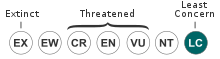 Least Concern (IUCN 3.1)[1] | |
Scientific classification  | |
| Kingdom: | Animalia |
| Phylum: | Chordata |
| Class: | Aves |
| Order: | Passeriformes |
| Family: | Acanthisittidae |
| Genus: | Acanthisitta Lafresnaye, 1842 |
| Species: | A. chloris |
Binomial name | |
Acanthisitta chloris Sparrman, 1787 | |
Subspecies | |
Acanthisitta chloris chloris | |
The rifleman (Acanthisitta chloris) (Māori: tītipounamu) is a small insectivorous passerine bird that is endemic to New Zealand. It belongs to the family Acanthisittidae, also known as the New Zealand wrens, of which it is one of only two surviving species. The rifleman resembles a wren in form, but is not related to the family of true wrens, Troglodytidae, nor the fairy-wrens of Australia.
The rifleman is named after a colonial New Zealand regiment because its plumage drew similarities with the military uniform of a rifleman.[2]
Contents
1 Description
1.1 Vocalisations
2 Distribution and habitat
3 Behaviour and ecology
3.1 Breeding
3.2 Feeding
4 Cultural references
5 References
6 External links
Description

Female (L) and Male (R) rifleman - A History of the Birds of New Zealand, Buller, 1888

Acanthisitta chloris nest from the collection of Auckland Museum
The rifleman is New Zealand's smallest endemic bird, with fully grown adults reaching around 8 cm. The male rifleman is bright green on the dorsal side, while the female is of a more somber brownish tone and her head and back are flecked with ochre. Male birds typically weigh around 6 g, females 7 g.. Both birds are white on their undersurfaces and have white eyebrow stripes. They have short, rounded wings, a very short tail and a long, thin, awl-like bill which is slightly upturned for insertion into cracks. The rifleman flies quickly with a wing beat producing a characteristic humming sound like a hummingbird.
Vocalisations
The rifleman has a high-pitched call that can be out of the range of people's hearing.[3]
Distribution and habitat

A female rifleman in the South Island
The true habitat of this bird is thinly wooded forests, but other similar New Zealand species live near rocky outcrops.
The rifleman is the most widespread species of acanthisittid in the two main islands of New Zealand. However, the bird occurs only rarely in latitudes north of Te Aroha. The North Island subspecies, A. c. granti, occurs mainly in lowland tawa forest, while the South Island subspecies, A. c. chloris, is found in high-altitude beech forest or lowland areas forested with podocarp.
The rifleman covers the same or similar territory every day, which a male/female pair defend. They can only fly short distances, meaning they are unlikely to cross open areas.[3] The bird was once common across New Zealand, but the fragmentation of forests from land development has meant less habitat and more isolated populations.[4]
Behaviour and ecology
Breeding
Acanthisittids build their nests in rock fissures, holes in tree trunks, or even in cavities in the ground. The nest entrance is often so narrow, the bird struggles to get inside. The nest most commonly has a domed shape and is finely interwoven with blades of grass, down feathers, and other light materials. Brooding lasts 13–15 days, with the female laying four or five eggs. Two broods per year are common. It has been shown that nest boxes increase the fledging success of rifleman chicks.[5]
Feeding
The rifleman is insectivorous and searches for maggots and small insects on tree trunks and among leaf litter on the forest floor. It searches for food in a similar way to the treecreeper. The bird begins its search from the base of a tree and climbs up it progressively, spiralling up around the trunk. Upon finishing its search of a particular tree, the bird glides to the foot of a neighbouring tree and begins its search again.
Cultural references
The rifleman was pictured on the reverse side of the New Zealand $2 note from 1967 until the note was phased out in 1991.[2]
References
^ BirdLife International (2012). "Acanthisitta chloris". IUCN Red List of Threatened Species. Version 2013.2. International Union for Conservation of Nature. Retrieved 26 November 2013..mw-parser-output cite.citation{font-style:inherit}.mw-parser-output .citation q{quotes:"""""""'""'"}.mw-parser-output .citation .cs1-lock-free a{background:url("//upload.wikimedia.org/wikipedia/commons/thumb/6/65/Lock-green.svg/9px-Lock-green.svg.png")no-repeat;background-position:right .1em center}.mw-parser-output .citation .cs1-lock-limited a,.mw-parser-output .citation .cs1-lock-registration a{background:url("//upload.wikimedia.org/wikipedia/commons/thumb/d/d6/Lock-gray-alt-2.svg/9px-Lock-gray-alt-2.svg.png")no-repeat;background-position:right .1em center}.mw-parser-output .citation .cs1-lock-subscription a{background:url("//upload.wikimedia.org/wikipedia/commons/thumb/a/aa/Lock-red-alt-2.svg/9px-Lock-red-alt-2.svg.png")no-repeat;background-position:right .1em center}.mw-parser-output .cs1-subscription,.mw-parser-output .cs1-registration{color:#555}.mw-parser-output .cs1-subscription span,.mw-parser-output .cs1-registration span{border-bottom:1px dotted;cursor:help}.mw-parser-output .cs1-ws-icon a{background:url("//upload.wikimedia.org/wikipedia/commons/thumb/4/4c/Wikisource-logo.svg/12px-Wikisource-logo.svg.png")no-repeat;background-position:right .1em center}.mw-parser-output code.cs1-code{color:inherit;background:inherit;border:inherit;padding:inherit}.mw-parser-output .cs1-hidden-error{display:none;font-size:100%}.mw-parser-output .cs1-visible-error{font-size:100%}.mw-parser-output .cs1-maint{display:none;color:#33aa33;margin-left:0.3em}.mw-parser-output .cs1-subscription,.mw-parser-output .cs1-registration,.mw-parser-output .cs1-format{font-size:95%}.mw-parser-output .cs1-kern-left,.mw-parser-output .cs1-kern-wl-left{padding-left:0.2em}.mw-parser-output .cs1-kern-right,.mw-parser-output .cs1-kern-wl-right{padding-right:0.2em}
^ ab "The history of bank notes in New Zealand". Reserve Bank of New Zealand. Archived from the original on 17 February 2012. Retrieved 4 February 2012.
^ ab "Story: Land birds – overview". Retrieved 4 February 2013.
^ "Story: Small forest birds - Page 2 – Riflemen". Te Ara - the Encyclopedia of New Zealand. Retrieved 4 February 2013.
^ Briskie, J.V.; Shorey, L.; Massaro, M. (2014). "Nest-boxes increase fledging success in the declining rifleman Acanthisitta chloris, New Zealand". Conservation Evidence. 11: 12–15. Retrieved 1 June 2016.
- Buller, W.L. Birds of New Zealand, 1888.
- Oliver, W.R.B. New Zealand Birds, 1955.
External links
- Photo, information
- Facts Sheet, Photo, Video
Birds of New Zealand | ||
|---|---|---|
| Common birds |
|  |
| Flightless birds |
| |
| Endangered endemic birds (flying) |
| |
| Extinct birds |
| |


Comments
Post a Comment