 Mixing
Emperor's Cup
 | |
| Founded | 1921 (1921) |
|---|---|
| Region | Japan |
| Number of teams | 88 |
| Domestic cup(s) | Japanese Super Cup |
| International cup(s) | AFC Champions League |
| Current champions | Urawa Red Diamonds (7th title) |
| Most successful club(s) | Keio University (9 titles) |
| Television broadcasters | NHK |
| Website | JFA |
 2019 Emperor's Cup 2019 Emperor's Cup | |

Emperor's Cup

Urawa Red Diamonds vs. Gamba Osaka 1 January 2007
The Emperor's Cup JFA All-Japan Soccer Championship Tournament (天皇杯 JFA 全日本サッカー選手権大会, Tennōhai Jei Efu Ei Zen Nippon Sakkā Senshuken Taikai), commonly known as The Emperor's Cup (天皇杯, Tennōhai) or The Emperor's Cup Soccer[citation needed] (サッカー天皇杯, Sakkā Tennōhai), is a Japanese association football competition. It has the longest tradition of any football tournament in Japan, dating back to 1921, before the formation of the J. League, Japan Football League and their predecessor, Japan Soccer League. Before World War II, teams could qualify not only from Japan proper but also from Korea, Taiwan, and sometimes Manchukuo. The women's counterpart is the Empress's Cup.
Contents
1 Overview
1.1 Format
1.2 The Trophy
1.3 Qualification to AFC Champions League
2 Past Emperor's Cup Champions
3 Top performing clubs
4 Other Emperor's Cups
5 References
6 External links
Overview
As it is a competition to decide the "best football team in Japan," the cup is now open to every member club of the Japan Football Association, from J1 and J2 (J. League Divisions 1 and 2) down to teams from J3 (J3 League), JFL, regional leagues, and top college and high school teams from around the country. The Emperor's Cup is one of two well-known national football tournaments named after a monarch (the other is Spain's Copa del Rey).
The holder can wear a Yatagarasu emblem (the ordinary winner wears one, the E letter and the purple line above the bird, the league-cup double winner can wear the gold star and line above the Yatagarasu) and obtains an AFC Champions League spot for the next season.
Since the creation of the J. League in 1992, the professional teams have dominated the competition, although doubles, once common in the JSL, have become very rare. However, because the Emperor's Cup is contested in a knockout tournament format, the opportunity for "giant-killers" from the amateur ranks upsetting a top J. League squad is a very real possibility. For example, a major upset almost occurred in the 2003/04 competition, when Funabashi Municipal High School took the 2003 J. League champion Yokohama F. Marinos to a penalty shootout.[1]. Although Waseda University was the last non-league winner in 1966, and the previous non-top tier winner was in 2011 (contested by two second-tier teams, FC Tokyo and Kyoto Sanga, with FC Tokyo winning 4–2).
Since 1969, the Emperor's Cup final had traditionally been played on New Year's Day of the following year at the National Olympic Stadium in Tokyo and is regarded as the traditional closing match of the season. Since 2014, the venue has varied due to the National Olympic Stadium's renovation for the 2020 Summer Olympics. The 2014 Emperor's Cup final was not held on New Year's Day, but 13 December 2014, due to the Japanese National Team's involvement in 2015 AFC Asian Cup. The 2018 cup final was held on 9 December 2018. Although an official reason has not been given, it appeared to be the Japanese National Team's involvement in 2019 AFC Asian Cup.
Format
The first matches to qualify for the Emperor's cup begin anywhere from April to August of that year, and varies year to year. For the 97th Emperor's Cup (2017), the games were played from 22 April 2017 and ended with the final on 1 January 2018.[2]
The knockout phase of the competition begins towards the end of the year. This phase is composed of all teams from J1 League (J1) and J2, the winners from each of the 47 prefectural championships (consist of amateur teams ranging from J3 League to college teams), and 1 organizer-nominated team among all amateur teams (this was assigned to the collegiate champion until 2011).
J1 teams, and sometimes J2 team(s) also receive bye(s) in the knockout phase. In 2016, all J1 teams and the previous year's J2 champions received a bye, and AFC Champions League participants received 3 byes. In 2017, all J1 and J2 teams received a bye. However, they lose home advantage starting from the third round, unless they are facing a higher-tier or higher ranked team.
From 1965 to 1970, the top 4 JSL clubs at the end of the season qualified for the Cup and the other four spaces allotted were taken by finalists from universities. From 1971 to 1994, as the League increased in size, the entire top division teams were entered automatically, while the second tier's member clubs participated in regional stages with other clubs. Beginning in 1995, the second tier clubs (at the time, the old Japan Football League) began to be admitted automatically instead of having to play regional stages, which in turn became prefectural stages.
Before 2008, 48 teams took part in the first two rounds – the winner from each of the 47 prefectural championships and the collegiate champion. The top team in the JFL standings and all thirteen J2 teams joined in the third round. Finally, the eighteen J1 teams joined in the fourth round, making a total of 80 participating teams.
The Trophy
The original All Japan Championship Tournament trophy was awarded to the JFA by the English Football Association in 1919. This trophy was used until January 1945, when the militarist government confiscated it and melted down to procure additional metal for the war effort.[3] When the tournament was reinstated, the present trophy, showing the Imperial chrysanthemum seal began to be awarded.[citation needed]
In August 2011, the English FA presented its Japanese counterpart with a replica of the original trophy, made by London silversmiths Thomas Lyte.[4] JFA President Junji Ogura expressed hope that the trophy, to be awarded at the 2011 final, would be "a symbol of peace".[5][3]
Qualification to AFC Champions League
The cup winner qualifies for AFC Champions League (ACL) since 2001 tournament, where Shimizu S-Pulse qualified for the ACL 2002-03. Before the establishment of ACL, the cup winner also qualified for the Asian Cup Winners Cup. From 2012, as a part of the requirement of AFC, the champion team must also hold a J1 Club License in order to enter the ACL (but not necessary to be a Division 1 team).
From the 2002–03 to 2008 ACL editions, the cup winner participated in the ACL that began one year later; for example, the Emperor's Cup winner for the 2005 season, crowned on 1 January 2006, participated in the 2007 tournament.
In November 2007, the JFA announced that the 2009 ACL spot would be given to the 2008 season's winner (crowned on 1 January 2009), not to the 2007 winner. As a result, the 2007 winner, Kashima Antlers, did not earn the 2009 ACL spot through the championship, qualifying for the 2008 edition instead. (However, Antlers earned the 2009 ACL spot by 2008 J. League Division 1 result.)
If the cup winner has already earned an AFC Champions League spot through finishing above third in J1 League, the spot obtained in the cup will be given to J1's fourth-placed team.
Past Emperor's Cup Champions
Teams in bold indicate doubles with the league title, while teams in italics indicate non-top flight clubs (both after 1965).
| Year | Champions | Score | Runners-Up | Finals Venue | Entrants |
|---|---|---|---|---|---|
1921 | Tokyo Shukyu-dan | 1–0 | Mikage Shukyu-dan (Kobe) | Hibiya Park | 4 |
1922 | Nagoya Shukyu-dan | 1–0 | Hiroshima Koto-shihan | Toshima-shihan Ground | 4 |
1923 | Astra Club (Tokyo) | 2–1 | Nagoya Shukyu-dan | Tokyo Koto-shihan Ground | 4 |
1924 | Rijo Shukyu Football Club (Hiroshima) | 1–0 | All Mikage Shihan Club (Kobe) | Meiji Jingu Stadium | 4 |
1925 | Rijo Shukyu Football Club (Hiroshima) | 3–0 | Imperial University of Tokyo | Meiji Jingu Stadium | 6 |
| 1926 | Cancelled due to the death of Emperor Taishō | ||||
1927 | Kobe-Ichi Junior High School Club | 2–0 | Rijo Shukyu Football Club (Hiroshima) | Meiji Jingu Stadium | 8 |
1928 | Waseda University WMW | 6–1 | Imperial University of Kyoto | Meiji Jingu Stadium | 7 |
1929 | Kwangaku Club | 3–0 | Hosei University | Meiji Jingu Stadium | 8 |
1930 | Kwangaku Club | 3–0 | Keio BRB | Koshien-minami Ground | 4 |
1931 | Imperial Univ. of Tokyo LB | 3–0 | Kobun Junior High School (Taiwan) | Meiji Jingu Stadium | 7 |
1932 | Keio Club | 5–1 | Yoshino Club (Nagoya) | Koshien-minami Ground | 3 |
1933 | Tokyo Old Boys Club | 4–1 | Sendai Soccer Club | Meiji Jingu Stadium | 8 |
| 1934 | No tournament due to the Far Eastern Championship Games in Manila | ||||
1935 | Kyungsung FC | 6–1 | Tokyo Bunri University | Meiji Jingu Stadium | 6 |
1936 | Keio BRB | 3–2 | Bosung College (Seoul) | Army Toyama Ground | 5 |
1937 | Keio University | 3–0 | Kobe University of Commerce | Meiji Jingu Stadium | 4 |
1938 | Waseda University | 4–1 | Keio University | Meiji Jingu Stadium | 5 |
1939 | Keio BRB | 3–2 | Waseda University | Meiji Jingu Stadium | 8 |
1940 | Keio BRB | 1–0 | Waseda University WMW | Meiji Jingu Stadium | 8 |
| 1941–45 | Suspended for World War II | ||||
1946 | University of Tokyo LB | 3–2 | Kobe University of Economics | Tokyo Imperial Univ. Gotenshita Stadium | 12 |
| 1947–48 | Cancelled due to post-World War II unrest | ||||
1949 | University of Tokyo LB | 3–2 | Kandai Club | Waseda Univ. Higashifushimi Ground | 5 |
1950 | All Kwangaku | 6–1 | Keio University | Kariya City Stadium | 16 |
1951 | Keio BRB | 3–2 | Osaka Club | Miyagino Soccer Stadium (Sendai) | 14 |
1952 | All Keio | 6–2 | Osaka Club | Fujieda Higashi High School | 16 |
1953 | All Kwangaku | 5–4 (AET) | Osaka Club | Nishikyogoku Stadium | 16 |
1954 | Keio BRB | 5–3 | Toyo Industries | Yamanashi Prefectural Stadium (Kofu) | 16 |
1955 | All Kwangaku | 4–2 | Chuo University Club | Nishinomiya Stadium | 16 |
1956 | Keio BRB | 4–2 | Yawata Steel | Omiya Athletic Stadium | 16 |
1957 | Chuo University Club | 1–0 | Toyo Industries | Kokutaiji High School (Hiroshima) | 16 |
1958 | Kwangaku Club | 1–0 | Yawata Steel | Fujieda Higashi High School | 16 |
1959 | Kwangaku Club | 1–0 | Chuo University | koishikawa Football Stadium | 16 |
1960 | Furukawa Electric | 4–0 | Keio BRB | Osaka Utsubo Soccer Stadium | 16 |
1961 | Furukawa Electric | 3–2 | Chuo University | Fujieda Higashi High School | 16 |
1962 | Chuo University | 2–1 | Furukawa Electric | Kyoto Nishikyogoku Stadium | 16 |
1963 | Waseda University | 2–1 | Hitachi Ltd. | Kobe Oji Stadium | 7 |
1964 | Yawata Steel & Furukawa Electric | 0–0 (AET) | none (shared title) | Kobe Oji Stadium | 10 |
1965 | Toyo Industries | 3–2 | Yawata Steel | Tokyo Komazawa Stadium | 8 |
1966 | Waseda University | 3–2 (AET) | Toyo Industries | Tokyo Komazawa Stadium | 8 |
1967 | Toyo Industries | 1–0 | Mitsubishi Heavy Industries | Tokyo National Stadium | 8 |
1968 | Yanmar Diesel | 1–0 | Mitsubishi Heavy Industries | Tokyo National Stadium | 8 |
1969 | Toyo Industries | 4–1 | Rikkyo University | Tokyo National Stadium | 8 |
1970 | Yanmar Diesel | 2–1 (AET) | Toyo Industries | Tokyo National Stadium | 8 |
1971 | Mitsubishi Heavy Industries | 3–1 | Yanmar Diesel | Tokyo National Stadium | 8 |
1972 | Hitachi Ltd. | 2–1 | Yanmar Diesel | Tokyo National Stadium | 75 |
1973 | Mitsubishi Heavy Industries | 2–1 | Hitachi Ltd. | Tokyo National Stadium | 807 |
1974 | Yanmar Diesel | 2–1 | Eidai Industries | Tokyo National Stadium | 1,105 |
1975 | Hitachi Ltd. | 2–0 | Fujita Industries | Tokyo National Stadium | 1,298 |
1976 | Furukawa Electric | 4–1 | Yanmar Diesel | Tokyo National Stadium | 1,358 |
1977 | Fujita Industries | 4–1 | Yanmar Diesel | Tokyo National Stadium | 1,421 |
1978 | Mitsubishi Heavy Industries | 1–0 | Toyo Industries | Tokyo National Stadium | 1,481 |
1979 | Fujita Industries | 2–1 | Mitsubishi Heavy Industries | Tokyo National Stadium | 1,494 |
1980 | Mitsubishi Heavy Industries | 1–0 | Tanabe Pharmaceutical | Tokyo National Stadium | 1,474 |
1981 | Nippon Kokan | 2–0 | Yomiuri FC | Tokyo National Stadium | 1,569 |
1982 | Yamaha Motor Company | 0–0 (1–0 replay) | Fujita Industries | Tokyo National Stadium | 1,567 |
1983 | Nissan Motor Company | 2–0 | Yanmar Diesel | Tokyo National Stadium | 1,565 |
1984 | Yomiuri FC | 2–0 | Furukawa Electric | Tokyo National Stadium | 1,476 |
1985 | Nissan Motor Company | 2–0 | Fujita Industries | Tokyo National Stadium | 1,498 |
1986 | Yomiuri FC | 2–1 | Nippon Kokan | Tokyo National Stadium | 1,612 |
1987 | Yomiuri FC | 2–0 | Mazda Soccer Club | Tokyo National Stadium | 1,690 |
1988 | Nissan Motor Company | 3–2 (AET) | Fujita Industries | Tokyo National Stadium | 1,786 |
1989 | Nissan Motor Company | 3–2 | Yamaha Motor Company | Tokyo National Stadium | 1,737 |
1990 | Matsushita Electric Industrial | 0–0 (4–3 PSO) | Nissan Motor Company | Tokyo National Stadium | 1,776 |
1991 | Nissan Motor Company | 4–2 (AET) | Yomiuri FC | Tokyo National Stadium | 1,872 |
1992 | Yokohama F. Marinos | 2–1 (AET) | Verdy Kawasaki | Tokyo National Stadium | 2,452 |
1993 | Yokohama Flügels | 6–2 (AET) | Kashima Antlers | Tokyo National Stadium | 2,511 |
1994 | Bellmare Hiratsuka | 2–0 | Cerezo Osaka | Tokyo National Stadium | 2,792 |
1995 | Nagoya Grampus Eight | 3–0 | Sanfrecce Hiroshima | Tokyo National Stadium | 2,800 |
1996 | Verdy Kawasaki | 3–0 | Sanfrecce Hiroshima | Tokyo National Stadium | (unknown) |
1997 | Kashima Antlers | 3–0 | Yokohama Flügels | Tokyo National Stadium | 6,107 |
1998 | Yokohama Flügels | 2–1 | Shimizu S-Pulse | Tokyo National Stadium | 6,317 |
1999 | Nagoya Grampus Eight | 2–0 | Sanfrecce Hiroshima | Tokyo National Stadium | 6,516 |
2000 | Kashima Antlers | 3–2 (AET) | Shimizu S-Pulse | Tokyo National Stadium | 6,578 |
2001 | Shimizu S-Pulse | 3–2 | Cerezo Osaka | Tokyo National Stadium | 6,306 |
2002 | Kyoto Purple Sanga | 2–1 | Kashima Antlers | Tokyo National Stadium | 6,418 |
2003 | Júbilo Iwata | 1–0 | Cerezo Osaka | Tokyo National Stadium | 6,849 |
2004 | Tokyo Verdy 1969 | 2–1 | Júbilo Iwata | Tokyo National Stadium | 6,685 |
2005 | Urawa Red Diamonds | 2–1 | Shimizu S-Pulse | Tokyo National Stadium | 5,918 |
2006 | Urawa Red Diamonds | 1–0 | Gamba Osaka | Tokyo National Stadium | 6,390 |
2007 | Kashima Antlers | 2–0 | Sanfrecce Hiroshima | Tokyo National Stadium | 6,161 |
2008 | Gamba Osaka | 1–0 (AET) | Kashiwa Reysol | Tokyo National Stadium | 5,948 |
2009 | Gamba Osaka | 4–1 | Nagoya Grampus | Tokyo National Stadium | (unknown) |
2010 | Kashima Antlers | 2–1 | Shimizu S-Pulse | Tokyo National Stadium | (unknown) |
2011 | F.C. Tokyo | 4–2 | Kyoto Sanga F.C. | Tokyo National Stadium | (unknown) |
2012 | Kashiwa Reysol | 1–0 | Gamba Osaka | Tokyo National Stadium | 4,927[6] |
2013 | Yokohama F. Marinos | 2–0 | Sanfrecce Hiroshima | Tokyo National Stadium | (unknown) |
2014 | Gamba Osaka | 3–1 | Montedio Yamagata | International Stadium Yokohama | (unknown) |
2015 | Gamba Osaka | 2–1 | Urawa Red Diamonds | Ajinomoto Stadium | (unknown) |
2016 | Kashima Antlers | 2–1 (AET) | Kawasaki Frontale | Suita City Football Stadium | (unknown) |
2017 | Cerezo Osaka | 2–1 (AET) | Yokohama F. Marinos | Saitama Stadium 2002 | (unknown) |
2018 | Urawa Red Diamonds | 1–0 | Vegalta Sendai | Saitama Stadium 2002 | (unknown) |
Top performing clubs
| Club | Champions | Runners-Up |
|---|---|---|
| Keio University | 9 | 4 |
| Urawa Red Diamonds | 7 | 4 |
| Yokohama F. Marinos | 7 | 2 |
| Kwansei Gakuin University | 7 | 1 |
| Tokyo Verdy | 5 | 3 |
| Gamba Osaka | 5 | 2 |
| Kashima Antlers | 5 | 2 |
| Cerezo Osaka | 4 | 8 |
| JEF United Ichihara Chiba | 4 | 2 |
| Waseda University | 4 | 2 |
| Sanfrecce Hiroshima | 3 | 11 |
| Shonan Bellmare | 3 | 4 |
| Kashiwa Reysol | 3 | 3 |
| University of Tokyo | 3 | 1 |
| Chuo University | 2 | 3 |
| Júbilo Iwata | 2 | 2 |
| Nagoya Grampus | 2 | 1 |
| Yokohama Flugels | 2 | 1 |
| Rijo Shukyu Football Club | 2 | 1 |
| Shimizu S-Pulse | 1 | 4 |
| Yawata Steel | 1 | 3 |
| Kyoto Sanga F.C. | 1 | 1 |
| NKK F.C. | 1 | 1 |
| Nagoya Shukyu-dan | 1 | 1 |
| F.C. Tokyo | 1 | 0 |
Astra Club (Tokyo) | 1 | 0 |
| Kobe-Ichi Junior High School Club | 1 | 0 |
| Kyungsung FC | 1 | 0 |
| Tokyo Shukyu-dan | 1 | 0 |
| Tokyo Old Boys Club | 1 | 0 |
| Osaka Club | 0 | 3 |
| Kobe University | 0 | 2 |
| Eidai Industries | 0 | 1 |
| Hiroshima University | 0 | 1 |
| Hosei University | 0 | 1 |
| Kansai University | 0 | 1 |
| Kobun Junior High School | 0 | 1 |
| Korea University | 0 | 1 |
| Kyoto University | 0 | 1 |
| All Mikage Shihan Club | 0 | 1 |
| Mikage Shukudan | 0 | 1 |
| Rikkyo University | 0 | 1 |
| Sendai Soccer Club | 0 | 1 |
| Tanabe Pharmaceuticals | 0 | 1 |
| Tokyo Bunri University | 0 | 1 |
| Tsukuba University | 0 | 1 |
| Yoshino Club | 0 | 1 |
| Montedio Yamagata | 0 | 1 |
| Kawasaki Frontale | 0 | 1 |
| Vegalta Sendai | 0 | 1 |
Other Emperor's Cups
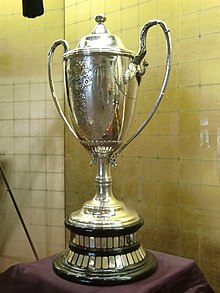
Sumo Emperor's Cup
The Emperor's Cup term is used for many national championships in other sports. Like the football prize, most of them are knockout tournaments, except for professional sumo where the trophy is awarded for winning a round-robin Grand Sumo Tournament.
- Kendo
- Kyudo
Judo – All-Japan Judo Championships
- Softball
Basketball – All Japan Basketball Championships
Volleyball – Emperor's Cup and Empress's Cup All Japan Volleyball Championship
Professional Sumo
- Amateur Sumo
- Tennis
- Soft Tennis
- Table Tennis
- Amateur Wrestling
Track & Field (students only)- Ekiden
Swimming (students only)
References
^ [1]
^ "第97回天皇杯全日本サッカー選手権大会". JFA.jp. Retrieved 10 January 2018..mw-parser-output cite.citation{font-style:inherit}.mw-parser-output .citation q{quotes:"""""""'""'"}.mw-parser-output .citation .cs1-lock-free a{background:url("//upload.wikimedia.org/wikipedia/commons/thumb/6/65/Lock-green.svg/9px-Lock-green.svg.png")no-repeat;background-position:right .1em center}.mw-parser-output .citation .cs1-lock-limited a,.mw-parser-output .citation .cs1-lock-registration a{background:url("//upload.wikimedia.org/wikipedia/commons/thumb/d/d6/Lock-gray-alt-2.svg/9px-Lock-gray-alt-2.svg.png")no-repeat;background-position:right .1em center}.mw-parser-output .citation .cs1-lock-subscription a{background:url("//upload.wikimedia.org/wikipedia/commons/thumb/a/aa/Lock-red-alt-2.svg/9px-Lock-red-alt-2.svg.png")no-repeat;background-position:right .1em center}.mw-parser-output .cs1-subscription,.mw-parser-output .cs1-registration{color:#555}.mw-parser-output .cs1-subscription span,.mw-parser-output .cs1-registration span{border-bottom:1px dotted;cursor:help}.mw-parser-output .cs1-ws-icon a{background:url("//upload.wikimedia.org/wikipedia/commons/thumb/4/4c/Wikisource-logo.svg/12px-Wikisource-logo.svg.png")no-repeat;background-position:right .1em center}.mw-parser-output code.cs1-code{color:inherit;background:inherit;border:inherit;padding:inherit}.mw-parser-output .cs1-hidden-error{display:none;font-size:100%}.mw-parser-output .cs1-visible-error{font-size:100%}.mw-parser-output .cs1-maint{display:none;color:#33aa33;margin-left:0.3em}.mw-parser-output .cs1-subscription,.mw-parser-output .cs1-registration,.mw-parser-output .cs1-format{font-size:95%}.mw-parser-output .cs1-kern-left,.mw-parser-output .cs1-kern-wl-left{padding-left:0.2em}.mw-parser-output .cs1-kern-right,.mw-parser-output .cs1-kern-wl-right{padding-right:0.2em}
^ ab "England replaces football trophy Japan melted down during Second World War". The Telegraph. 7 September 2011.
^ "FA Gives Japan New Cup". Acumen. British Chamber of Commerce in Japan. October 2011.
^ "F.A. Silver Cup to be presented to Emperor's Cup winners". Japan Football Association. 29 August 2011.
^ "サッカー日本一を決める最大のトーナメント 第92回天皇杯全日本サッカー選手権大会、9月1日(土)いよいよ開幕!" [The largest tournament in Japan for the championship - The 92nd Emperor's Cup All-Japan Soccer Championship begins on September 1!]. Japan Football Association. 31 August 2012. Retrieved 31 August 2012.
External links
- RSSSF.com - Japan - List of Emperor's Cup Finals
 Football in Japan Football in Japan | |||||||
|---|---|---|---|---|---|---|---|
Japan Football Association | |||||||
| National teams |
| ||||||
| League System |
| ||||||
| Domestic cups |
| ||||||
| Reserve & Academy |
| ||||||
| Culture |
| ||||||
| |||||||


Comments
Post a Comment