 Mixing
Eurovision Song Contest 1988
| Eurovision Song Contest 1988 | |
|---|---|
 | |
| Dates | |
| Final | 30 April 1988 |
| Host | |
| Venue | RDS Simmonscourt Pavilion Dublin, Ireland |
| Presenter(s) | Pat Kenny Michelle Rocca |
| Conductor | Noel Kelehan |
| Directed by | Declan Lowney |
| Executive supervisor | Frank Naef |
| Executive producer | Liam Miller |
| Host broadcaster | Raidió Teilifís Éireann (RTÉ) |
| Opening act | Johnny Logan performing "Hold Me Now" |
| Interval act | Hothouse Flowers performing "Don't Go" |
| Participants | |
| Number of entries | 21 |
| Debuting countries | None |
| Returning countries | None |
| Withdrawing countries |  Cyprus Cyprus |
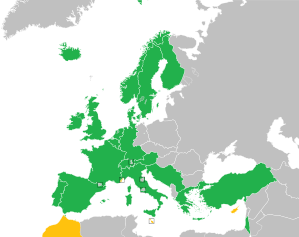
Participation map
| |
| Vote | |
| Voting system | Each country awarded 12, 10, 8-1 point(s) to their 10 favourite songs |
| Nul points |  Austria Austria |
| Winning song |  Switzerland Switzerland"Ne partez pas sans moi" |

The Eurovision Song Contest 1988 was the 33rd edition of the annual Eurovision Song Contest. The contest took place on 30 April 1988 in Dublin, Ireland, following the country's win at the previous 1987 edition. The presenters were Pat Kenny and Michelle Rocca. The host broadcaster was Radio Telefís Éireann (RTÉ) which revamped the show's production style compared to its earlier editions, in order to appeal to a younger audience.
The winner was Switzerland with the song "Ne partez pas sans moi", performed by Canadian singer Céline Dion and composed by Atilla Şereftuğ with lyrics in French by Nella Martinetti. Switzerland beat the United Kingdom by just a point in the last vote to win the title. Twenty-one countries took part, after an initial plan of twenty-two, as Cyprus withdrew its already registered entry for breaching the contest's rules by being published few years earlier, in an attempt to represent the country at a prior edition of the contest. The Cypriot song had been drawn to be performed 2nd in the running order.
Contents
1 Location
2 Format
2.1 Graphic design
2.2 Voting
3 Conductors
4 Participants
4.1 Results
5 Score sheet
5.1 12 points
6 Commentators
6.1 Television
6.2 Radio
7 Spokespersons
8 National jury members
9 Notes
10 References
11 External links
Location

RDS Simmonscourt – host venue of the 1988 contest.
Dublin is the capital and largest city of Ireland. Dublin is in the province of Leinster on Ireland's east coast, at the mouth of the River Liffey. Founded as a Viking settlement, the Kingdom of Dublin became Ireland's principal city following the Norman invasion. The city expanded rapidly from the 17th century and was briefly the second largest city in the British Empire before the Acts of Union in 1800. Following independence in 1922, Dublin became the capital of the Republic of Ireland.
The contest took place at the Simmonscourt Pavilion of the Royal Dublin Society, which was normally used for agricultural and horse shows. The same venue hosted the 1981 contest.
Format
Graphic design
Host broadcaster RTÉ employed Declan Lowney, who was notable for being a director of music videos and youth programming, as director for this edition, in order to revamp the contest to attract and sustain a younger audience. The traditional scoreboard was replaced with two giant Vidiwalls located on either side of the stage, which also projected live images of the performers from the green room where the competitors set during the votes announcements, and a new computer-generated scoreboard was used.
The stage itself, conceived by Paula Farrell under chief production designer Michael Grogan, was also the largest and most elaborate ever constructed for the Eurovision Song Contest. To compensate for the fact that the vast stage took up most of the room in what is really an average size exhibition hall, the director deliberately darkened the hall where the audience was located and refused to use wide angled shots of the audience, in order to create the illusion of the venue being bigger than it actually was.
The Postcards featured the participants doing things in Ireland from culture, to tradition, to sports or sightseeing.
Lowney was also the director of the show's interval act, introduced after the competing songs and before the votes announcement. The interval act was a video of the popular Irish rock group Hothouse Flowers, which was filmed in eleven countries around Europe and was the most expensive music video ever produced in Ireland at the time.
Voting
Each country had a jury who awarded 12, 10, 8, 7, 6, 5, 4, 3, 2 and 1 point(s) for its top ten songs.
This edition features one of the closest and fickle-ending votes in the history of the contest. With three countries left to vote, the UK was well in the lead with 133 points against Switzerland's 118. With the third last country, France, only awarding Switzerland one point, the UK looked certain of victory, as even if Switzerland scooped the two final 12s, the UK would only need to gather eleven points from three juries combined to be unbeatable. However, France didn't award the UK any points, and the following country, Portugal, gave the UK a meagre three points while giving the maximum 12 to Switzerland, making the contest blown open between the two countries until the end of the voting.
With the conclusion of voting from the penultimate jury, the UK was holding a five-point lead over Switzerland. As the final jury, that of Yugoslavia, began to award its points in the customary ascending order, a lot of excitement-sighs were heard from the audience to see how the two rivals for victory would fare. Switzerland was the first to be named with six points, edging it into a one-point lead over the UK. After earlier strong votes from most countries to the UK, it seemed highly likely that the UK would be given one of the higher remaining set of points. However, eventually the UK only managed to garner a meagre three points between the last three juries, as after Yugoslavia announced its seven, eight, ten and twelve points, it transpired that it had awarded the UK no points at all,[n 1] and Switzerland was left with its one-point lead to savour a dramatic triumph.
Conductors
Each performance had a conductor who was maestro to the orchestra, expect for Iceland and Italy.
 Iceland – No conductor
 Sweden – Anders Berglund
 Finland – Ossi Runne
 United Kingdom – Ronnie Hazlehurst
 Turkey – Turhan Yükseler
 Spain – Javier de Juan
 Netherlands – Harry van Hoof
 Israel – Eldad Shrem
 Switzerland – Atilla Şereftuğ
 Ireland – Noel Kelehan
 Germany – Michael Thatcher
 Austria – Harald Neuwirth
 Denmark – Henrik Krogsgård
 Greece – Charis Andreadis
 Norway – Arild Stav
 Belgium – Daniel Willem
 Luxembourg – Régis Dupré
 Italy – No conductor
 France – Guy Matteoni
 Portugal – José Calvário
 Yugoslavia – Nikica Kalogjera
Participants
Twenty-one countries took part, after an initial plan of twenty-two, as Cyprus withdrew from the contest after it had already submitted an entry. Cypriot broadcaster CyBC had selected the song 'Thimame' sung by Yiannis Dimitrou, and at a late stage saw that the song was ineligible to represent them as it had been entered into the Cypriot selection for the 1984 Contest, where it had finished in 3rd place. This was classed as a breach of the Cypriot rules of selecting their entry at this time as well as an infringement of the Eurovision Song Contest rules. It was a very late decision as the song was already drawn to perform second in the contest, advertised in the Radio Times information about the preview programme of the contest, and appears as song number two in accordance to its initial performance draw, on the record release “Melodi Grand Prix 1988” – the compilation disc of the contest’s entries.
This was the second victory for Switzerland at the Eurovision Song Contest after winning its first edition in 1956, and the last time a song in French won the contest, the language having dominated the event in earlier years.
The contest helped launch an international career for two artists, the winner for Switzerland Céline Dion and Luxembourg’s representative Lara Fabian. French-Canadian Céline Dion was only famous in the French-speaking world at the time of the contest, shortly afterwards started recording songs in English.[1]Belgian-Canadian Lara Fabian started a successful career after the contest with becoming established in various countries worldwide, with a mainly French-sung repertoire.[1] The UK entry was written and composed by Julie Forsyth, the daughter of the entertainer Bruce Forsyth who was present. When interviewed afterwards he was particularly annoyed at the Dutch jury not having given a vote to the UK, as they had done some work there.
The contest saw the return of seven artists who had participated in its previous editions: Denmark's Kirsten & Søren represented the country in 1984 and 1985, Finland's Boulevard represented the country in 1987 as Vicky Rosti's backing group, Israel's Re'uven Gvirtz and Yehuda Tamir, winners of the contest in 1979 as part of Milk and Honey returned to Eurovision as backing singers for Yardena Arazi, who represented the country in 1976 as part of the group Chocolat, Menta, Mastik. Arazi had hosted the contest in 1979,[n 2] Portugal's Dora represented the country in 1986, Sweden's Tommy Körberg represented the country in 1969, and Turkey's MFÖ represented the country in 1985.
Results
| Draw | Country | Artist | Song | Language[2] | Place | Points |
|---|---|---|---|---|---|---|
| 01 |  Iceland Iceland | Beathoven | "Þú og þeir (Sókrates)" | Icelandic | 16 | 20 |
| 02 |  Sweden Sweden | Tommy Körberg | "Stad i ljus" | Swedish | 12 | 52 |
| 03 |  Finland Finland | Boulevard | "Nauravat silmät muistetaan" | Finnish | 20 | 3 |
| 04 |  United Kingdom United Kingdom | Scott Fitzgerald | "Go" | English | 2 | 136 |
| 05 |  Turkey Turkey | MFÖ | "Sufi" | Turkish | 15 | 37 |
| 06 |  Spain Spain | La Década | "La chica que yo quiero (Made in Spain)" | Spanish | 11 | 58 |
| 07 |  Netherlands Netherlands | Gerard Joling | "Shangri-La" | Dutch | 9 | 70 |
| 08 |  Israel Israel | Yardena Arazi | "Ben Adam" (בן אדם) | Hebrew | 7 | 85 |
| 09 | Switzerland | Céline Dion | "Ne partez pas sans moi" | French | 1 | 137 |
| 10 |  Ireland Ireland | Jump the Gun | "Take Him Home" | English | 8 | 79 |
| 11 |  Germany Germany | Maxi & Chris Garden | "Lied für einen Freund" | German | 14 | 48 |
| 12 | Austria | Wilfried | "Lisa Mona Lisa" | German | 21 | 0 |
| 13 |  Denmark Denmark | Hot Eyes | "Ka' du se hva' jeg sa'?" | Danish | 3 | 92 |
| 14 |  Greece Greece | Afroditi Frida | "Clown" (Κλόουν) | Greek | 17 | 10 |
| 15 |  Norway Norway | Karoline Krüger | "For vår jord" | Norwegian | 5 | 88 |
| 16 |  Belgium Belgium | Reynaert | "Laissez briller le soleil" | French | 18 | 5 |
| 17 |  Luxembourg Luxembourg | Lara Fabian | "Croire" | French | 4 | 90 |
| 18 |  Italy Italy | Luca Barbarossa | "Vivo (Ti scrivo)" | Italian | 12 | 52 |
| 19 |  France France | Gérard Lenorman | "Chanteur de charme" | French | 10 | 64 |
| 20 |  Portugal Portugal | Dora | "Voltarei" | Portuguese | 18 | 5 |
| 21 |  Yugoslavia Yugoslavia | Srebrna krila | "Mangup" | Serbo-Croatian | 6 | 87 |
Score sheet

Points allocated to the winning Song from Switzerland
| Juries | |||||||||||||||||||||||
|---|---|---|---|---|---|---|---|---|---|---|---|---|---|---|---|---|---|---|---|---|---|---|---|
 |  |  |  |  |  |  |  |  |  |  |  |  |  |  |  |  |  |  |  |  |  | ||
 | Iceland | 20 | 1 | 4 | 4 | 1 | 2 | 8 | |||||||||||||||
| Sweden | 52 | 3 | 2 | 8 | 5 | 8 | 12 | 1 | 3 | 10 | |||||||||||||
| Finland | 3 | 3 | |||||||||||||||||||||
| United Kingdom | 136 | 1 | 5 | 10 | 12 | 10 | 10 | 5 | 7 | 10 | 10 | 10 | 6 | 5 | 12 | 8 | 12 | 3 | |||||
| Turkey | 37 | 4 | 1 | 5 | 1 | 8 | 8 | 4 | 6 | ||||||||||||||
| Spain | 58 | 2 | 5 | 2 | 6 | 8 | 1 | 8 | 2 | 6 | 6 | 8 | 4 | ||||||||||
| Netherlands | 70 | 6 | 6 | 7 | 7 | 2 | 6 | 12 | 12 | 5 | 7 | ||||||||||||
| Israel | 85 | 6 | 6 | 4 | 6 | 3 | 10 | 1 | 5 | 2 | 3 | 10 | 5 | 3 | 10 | 10 | 1 | ||||||
Switzerland | 137 | 7 | 12 | 5 | 10 | 10 | 8 | 10 | 4 | 10 | 12 | 10 | 8 | 4 | 1 | 7 | 1 | 12 | 6 | ||||
| Ireland | 79 | 7 | 2 | 3 | 2 | 12 | 6 | 4 | 7 | 6 | 7 | 7 | 5 | 4 | 5 | 2 | |||||||
| Germany | 48 | 8 | 5 | 1 | 3 | 5 | 6 | 6 | 4 | 2 | 8 | ||||||||||||
| Austria | 0 | ||||||||||||||||||||||
| Denmark | 92 | 10 | 3 | 4 | 1 | 12 | 6 | 1 | 4 | 4 | 12 | 10 | 7 | 12 | 6 | ||||||||
| Greece | 10 | 3 | 7 | ||||||||||||||||||||
| Norway | 88 | 5 | 8 | 7 | 12 | 7 | 1 | 8 | 1 | 3 | 5 | 7 | 3 | 4 | 7 | 10 | |||||||
| Belgium | 5 | 5 | |||||||||||||||||||||
| Luxembourg | 90 | 4 | 10 | 12 | 7 | 5 | 12 | 12 | 1 | 2 | 2 | 6 | 8 | 2 | 4 | 3 | |||||||
| Italy | 52 | 8 | 4 | 7 | 8 | 2 | 5 | 3 | 2 | 8 | 5 | ||||||||||||
| France | 64 | 2 | 3 | 8 | 2 | 2 | 3 | 3 | 7 | 3 | 5 | 1 | 2 | 10 | 1 | 12 | |||||||
| Portugal | 5 | 4 | 1 | ||||||||||||||||||||
| Yugoslavia | 87 | 12 | 6 | 1 | 8 | 7 | 12 | 2 | 3 | 4 | 12 | 4 | 7 | 6 | 3 | ||||||||
12 points
Below is a summary of all 12 points in the final:
| N. | Contestant | Voting nation |
|---|---|---|
| 3 | Denmark | Austria, France, Netherlands |
| Luxembourg | Finland, Ireland, Switzerland | |
| Switzerland | Germany, Portugal, Sweden | |
| United Kingdom | Belgium, Italy, Turkey | |
| Yugoslavia | Denmark, Iceland, Israel | |
| 2 | Netherlands | Greece, Luxembourg |
| 1 | France | Yugoslavia |
| Ireland | Spain | |
| Norway | United Kingdom | |
| Sweden | Norway |
Commentators
|
|
Spokespersons
Iceland - Guðrún Skúladóttir[3]
Sweden - Maud Uppling[4]
Finland - Solveig Herlin[18]
United Kingdom - Colin Berry
Turkey - Canan Kumbasar
Spain - Matilde Jarrín
Netherlands – Joop van Os
Israel - Yitzhak Shim'oni[19]
Switzerland - Michel Stocker[20]
Ireland - John Skehan
Germany - Corry von Kiel
Austria - Tilia Herold
Denmark - Bent Henius[11]
Greece - Fotini Giannoulatou[21]
Norway - Andreas Diesen[22]
Belgium - Jacques Olivier
Luxembourg - Jean-Luc Bertrand
Italy - Mariolina Cannuli
France - Catherine Ceylac
Portugal - Maria Margarida Gaspar[17]
Yugoslavia - Miša Molk[23]
National jury members
The size of the national juries changed this year from 11 to 16 members, and this lasted until 1997.
Iceland - Árni Gunnarsson, Ásgeir Guðnason, Davíð Sveinsson, Elín Þóra Stefánsdóttir, Ellý Þorðardóttir, Erla Björk Jónasdóttir, Guðrún Kristmannsdóttir, Hólmfríður Jónsdóttir, Jónas Engilbertsson, Jónína Bachmann, Kjartan Þor Kjartansson, Ólafur Egilsson, Sigrún Kristjánsdóttir, Sigurður Fanndal, Sigurður Ægisson, Þórdís Garðarsdóttir[3]
Finland – Ilpo Hakasalo[24]
United Kingdom – Nicola Chapman, Terry Clarke, Alfred Collet, Geoff Dennis, James Douglas, Alison Fox, Mike Goss, Carol Holroyd, Muir Johnson, Karen Marsden, Mavis Masters, Molly Roberts, Andrew Sidell, Renate Smith, Paul Tunnicliffe, Robert Unsworth
Spain – Pepe Barroso (businessman), Paquita Torres (former model and Miss Europe), Mario Pardo (actor), Lola Forner (actress), José Coronado (actor), Analía Gadé (actress), Miguel Báez "El Litri" (bullfighter), Laura Valenzuela (actress and TV host, presenter of Eurovision Song Contest 1969), Antonio de Senillosa (writer), Cyra Toledo (fashion model), José Oneto (journalist), María Vidaurreta (PhD in Political Sciences and lecturer), Jorge Sanz (actor), Emma Suárez (actress), Caty Arteaga (dancer), Jaime Andrada (architect)
Netherlands – Hans van den Berg
Greece – Alexandros Roussos, Stylianos Pesmatzoglou, Litsa Pappa, Mariliz Ritsardi, Nikos Desypris
Notes
^ Yugoslavia, as being the last jury to announce its votes, had caused the same situation to happen when after their voting UK lost to Spain by 1 point in the 1968 Contest.
^ With this, she became the first person to compete in the contest after hosting an earlier edition; before her, there were few competitors that hosted later editions of the contest.
References
^ ab "Eurovision Song Contest 1998". European Broadcasting Union official website – History by year section. Retrieved 5 March 2012..mw-parser-output cite.citation{font-style:inherit}.mw-parser-output q{quotes:"""""""'""'"}.mw-parser-output code.cs1-code{color:inherit;background:inherit;border:inherit;padding:inherit}.mw-parser-output .cs1-lock-free a{background:url("//upload.wikimedia.org/wikipedia/commons/thumb/6/65/Lock-green.svg/9px-Lock-green.svg.png")no-repeat;background-position:right .1em center}.mw-parser-output .cs1-lock-limited a,.mw-parser-output .cs1-lock-registration a{background:url("//upload.wikimedia.org/wikipedia/commons/thumb/d/d6/Lock-gray-alt-2.svg/9px-Lock-gray-alt-2.svg.png")no-repeat;background-position:right .1em center}.mw-parser-output .cs1-lock-subscription a{background:url("//upload.wikimedia.org/wikipedia/commons/thumb/a/aa/Lock-red-alt-2.svg/9px-Lock-red-alt-2.svg.png")no-repeat;background-position:right .1em center}.mw-parser-output .cs1-subscription,.mw-parser-output .cs1-registration{color:#555}.mw-parser-output .cs1-subscription span,.mw-parser-output .cs1-registration span{border-bottom:1px dotted;cursor:help}.mw-parser-output .cs1-hidden-error{display:none;font-size:100%}.mw-parser-output .cs1-visible-error{font-size:100%}.mw-parser-output .cs1-subscription,.mw-parser-output .cs1-registration,.mw-parser-output .cs1-format{font-size:95%}.mw-parser-output .cs1-kern-left,.mw-parser-output .cs1-kern-wl-left{padding-left:0.2em}.mw-parser-output .cs1-kern-right,.mw-parser-output .cs1-kern-wl-right{padding-right:0.2em}
^ "Eurovision Song Contest 1988". The Diggiloo Thrush. Retrieved 5 March 2012.
^ abc "Fór út með vinningsglampann í sólgleraugunum segir Sverrir Stormsker". Mbl.is. Retrieved 2012-08-10.
^ abc "Infosajten.com". Infosajten.com. Archived from the original on July 18, 2012. Retrieved 2012-08-10.
^ "Selostajat ja taustalaulajat läpi vuosien? • Viisukuppila". Viisukuppila.fi. Retrieved 2012-08-10.
^ Eurovision Song Contest 1988 BBC Archives
^ "FORO FESTIVAL DE EUROVISIÓN • Ver Tema - Uribarri comentarista Eurovision 2010". Eurosongcontest.phpbb3.es. Archived from the original on 2012-03-17. Retrieved 2012-08-10.
^ "Welkom op de site van Eurovision Artists". Eurovisionartists.nl. Retrieved 2012-08-10.
^ "Eurovision Song Contest 1988". Ecgermany.de. Retrieved 2012-08-10.
^ [1] Archived October 24, 2007, at the Wayback Machine.
^ ab "Forside". esconnet.dk. Archived from the original on 2012-03-24. Retrieved 2012-08-10.
^ "Η Δάφνη Μπόκοτα και η EUROVISION (1987-2004)". Retromaniax.gr. Retrieved 2012-08-10.
^ "Hvem kommenterte før Jostein Pedersen? - Debattforum". Nrk.no. Archived from the original on November 2, 2012. Retrieved 2012-08-10.
^ abc Christian Masson. "1988 - Dublin". Songcontest.free.fr. Retrieved 2012-08-10.
^ Adriaens, Manu & Loeckx-Van Cauwenberge, Joken. Blijven kiken!. Lannoo, Belgium. 2003
ISBN 90-209-5274-9
^ "Luca Barbarossa Ti scrivo Eurofestival 1988". YouTube. 2010-12-16. Retrieved 2012-08-10.
^ ab "Comentadores Do ESC - escportugalforum.pt.vu | o forum eurovisivo português". 21595.activeboard.com. Archived from the original on April 21, 2012. Retrieved 2012-08-10.
^ "Selostajat ja taustalaulajat läpi vuosien? • Viisukuppila". Viisukuppila.fi. Retrieved 2012-08-10.
^ "פורום אירוויזיון". Sf.tapuz.co.il. 1999-09-13. Archived from the original on October 8, 2011. Retrieved 2012-08-10.
^ Baumann, Peter Ramón (OGAE Switzerland)
^ "Εκφωνητές της ΕΡΤ για τις ψήφους της Ελλάδας στην EUROVISION - Page 3". Retromaniax.gr. Retrieved 2012-08-10.
^ Dyrseth, Seppo (OGAE Norway)
^ "Sumnja od Jugolasvenskog glasanja". Evropesma.org. Archived from the original on April 8, 2012. Retrieved 2012-08-10.
^ http://www.viisukuppila.fi/phpBB3/viisula/topic7042.html#p871555
External links
 | Wikimedia Commons has media related to Eurovision Song Contest 1988. |
- Official website
Eurovision Song Contest | |||||||||
|---|---|---|---|---|---|---|---|---|---|
| |||||||||
| Contests |
| ||||||||
| Countries |
| ||||||||
| National selections |
| ||||||||
| Other awards |
| ||||||||
| Television and concerts |
| ||||||||
| |||||||||
 Category
 Portal


Comments
Post a Comment