 Mixing
Eurovision Song Contest 1957
| Eurovision Song Contest 1957 | |
|---|---|
 | |
| Dates | |
| Final | 3 March 1957 |
| Host | |
| Venue | Großer Sendesaal des hessischen Rundfunks Frankfurt, West Germany |
| Presenter(s) | Anaïd Iplicjian |
| Conductor | Willy Berking |
| Executive supervisor | Rolf Liebermann |
| Host broadcaster | Arbeitsgemeinschaft der öffentlich-rechtlichen Rundfunkanstalten der Bundesrepublik Deutschland (ARD) |
| Interval act | None |
| Participants | |
| Number of entries | 10 |
| Debuting countries |
|
| Returning countries | None |
| Withdrawing countries | None |
Participation map
| |
| Vote | |
| Voting system | Ten-member juries distributed 10 points among their favourite songs. |
| Nul points | None |
| Winning song |  Netherlands Netherlands"Net als toen" |


The Eurovision Song Contest 1957 was the second edition of the annual Eurovision Song Contest. It was held on Sunday 3 March 1957 in Frankfurt-am-Main, West Germany. It was won by the Netherlands with "Net als toen", performed by Corry Brokken.[1] Like the first 1956 edition, this one was still mainly a radio programme, but there was a noticeable increase in the number of people with televisions.
For some time, a rumour had existed that the privilege of hosting the 1957 contest was given to Germany because they had come in second place in 1956 with "Im Wartesaal zum großen Glück" by Walter Andreas Schwarz. In fact, not only were the official 1956 scores withheld, but the rule stating that the winning nation hosts the next year's Eurovision Song Contest had not yet been conceived. It was planned at the time that each participating country would take it in turns to host the event. However, as more countries wished to participate, this became impractical.[1]
Contents
1 Location
2 Format
3 Participating countries
3.1 Conductors
3.2 Returning artists
4 Results
5 Scoreboard
6 International broadcasts and voting
7 References
8 External links
Location
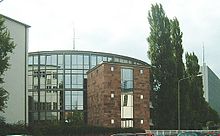
Großer Sendesaal des hessischen Rundfunks, Frankfurt am Main - venue of the 1957 contest.
The contest took place in Frankfurt am Main (or simply Frankfurt), one of the largest cities in, at the time West Germany. The host venue was the Großer Sendesaal des Hessischen Rundfunks, a building, music hall and former television studio based in Frankfurt am Main. Today it is used as a music hall.[2][3]
After being devastated in the Second World War during the early 1940s, Frankfurt rebuilt itself well into the 1950s into one of Europe's most prominent financial centres. With investments coming in from both national and international financial institutions, 1957, the year of the contest, already saw the first of Frankfurt's high-rise business buildings.[4][5]
Format
In this year's contest the Italian entry lasted for 5:09 minutes, whilst the UK's entry lasted for only 1:52 minutes. It was because of songs like the former that a rule was eventually introduced restricting each song to a maximum of 3 minutes; this rule still applies.[1]
In a change of rules from the previous year's contest, duos were allowed to compete. Danish representatives, Birthe Wilke and Gustav Winckler, were the first of such acts to participate under this rule change. At the end of their performance, the couple exchanged the longest kiss in the contest's history, although only people with televisions could actually see it. This was due to a member of the production staff forgetting to give a pre-arranged sign that the kiss should end.[1]
This was the first year where the juries were contacted by telephone. It was also the first time the Netherlands won the contest. Another notable change was that the national juries could not vote for their own song, a rule which would be continued throughout the contest's subsequent history.[1]
Participating countries
Belgium, France, Germany, Italy, Luxembourg, Netherlands, and Switzerland made their second appearances following their débuts in 1956. Austria and Denmark made their débuts; these countries had wanted to participate in 1956, but had applied to the European Broadcasting Union after the deadline for song submissions for that year's contest had passed, thus missing it. With those joining in 1957, the total number of countries was ten, three more than in the first ever contest.[1]
It was thought that the United Kingdom had also missed the participation deadline for the 1956 contest, but the EBU revealed in January 2017 that this was unfounded speculation spread by fans of the contest.[6] The EBU further went on to explain that the "Festival of British Popular Song", a contest created by the BBC for the United Kingdom, was the inspiration that brought in changes to the contest format from 1957.[6]
Conductors
Each performance had a conductor who conducted the orchestra.[7]
 Belgium - Willy Berking
 Luxembourg - Willy Berking
 United Kingdom - Eric Robinson
 Italy - Armando Trovajoli
 Austria - Carl de Groof
 Netherlands - Dolf van der Linden
 Germany - Willy Berking
 France - Paul Durand
 Denmark - Kai Mortensen
 Switzerland - Willy Berking
Returning artists
The contest saw the return of two artists who had participated in the previous edition of the contest - Corry Brokken for Netherlands, and Lys Assia for Switzerland.[1]
Results
| Draw | Country | Artist | Song | Language[8] | Place[9] | Points |
|---|---|---|---|---|---|---|
| 01 |  Belgium Belgium | Bobbejaan Schoepen | "Straatdeuntje" | Dutch | 8 | 5 |
| 02 |  Luxembourg Luxembourg | Danièle Dupré | "Amours mortes (tant de peine)" | French | 4 | 8 |
| 03 |  United Kingdom United Kingdom | Patricia Bredin | "All" | English | 7 | 6 |
| 04 |  Italy Italy | Nunzio Gallo | "Corde della mia chitarra" | Italian | 6 | 7 |
| 05 |  Austria Austria | Bob Martin | "Wohin, kleines Pony?" | German | 10 | 3 |
| 06 | Netherlands | Corry Brokken | "Net als toen" | Dutch | 1 | 31 |
| 07 |  Germany Germany | Margot Hielscher | "Telefon, Telefon" | German | 4 | 8 |
| 08 |  France France | Paule Desjardins | "La belle amour" | French | 2 | 17 |
| 09 |  Denmark Denmark | Birthe Wilke & Gustav Winckler | "Skibet skal sejle i nat" | Danish | 3 | 10 |
| 10 |  Switzerland Switzerland | Lys Assia | "L'enfant que j'étais" | French | 8 | 5 |
Scoreboard
| Voting results | ||||||||||||
|---|---|---|---|---|---|---|---|---|---|---|---|---|
 |  |  |  |  |  |  |  |  |  |  | ||
 | Belgium | 5 | 2 | 2 | 1 | |||||||
| Luxembourg | 8 | 1 | 4 | 3 | ||||||||
| United Kingdom | 6 | 1 | 1 | 1 | 1 | 2 | ||||||
| Italy | 7 | 1 | 1 | 2 | 2 | 1 | ||||||
| Austria | 3 | 2 | 1 | |||||||||
Netherlands | 31 | 5 | 3 | 1 | 1 | 6 | 1 | 4 | 3 | 7 | ||
| Germany | 8 | 1 | 1 | 6 | ||||||||
| France | 17 | 2 | 4 | 2 | 1 | 6 | 2 | |||||
| Denmark | 10 | 2 | 3 | 5 | ||||||||
| Switzerland | 5 | 1 | 1 | 1 | 2 | |||||||
International broadcasts and voting
The table below shows the order in which votes were cast during the 1957 contest along with the spokesperson who was responsible for announcing the votes for their respective country. Each national broadcaster also sent a commentator to the contest, in order to provide coverage of the contest in their own native language. Details of the commentators and the broadcasting station for which they represented are also included in the table below.[10]
| Voting order | Country | Spokespersons | Commentator(s) | Broadcaster(s) |
|---|---|---|---|---|
| 01 | Switzerland | Mäni Weber | Robert Beauvais | TSR |
| 02 | Denmark | Svend Pedersen | Gunnar Hansen | Statsradiofonien TV |
| 03 | France | Claude Darget | Robert Beauvais | RTF |
| 04 | Germany | Joachim Fuchsberger | Wolf Mittler | Deutsches Fernsehen |
| 05 | Netherlands | Siebe van der Zee | Piet te Nuyl | NTS |
| 06 | Austria | Rudolf Fochler | No Commentator | ORF |
| 07 | Italy | Nunzio Filogamo | Bianca Maria Piccinino | Programma Nazionale |
| 08 | United Kingdom | David Jacobs | Berkeley Smith, Tom Sloan | BBC Television Service BBC Light Programme |
| 09 | Luxembourg | Pierre Bellemare | Robert Beauvais | Télé-Luxembourg |
| 10 | Belgium | Bert Leysen | Nic Bal, Janine Lambotte | NIR, INR |
References
^ abcdefg "Eurovision Song Contest 1957". EBU. Retrieved 11 June 2012..mw-parser-output cite.citation{font-style:inherit}.mw-parser-output q{quotes:"""""""'""'"}.mw-parser-output code.cs1-code{color:inherit;background:inherit;border:inherit;padding:inherit}.mw-parser-output .cs1-lock-free a{background:url("//upload.wikimedia.org/wikipedia/commons/thumb/6/65/Lock-green.svg/9px-Lock-green.svg.png")no-repeat;background-position:right .1em center}.mw-parser-output .cs1-lock-limited a,.mw-parser-output .cs1-lock-registration a{background:url("//upload.wikimedia.org/wikipedia/commons/thumb/d/d6/Lock-gray-alt-2.svg/9px-Lock-gray-alt-2.svg.png")no-repeat;background-position:right .1em center}.mw-parser-output .cs1-lock-subscription a{background:url("//upload.wikimedia.org/wikipedia/commons/thumb/a/aa/Lock-red-alt-2.svg/9px-Lock-red-alt-2.svg.png")no-repeat;background-position:right .1em center}.mw-parser-output .cs1-subscription,.mw-parser-output .cs1-registration{color:#555}.mw-parser-output .cs1-subscription span,.mw-parser-output .cs1-registration span{border-bottom:1px dotted;cursor:help}.mw-parser-output .cs1-hidden-error{display:none;font-size:100%}.mw-parser-output .cs1-visible-error{font-size:100%}.mw-parser-output .cs1-subscription,.mw-parser-output .cs1-registration,.mw-parser-output .cs1-format{font-size:95%}.mw-parser-output .cs1-kern-left,.mw-parser-output .cs1-kern-wl-left{padding-left:0.2em}.mw-parser-output .cs1-kern-right,.mw-parser-output .cs1-kern-wl-right{padding-right:0.2em}
^ "Location database - Großer Sendesaal des hessischen Rundfunks". film-commission-hessen.de. Retrieved 12 June 2012.
^ "Die singende Richterin: Corry Brokken" (in German). Eurovision.de. Retrieved 12 June 2012.
^ "Reconstruction and the "Frankfurter Principle"". Messe Frankfurt. Retrieved 20 October 2012.
^ "Frankfurt City History". Tourist Information Offices Frankfurt. Retrieved 20 October 2012.
^ ab Jordan, Paul (11 January 2017). "Shining a light on the United Kingdom: 60 Years at Eurovision". eurovision.tv. European Broadcasting Union. Retrieved 13 January 2017.Contrary to popular fan myths, the UK did not intend to enter in 1956 as the BBC had previously created their own separate contest, the Festival Of British Popular Songs
^ http://www.andtheconductoris.eu
^ "Eurovision Song Contest 1957". The Diggiloo Thrush. Retrieved 4 March 2012.
^ "Scoreboard results". Eurovision Song Contest 1957. EBU. Retrieved 11 June 2012.
^ "Eurovision 1957 Cast and Crew". IMDb. Retrieved 5 March 2012.
External links
 | Wikimedia Commons has media related to Eurovision Song Contest 1957. |
- Official website
Eurovision Song Contest | |||||||||
|---|---|---|---|---|---|---|---|---|---|
| |||||||||
| Contests |
| ||||||||
| Countries |
| ||||||||
| National selections |
| ||||||||
| Other awards |
| ||||||||
| Television and concerts |
| ||||||||
| |||||||||
 Category
 Portal
Coordinates: 50°07′N 8°41′E / 50.117°N 8.683°E / 50.117; 8.683


Comments
Post a Comment