 Mixing
量子计算机
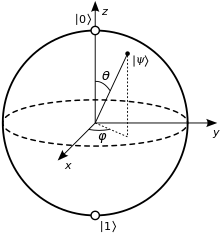
布洛赫球面乃一種對於二階量子系統之純態空間的幾何表示法,是建立量子電腦的基礎。
量子计算机(英语:quantum computer)是一种使用量子邏輯進行通用計算的設備。
不同於电子计算机(或稱傳統電腦),量子計算用來存儲數據的對象是量子比特,它使用量子演算法來進行數據操作。
马约拉纳费米子反粒子就是自己本身的属性,或许是令量子计算机的制造变成现实的一个关键。[1]
目录
1 历史
2 基本概念
3 实现
4 參考文獻
4.1 引用
4.2 来源
5 参见
6 外部連結
历史
隨著计算机科学的發展,史蒂芬·威斯納在1969年最早提出「基於量子力學的計算設備」。而关于「基於量子力學的信息處理」的最早文章則是由亞歷山大·豪勒夫(1973)、帕帕拉維斯基(1975)、羅馬·印戈登(1976)和尤里·馬尼(1980)年發表[2][3][4][5]。史蒂芬·威斯納的文章發表於1983年[6]。1980年代一系列的研究使得量子计算机的理論變得豐富起來。1982年,理查德·費曼在一個著名的演講中提出利用量子體系實現通用計算的想法。緊接著1985年大衛·杜斯提出了量子圖靈機模型[7]。人們研究量子计算机最初很重要的一個出發點是探索通用計算機的計算極限。當使用計算機模擬量子現象時,因為龐大的希爾伯特空間而資料量也變得龐大。一個完好的模擬所需的運算時間則變得相當长,甚至是不切實際的天文數字。理查德·費曼當時就想到如果用量子系統所構成的計算機來模擬量子現象則運算時間可大幅度減少,從而量子计算机的概念誕生。半導體靠控制積體電路來記錄及運算資訊,量子電腦則希望控制原子或小分子的狀態,記錄和運算資訊。
量子计算机在1980年代多處於理論推導狀態。1994年彼得·秀爾(Peter Shor)提出量子質因數分解演算法後[8],證明量子電腦能做出离散對數運算[9],而且速度遠勝傳統電腦。因為量子不像半導體只能記錄0與1,可以同時表示多種狀態。如果把半導體比喻成單一樂器,量子電腦就像交響樂團,一次運算可以處理多種不同狀況,因此,一個40位元的量子電腦,就能在很短时间内解開1024位元電腦花上數十年解決的問題。因其對於現在通行於銀行及網路等處的RSA加密演算法可以破解而構成威脅之後,量子计算机變成了熱門的話題,除了理論之外,也有不少學者著力於利用各種量子系統來實現量子计算机。
基本概念
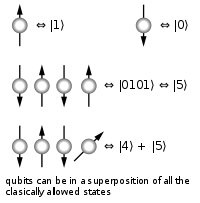
量子位元由受控粒子和控制方法組成(比如,捕獲顆粒的設備能將他們從一個狀態切換到另一個狀態).[10]
傳統计算机即对输入信号序列按一定算法进行变换的机器,其算法由计算机的内部逻辑电路实现。
- 输入态和输出态都是傳統信号,用量子力学的语言来描述,也即是:其输入态和输出态都是某一力学量的本征态。如输入二进制序列0110110{displaystyle 0110110}
,用量子记号,即|0110110⟩{displaystyle left|0110110rightrangle }
。所有的输入态均相互正交。对傳統计算机不可能输入如下叠加态:c1|0110110⟩+c2|1001001⟩{displaystyle c_{1}left|0110110rightrangle +c_{2}left|1001001rightrangle }
。
- 傳統计算机内部的每一步变换都演化为正交态,而一般的量子变换没有这个性质,因此,傳統计算机中的变换(或计算)只对应一类特殊集。
量子计算机分别对傳統计算机的限制作了推广。量子计算机的输入用一个具有有限能级的量子系统来描述,如二能级系统(称为量子位元(qubits)),量子计算机的变换(即量子计算)包括所有可能的正变换。
- 量子计算机的输入态和输出态为一般的叠加态,其相互之间通常不正交;
- 量子计算机中的变换为所有可能的正变换。得出输出态之后,量子计算机对输出态进行一定的测量,给出计算结果。
傳統计算是一类特殊的量子计算,量子计算对傳統计算作了极大的扩充,其最本质的特征为量子叠加性和量子相干性。量子计算机对每一个叠加分量实现的变换相当于一种经典计算,所有这些傳統计算同时完成,并按一定的概率振幅叠加起来,给出量子计算机的输出结果。这种计算称为量子并行计算。
实现
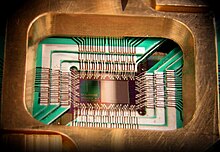
D-Wave 系統公司發布的計算設備
一般認為量子计算机仍處於研究階段。然而2011年5月11日加拿大的D-Wave 系統公司發布了一款號稱“全球第一款商用型量子计算机”的計算設備“D-Wave One”,含有128個量子位[11][12]。2011年5月25日,洛克希德·馬丁同意購買D-Wave One[13]。南加州大學洛克希德馬丁量子電腦研究中心(USC-Lockheed Martin Quantum Computation Center)證明D-Wave One不遵循古典物理學法則的模擬退火(simulated annealing)運算模型,而是量子退火法。該論文《可編程量子退火的實驗特性》(Experimental Signature of Programmable Quantum Annealing)發表於《自然通訊》(Nature Communications)期刊。該量子設備是否真的實現了量子計算目前還沒有得到學術界廣泛認同,只能有證據顯示D-Wave系統在運作時邏輯不同於傳統電腦[14]。
2013年5月D-Wave 系统公司宣称NASA和Google共同预定了一台采用512量子位的D-Wave Two量子计算机。[15]該電腦執行特定演算法時比傳統電腦快上億倍,但換用演算法解相同問題時卻又輸給傳統電腦,所以實驗色彩濃厚並延續了學術界爭論。
2013年5月,谷歌和NASA在加利福尼亚的量子人工智能实验室发布D-Wave Two。
2015年5月,IBM在量子運算上取得兩項關鍵性突破,開發出四量子位原型電路(four quantum bit circuit),成為未來10年量子電腦基礎。另外一項是,可以同時發現兩項量子的錯誤型態,分別為bit-flip(位元翻轉)與phase-flip(相位翻轉),不同於過往在同一時間內只能找出一種錯誤型態,使量子電腦運作更為穩定。[16]
2015年10月,新南威爾斯大學首度使用硅製作出量子閘[17]。
2016年8月,美国马里兰大学学院市分校发明世界上第一台由5量子位元组成的可编程量子计算机。[18][19]
2017年5月,中国科学院宣布制造出世界首台超越早期经典计算机的光量子计算机,研发了10位元超导量子线路样品,通过高精度脉冲控制和全局纠缠操作,成功实现了目前世界上最大数目的超导量子位元多体纯纠缠,并通过层析测量方法完整地刻画了十位元量子态。[20]此原型機的「玻色取樣」速度比國際同行之前所有實驗機加快至少24000倍,比人類歷史上第一台電子管計算機(ENIAC)和第一台晶體管計算機(TRADIC)運行速度快10-100倍,雖然還是緩慢但已經逐步跨入實用價值階段。[21][22]
2017年7月,美國研究人員宣布完成51個量子位元的量子電腦模擬器[23]。哈佛大學米哈伊爾·盧金(Mikhail Lukin)在莫斯科量子技術國際會議上宣布這一消息。量子模擬器使用了激光冷卻的原子,並使用激光將原子固定。
2018年6月,英特爾宣布開發出新款量子晶片,使用五十奈米的量子位元做運算,並已在攝氏零下273度的極低溫度中進行測試。[24]
2019年1月8日、IBM在消費電子展(CES)上展示了已开发的世界首款商业化量子计算机IBM Q System One[25]。
參考文獻
引用
^ 上海交大科研团队捕获马约拉纳费米子 造量子计算机的完美选择之一. 观察者网. 2016-06-22 [2016-06-22].
^ Holevo, A.S.(1973),‘Bounds for the quantity of information transmitted by a quantum communication channel’, Problemy Peredachi Informatsii, 9(3): 3–11. English translation in Problems of Information Transmission, 9: 177–183, 1973.
^ Ingarden, R.S.(1976),‘Quantum information theory’, Rep. Math. Phys., 10: 43–72.
^ Manin, Y.(1980), Computable and Uncomputable, Moscow: Sovetskoye Radio.
^ Poplavskii, R.P(1975),‘Thermodynamical models of information processing’,(in Russian). Uspekhi Fizicheskikh Nauk, 115 (3): 465–501.
^ Wiesner, S.(1983),‘Conjugate coding’, Sigact news, 18: 78–88.
^ David Deutsch, Quantum theory, the Church-Turingprinciple and the universal quantum computer, Proc. R. Soc. Lond.
^ Shor, Peter W.(1997), "Polynomial-Time Algorithms for Prime Factorization and Discrete Logarithms on a Quantum Computer", SIAM J. Comput. 26 (5): 1484–1509, arXiv:quant-ph/9508027v2
^ Peter Shor, Algorithms for Quantum Computation: Discrete Logarithms and Factoring, IEEE Symposium on Foundations of Computer Science 124-134 (1994)
^ Waldner, Jean-Baptiste. Nanocomputers and Swarm Intelligence. London: ISTE. 2007: 157. ISBN 2-7462-1516-0.
^ Learning to program the D-Wave One. Hack The Multiverse. D-Wave. [2011-05-11].
^ Quantum annealing with manufactured spins, Nature 473-7346
^ D-Wave Systems sells its first Quantum Computing System to Lockheed Martin Corporation. D-Wave. 2011-05-25 [2011-05-30].
^ Controversial Computer Is at Least a Little Quantum Mechanical, Science, 13 May 2011
^ Mansfield, Alex. BBC News - Nasa buys into 'quantum' computer. Bbc.co.uk. [2013-05-16].
^ [1],iThome新聞,2015年5月1日
^ World's First Silicon Quantum Logic Gate Brings Quantum Computing One Step Closer
^ 全球首台可编程量子计算机在美国诞生. 搜狐新聞. [2016-08-05].
^ Debnath, S.; Linke, N. M.; Figgatt, C.; Landsman, K. A.; Wright, K.; Monroe, C. Demonstration of a small programmable quantum computer with atomic qubits. Nature. 2016-08-04, 536: 63–66. doi:10.1038/nature18648 (英语).
^ 世界首台超越早期经典计算机的光量子计算机在我国诞生. 中科院网站. [2017-05-04].
^ 真量子電腦首次具有實用級運算力
^ 央視-我國量子计算机研究取得重大国际突破
^ Reynolds, Matt. Quantum simulator with 51 qubits is largest ever. NewScientist. [23 July 2017].
^ [2]
^ IBM unveils world's first commercial quantum computer The Telegraph 2019年1月8日
来源
.mw-parser-output .refbegin{font-size:90%;margin-bottom:0.5em}.mw-parser-output .refbegin-hanging-indents>ul{list-style-type:none;margin-left:0}.mw-parser-output .refbegin-hanging-indents>ul>li,.mw-parser-output .refbegin-hanging-indents>dl>dd{margin-left:0;padding-left:3.2em;text-indent:-3.2em;list-style:none}.mw-parser-output .refbegin-100{font-size:100%}
Nielsen, Michael; Chuang, Isaac. Quantum Computation and Quantum Information. Cambridge: Cambridge University Press. 2000. ISBN 0-521-63503-9. OCLC 174527496.
Abbot, Derek; Doering, Charles R.; Caves, Carlton M.; Lidar, Daniel M.; Brandt, Howard E.; Hamilton, Alexander R.; Ferry, David K.; Gea-Banacloche, Julio; Bezrukov, Sergey M.; Kish, Laszlo B. Dreams versus Reality: Plenary Debate Session on Quantum Computing. Quantum Information Processing. 2003, 2 (6): 449–472. arXiv:quant-ph/0310130. doi:10.1023/B:QINP.0000042203.24782.9a.
- DiVincenzo, David P. (2000). "The Physical Implementation of Quantum Computation". Experimental Proposals for Quantum Computation. arXiv:quant-ph/0002077
DiVincenzo, David P. Quantum Computation. Science. 1995, 270 (5234): 255–261. Bibcode:1995Sci...270..255D. doi:10.1126/science.270.5234.255. Table 1 lists switching and dephasing times for various systems.
Feynman, Richard. Simulating physics with computers. International Journal of Theoretical Physics. 1982, 21 (6–7): 467. Bibcode:1982IJTP...21..467F. doi:10.1007/BF02650179.
Jaeger, Gregg. Quantum Information: An Overview. Berlin: Springer. 2006. ISBN 0-387-35725-4. OCLC 255569451.
Singer, Stephanie Frank. Linearity, Symmetry, and Prediction in the Hydrogen Atom. New York: Springer. 2005. ISBN 0-387-24637-1. OCLC 253709076.
Benenti, Giuliano. Principles of Quantum Computation and Information Volume 1. New Jersey: World Scientific. 2004. ISBN 981-238-830-3. OCLC 179950736.
- Lomonaco, Sam. Four Lectures on Quantum Computing given at Oxford University in July 2006
- C. Adami, N.J. Cerf. (1998). "Quantum computation with linear optics". arXiv:quant-ph/9806048v1.
Stolze, Joachim; Suter, Dieter. Quantum Computing. Wiley-VCH. 2004. ISBN 3-527-40438-4.
Mitchell, Ian. Computing Power into the 21st Century: Moore's Law and Beyond. 1998.
Landauer, Rolf. Irreversibility and heat generation in the computing process (PDF). 1961.
Moore, Gordon E. Cramming more components onto integrated circuits. Electronics Magazine. 1965.
Keyes, R. W. Miniaturization of electronics and its limits. IBM Journal of Research and Development. 1988.
Nielsen, M. A.; Knill, E.; Laflamme, R. Complete Quantum Teleportation By Nuclear Magnetic Resonance.
Vandersypen, Lieven M.K.; Yannoni, Constantino S.; Chuang, Isaac L.. Liquid state NMR Quantum Computing. 2000.
Hiroshi, Imai; Masahito, Hayashi. Quantum Computation and Information. Berlin: Springer. 2006. ISBN 3-540-33132-8.
Berthiaume, Andre. Quantum Computation. 1997.
Simon, Daniel R. On the Power of Quantum Computation. Institute of Electrical and Electronic Engineers Computer Society Press. 1994.
Seminar Post Quantum Cryptology. Chair for communication security at the Ruhr-University Bochum. [永久失效連結]
Sanders, Laura. First programmable quantum computer created. 2009.
New trends in quantum computation.
参见


- 量子網路
- 光學電腦
量子霸權(Quantum supremacy)
米哈伊爾·盧金(Mikhail Lukin)
外部連結
 | 维基共享资源中相关的多媒体资源:量子计算机 |
Stanford Encyclopedia of Philosophy: "Quantum Computing" by Amit Hagar.
Quantiki – Wiki and portal with free-content related to quantum information science.
- Basic concepts
Scott Aaronson's blog, which features informative and critical commentary on developments in the field
D-Wave thinks it has built the world's first commercial quantum computer. Mother Nature has other ideas, in the January 2014 issue of Inc. magazine
Quantum Annealing and Computation: A Brief Documentary Note, A. Ghosh and S. Mukherjee
Maryland University Laboratory for Physical Sciences: conducts researches for the quantum computer-based project led by the NSA, named 'Penetrating Hard Target'.- Visualized history of quantum computing
- Quantum Annealing and Analog Quantum Computation by Arnab Das and BK Chakrabarti
- Joseph B. Altepeter (2010). "A tale of two qubits: how quantum computers work". Ars Technica.
- 讲座视频
Quantum computing for the determined – 22 video lectures by Michael Nielsen
Video Lectures by David Deutsch- Lectures at the Institut Henri Poincaré (slides and videos)
- Online lecture on An Introduction to Quantum Computing, Edward Gerjuoy (2008)
YouTube上的Quantum Computing research by Mikko Möttönen at Aalto University (video)
| ||||||||||||||||||||||||||||||||||||||||||||||
| ||||||||||||||||||||||||||||||||||||||||||||||||||||||||||||||||||||||||||||||||||||||||||||||||||||||||||||||||||||
 分类
分类 列表
列表
| ||||||||||||||||||||||||||||||||||||||||||||||||||||||||||||||||||||||||||||||
 主题
主题 专题
专题 维基共享
维基共享
| ||||||||||||||||||||||||||||||||||||||||||||||||||||||
|


Comments
Post a Comment