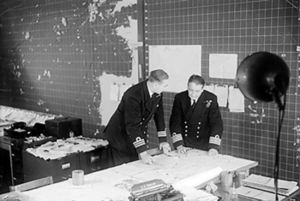
Commander RDS Crosse, Staff Officer Convoys, (left) discussing a special convoy movement map with Captain Lake, RN, Duty Officer in the Operations Room at Derby House, Liverpool.
Active
1939-1945
Country
United Kingdom
Branch
Royal Navy
Type
Fleet
Commanders
Notable commanders
Martin Dunbar-Nasmith (1939–1941) Percy Noble (1941–1942) Max Horton (1942–1945)
Commander-in-Chief, Western Approaches was the commander of a major operational command of the Royal Navy during World War II. The admiral commanding, and his forces, sometimes informally known as 'Western Approaches Command,' were responsible for the safety of British shipping in the Western Approaches.
Contents
1History
2Museum
3Commanders-in-Chief, Western Approaches
4See also
5References
6External links
History
Admiral Martin Dunbar-Nasmith, who had been Commander-in-Chief, Plymouth, also took over responsibility for the Western Approaches from the start of World War II.[1]
After the fall of France in June 1940, the main North Atlantic convoy routes were diverted around the north of Ireland through the north-western approaches.[2] By late 1940, the location of the Combined Operations headquarters at Plymouth was increasingly awkward and the decision was taken to move the Combined Operations headquarters to Liverpool.[2] On 7 February 1941, the headquarters was established at Derby House, Liverpool,[2] with a secondary control bunker built in Magee College, Derry.[3] The headquarters of No. 15 Group RAF (part of Coastal Command) moved to Liverpool at the same time.[4] On 17 February 1941 Admiral Sir Percy Noble was appointed as the new Commander-in-Chief, Western Approaches Command.[2]
Over the next two years, Admiral Noble built up the bases for the North Atlantic escort groups at Greenock on the Clyde, Derry and Liverpool and set up the training facilities that were the foundations for eventual victory in the Battle of the Atlantic.[5]
Derby House, Liverpool, in 2013
On 19 November 1942, Admiral Max Horton replaced Admiral Noble; Horton then was Commander-in-Chief until Western Approaches Command closed on 15 August 1945.[2]
Horton’s leadership played a vital role in the final defeat of the U-boat menace. Horton used the increasing number of escorts that were available to the command to organize "support groups" that were used to reinforce convoys that came under attack.[6] Unlike the regular escort groups, the support groups were not directly responsible for the safety of any particular convoy. This freedom gave them much greater tactical flexibility, allowing the support groups to detach ships to hunt submarines spotted by reconnaissance or picked up by high-frequency direction finding (HF/DF). In situations where the regular escorts would have had to return to their convoy, the support groups were able to persist in hunting a submarine for many hours until it was forced to the surface.
Museum
The reinforced central core of the command bunker at Derby House proved too costly to demolish, and so whilst the rest of the building has been converted to modern offices, the bunker has been restored as a museum, open to the public. The areas open to visitors are only a small part of the original complex. The museum is known as the Western Approaches Museum.[2]
Following years of neglect, the site was taken over by non-profit organisation Big Heritage in 2017, which saw an extensive restoration of the site and the discovery of new hidden parts of the bunker complex . The reopened site has seen a large increase in visitor numbers, and now ranks as one of the most popular historic sites in Liverpool.
Commanders-in-Chief, Western Approaches
Plaque in Liverpool at Western Approaches HQ
Commanders-in-Chief included:[7]
Rank
Name
Term began
Term ended
Commander-in-Chief, Western Approaches
Admiral
Martin Dunbar-Nasmith
9 September 1939
17 February 1941
Admiral
Sir Percy Noble
17 February 1941
19 November 1942
Admiral
Max Horton
19 November 1942
15 August 1945
See also
Anti-submarine warfare
U-boat
Battle of the Atlantic (1939-1945)
References
^Liddell Hart Centre for Military Archives
^ abcdefHistory of Derby House (Western Approaches Museum), accessed 1 May 2017
This article is part of a series on Information security Related security categories Internet security Cyberwarfare Computer security Mobile security Network security Threats Computer crime Vulnerability Eavesdropping Malware Spyware Ransomware Trojans Viruses Worms Rootkits Bootkits Keyloggers Screen scrapers Exploits Backdoors Logic bombs Payloads Denial of service Defenses Computer access control Application security Antivirus software Secure coding Secure by default Secure by design Secure operating systems Authentication Multi-factor authentication Authorization Data-centric security Encryption Firewall Intrusion detection system Mobile secure gateway Runtime application self-protection (RASP) v t e Information security , sometimes shortened to InfoSec , is the practice of preventing unauthorized access, use, disclosure, disruption, modification, inspection, recording or destruction of information. Th...
For other uses, see Monte Carlo (disambiguation). Quarter and ward of Monaco in Monaco Monte Carlo Quarter and ward of Monaco Monte Carlo in Monaco (Ward shown) Monte Carlo Location in relation to France Coordinates: 43°44′23″N 7°25′38″E / 43.73972°N 7.42722°E / 43.73972; 7.42722 Coordinates: 43°44′23″N 7°25′38″E / 43.73972°N 7.42722°E / 43.73972; 7.42722 Country Monaco Government • Type Principality Area • Urban 0.61 km 2 (.234 sq mi) Population • Quarter and ward of Monaco 15,200 (in the quarter) 3,500 (in the ward) Postcode 98000 Monte Carlo ( / ˈ m ɒ n t i ˈ k ɑːr l oʊ / ; Italian: [ˈmonte ˈkarlo] ; French: Monte-Carlo [mɔ̃te kaʁlo] , or colloquially Monte-Carl [mɔ̃te kaʁl] ; Monégasque: Munte Carlu ) officially refers to an administrative area of the Principality of Monaco, specifically the ward of Monte Carlo/Spélugues, where the Monte Carlo Casino is located. Informally the name also refers to a ...
Music in South Korea "KPOP" redirects here. For other uses, see KPOP (disambiguation). K-pop Stylistic origins Korean music experimental pop gospel rhythm and blues hip hop jazz folk classical country rock reggae EDM Cultural origins 1940s, South Korea Typical instruments Vocals drum machine electronic drums bass guitar acoustic guitar synthesizer keyboard sampler sequencer digital audio workstation percussion groovebox Local scenes Seoul Incheon Busan Jeju K-pop (abbreviation of Korean pop ; Hangul: 케이팝 ) is a genre of music characterized by a wide variety of audiovisual elements. While the modern form of K-pop can be traced back to the early 90s, the term itself has been popularized since the 2000s, replacing the term Gayo (가요), which also refers to domestic pop music in South Korea. [1] [2] Although it generally indicates "popular music" within South Korea, the term is often used in a narrower sen...
 Mixing
 United Kingdom
 Royal Navy

 Admiralty Department


Comments
Post a Comment