 Mixing
Swindon and Cricklade Railway
| Swindon and Cricklade Railway | |
|---|---|
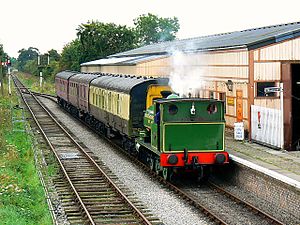 Slough Estates No.3 with a service train at Hayes Knoll | |
| Locale | Swindon, Wiltshire, England |
| Terminus | Blunsdon |
| Coordinates | 51°36′25″N 1°50′37″W / 51.607°N 1.8436°W / 51.607; -1.8436Coordinates: 51°36′25″N 1°50′37″W / 51.607°N 1.8436°W / 51.607; -1.8436 |
| Commercial operations | |
| Original gauge | 4 ft 8 1⁄2 in (1,435 mm) standard gauge |
| Preserved operations | |
| Length | 2.5 miles (4.0 km) |
| Preserved gauge | 4 ft 8 1⁄2 in (1,435 mm) standard gauge |
| Preservation history | |
| 1978 | Preservation Society formed |
| 1984 | S&CR granted Light Railway Order (following reconstruction of the line) |
| 1985 | S&CR re-opened and runs its first trains |
| 2008 | South Meadow reached |
| 2012 | Taw Valley Halt reached |
| 2014 | Taw Valley Halt officially opened |
| Headquarters | Blunsdon |
Swindon & Cricklade Railway | |||||||||||||||||||||||||||||||||||||||||||||||||||||||||||||||||||
|---|---|---|---|---|---|---|---|---|---|---|---|---|---|---|---|---|---|---|---|---|---|---|---|---|---|---|---|---|---|---|---|---|---|---|---|---|---|---|---|---|---|---|---|---|---|---|---|---|---|---|---|---|---|---|---|---|---|---|---|---|---|---|---|---|---|---|---|
| |||||||||||||||||||||||||||||||||||||||||||||||||||||||||||||||||||


The Swindon & Cricklade Railway is a heritage railway in Wiltshire, England, that operates on a short section of the old Midland and South Western Junction Railway line between Swindon and Cricklade.
Swindon and Cricklade Railway is a registered charity.[1]
Contents
1 Preservation history
2 Locomotives
2.1 Steam locomotives
2.2 Diesel locomotives
2.3 Diesel multiple units
2.4 Specialist vehicles
3 Vintage railway coaches
4 Stations of the S&CR line
5 References
6 External links
Preservation history
The Swindon & Cricklade Railway Preservation Society was formed by a group of enthusiasts in November 1978 to reconstruct and preserve a section of the Midland & South Western Junction Railway that ran from Andover, Hampshire, to Cheltenham, Gloucestershire.
The volunteer-operated railway has reopened three stations: Hayes Knoll, Taw Valley Halt and Blunsdon, the headquarters of the line. Hayes Knoll features a restored signalbox that is operational during special events and a running/restoration shed. The length of the restored line is a little under 2.5 miles (4.0 km).
The line extends north to South Meadow Lane (a few hundred yards from the site of a proposed Farfield Lane halt) near Cricklade, and south to Taw Valley Halt on the outskirts of Swindon, near Mouldon Hill Country Park.[2] A southern terminus, Mouldon Hill, is proposed within the park.[3]
Locomotives
Steam locomotives
| Number & Name | Class | Notes | Photograph |
|---|---|---|---|
| No. 2138 Swordfish | Andrew Barclay 0-6-0ST | Built in 1941. Operational, returned to service in 2016 after restoration. | 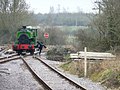 |
| No. 2413 Gunby | Hunslet 0-6-0ST | Built in 1941. Awaiting a major restoration. | |
| No. 2354 Richard Trevithick | Andrew Barclay 0-4-0ST | Built in 1954. Undergoing a ten-yearly overhaul. | |
| No. 1464 MSC No. 70 | Hudswell Clarke 0-6-0T | Built in 1921. Undergoing overhaul. | 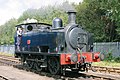 |
| No. 3135 Spartan | Fablok TKh49 Class | Built in 1953. Operational. | 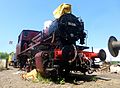 |
| No.5637 | GWR 5600 Class | Built in 1925. On loan to the East Somerset Railway. |  |
| No. 6984 Owsden Hall | GWR 6959 Modified Hall Class | Built in 1948. Arrived in May 2013 from the Gloucestershire and Warwickshire Railway for the completion of its restoration to working order. | |
| No. 7903 Foremarke Hall | GWR 6959 Modified Hall Class | Built in 1949. Operational at the Gloucestershire and Warwickshire Railway. |  |
Diesel locomotives
BR Class 03 0-6-0DM – D2022. Awaiting major overhaul.- BR Class 03 0-6-0DM – D2152 – cut-down cab variant. Major overhaul almost complete. Intermittent service.
- BR Class 97/6 0-6-0DE – PWM651. Arrived from Strathspey Railway in August 2015. Operational.
- BR Class 08 0-6-0DE – D3261. Restored to service in October 2010.
- BR Class 09 0-6-0DE – 09004. Undergoing overhaul. Intermittent service.
- BR Class 73 Bo-Bo electro-diesel Sir Herbert Walker No E6003. In service.
Fowler 0-4-0DM Woodbine No 21442. In service.- Fowler 0-4-0DM No 7342. In regular use on works trains.
- Fowler 0-4-0DM No 422003. In service.
Diesel multiple units
- BR Class 119 unit 119021 (formed of 51074+51104). Undergoing a complete overhaul.
- BR Class 207 unit 207203 (formed of 60127+60901). In service until destroyed in a fire on 20 May 2016.[4]
Specialist vehicles
- TASC 45 No. 98504, built by Plasser & Theurer for British Rail. A four-wheel vehicle with side-tipping dropside rear body, crew cab with mess facilities and a HIAB crane on the rear. Used regularly on works trains and on galas.
Wickham Railcar No 9031 (Type 27 Mk III, Works No. 8089), a small four-wheeled vehicle for departmental use.[5] Crew cab seating five. Smaller than normal railway vehicles to standard loading gauge, as it is roughly 6 feet (1.8 m) tall. Has no external couplings/drawbar or buffers. Undergoing overhaul, engine being replaced with that of a Peugeot 106.[6]
Vintage railway coaches
| Number | Type | Notes | Photograph |
|---|---|---|---|
| No. 7545 | GWR Toplight | built 1907 – extensive restoration in progress | |
| No. 3898 | GWR Toplight | built 1920 – awaiting restoration | |
| No. 73 | Taff Vale Railway Composite coach. | built 1890 – restoration completed using ex Fruit D chassis | |
| No. 104 | Cambrian Railways Full Brake | Recovered from derelict property in North Devon in August 2018. Awaiting restoration. Will run with No. 110 when complete. | |
| No. 110 | Cambrian Railways 1st/2nd composite | built 1894 – coach body being restored | |
| No. 111 | North London Railway 1st class | Underframe suitable for 111 in stock. Work on rebuilding original frame has begun. | |
| No. 422 | Luggage Brake | New-build brake carriage being converted from a goods brake for use on the vintage trains with Taff Vale 73. This is due to the possibility of obtaining a vintage brake carriage being very slim. Possibility of entering service in 2019. |
Stations of the S&CR line
| Station | Notes |
|---|---|
Cricklade | Construction planned as part of northern extension |
| Farfield Lane | Construction planned as a temporary northern terminus until Cricklade station is built; at the site of a collapsed and in-filled bridge where Farfield Lane crosses the line |
| South Meadow Lane | Halfway point between Hayes Knoll and Farfield Lane; used as a return point to Hayes Knoll when running north from Blunsdon. No run-round loop, no platform facilities. A siding is planned but has yet to be laid. |
Hayes Knoll | Depot and workshop; no road access |
Blunsdon | Headquarters of the line |
Taw Valley Halt | Opened in 2014. Used as a return point to Blunsdon when running south from Hayes Knoll, and is the current terminus of the line (until funding, planning and issues with the existing utilities can be overcome to allow access to Mouldon Hill station to be built) |
Mouldon Hill | Construction planned as part of southern extension towards Swindon |
References
^ Charity Commission. SWINDON AND CRICKLADE RAILWAY, registered charity no. 1067447..mw-parser-output cite.citation{font-style:inherit}.mw-parser-output q{quotes:"""""""'""'"}.mw-parser-output code.cs1-code{color:inherit;background:inherit;border:inherit;padding:inherit}.mw-parser-output .cs1-lock-free a{background:url("//upload.wikimedia.org/wikipedia/commons/thumb/6/65/Lock-green.svg/9px-Lock-green.svg.png")no-repeat;background-position:right .1em center}.mw-parser-output .cs1-lock-limited a,.mw-parser-output .cs1-lock-registration a{background:url("//upload.wikimedia.org/wikipedia/commons/thumb/d/d6/Lock-gray-alt-2.svg/9px-Lock-gray-alt-2.svg.png")no-repeat;background-position:right .1em center}.mw-parser-output .cs1-lock-subscription a{background:url("//upload.wikimedia.org/wikipedia/commons/thumb/a/aa/Lock-red-alt-2.svg/9px-Lock-red-alt-2.svg.png")no-repeat;background-position:right .1em center}.mw-parser-output .cs1-subscription,.mw-parser-output .cs1-registration{color:#555}.mw-parser-output .cs1-subscription span,.mw-parser-output .cs1-registration span{border-bottom:1px dotted;cursor:help}.mw-parser-output .cs1-hidden-error{display:none;font-size:100%}.mw-parser-output .cs1-visible-error{font-size:100%}.mw-parser-output .cs1-subscription,.mw-parser-output .cs1-registration,.mw-parser-output .cs1-format{font-size:95%}.mw-parser-output .cs1-kern-left,.mw-parser-output .cs1-kern-wl-left{padding-left:0.2em}.mw-parser-output .cs1-kern-right,.mw-parser-output .cs1-kern-wl-right{padding-right:0.2em}
^ "The Line". Retrieved 15 November 2010.
^ Pigott, Nick, ed. (July 2012). "Putting the Swindon in Swindon & Cricklade!". The Railway Magazine. Horncastle: Mortons Media Group. 158 (1335): 65. ISSN 0033-8923.
^ Robins, Tina. "Blaze destroys vintage train" (20 May 2016). Swindon Advertiser. Retrieved 21 May 2016.
^ "News – Wickham Trolleys – October 2009". ontrackplant.com.
^ "9031 – Wickham Type 27A Trolley". Retrieved 28 October 2010.
External links
 | Wikimedia Commons has media related to Swindon and Cricklade Railway. |
Official website


Comments
Post a Comment